
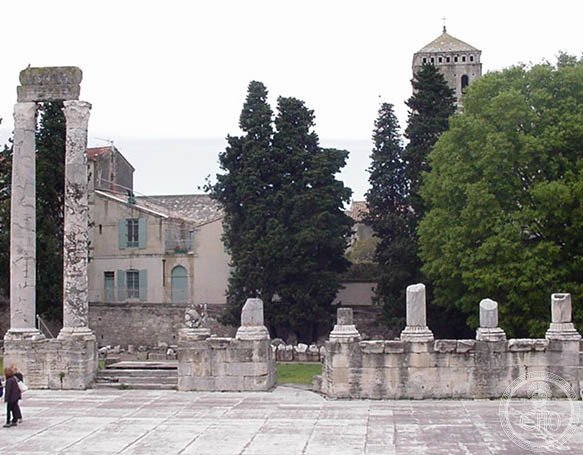
A UNESCO-listed ensemble of Roman and medieval structures spanning two millennia, Arles preserves one of southern France’s most compelling dialogues between classical antiquity and the Romanesque. The city’s monuments chart three distinct periods of prosperity: the Roman era, the early Christian age, and the medieval Mediterranean renaissance.
At a glance
The protected site encompasses 65 hectares of Arles’ city centre, featuring major monuments from the 1st century BCE through the 12th century. It demonstrates how an ancient Roman settlement adapted and thrived through successive civilizations, each leaving its architectural imprint on the urban fabric.
History
Arles’ first prominence emerged during the Roman period, when the city became an important regional centre. The arena, theatre, and cryptoporticus date to the 1st century BCE, anchoring the site’s classical heritage.
During the 4th century, Arles experienced a second golden age. The grand Thermes of Constantine and the extensive necropolis of Alyscamps reflect renewed wealth and Christian influence during this transformative period.
Medieval revival came in the 11th and 12th centuries, when Arles regained its status as one of the Mediterranean’s most prosperous cities. Saint-Trophime’s construction during this era, together with its remarkable Romanesque cloister, epitomizes Provence’s medieval architectural achievement.
What you see
The Arles Amphitheatre ranks among the best-preserved Roman arenas, its tiered structure evoking centuries of spectacle and civic life. The Roman theatre adjoins it, revealing the city’s sophisticated entertainment culture.
Below street level lies the cryptoporticus—subterranean galleries likely constructed by the Greeks in the 1st century BCE—accessible beneath the former Jesuit College Chapel and City Hall. Its original purpose may have included slave housing.
Saint-Trophime stands as Provence’s major Romanesque monument. Its sculptural portal and adjoining cloister demonstrate the ornamental sophistication and spatial planning of 12th-century ecclesiastical architecture. The Thermes of Constantine showcase 4th-century Roman bathing culture, while the ramparts of the Roman castrum and the Roman exedra in the courtyard of Museon Arlaten further document the city’s classical foundations.
The Alyscamps necropolis extends across the site, preserving burial traditions spanning centuries.
Cultural significance
Arles represents a rare and legible example of urban continuity across radical cultural transformation. Rather than obliteration or abandonment, the medieval city consciously incorporated and reused its Roman predecessor, creating a palimpsest that reveals how communities navigate historical rupture.
The ensemble illustrates key transitions: from pagan civic institutions to Christian devotional structures, from imperial to local governance, from Roman engineering to Romanesque aesthetic. This narrative is physically readable in the city’s layout and monuments.
Key facts
- UNESCO World Heritage Site since 1981
- Location: Arles, France (coordinates: 43.6776, 4.6307)
- Protected area: 65 hectares (160 acres)
- Earliest monuments date to 1st century BCE
- Key medieval construction: 11th–12th centuries
Practical information & getting there
Arles is accessible by train from major French cities including Paris and Marseille. The city centre is best explored on foot; all major monuments lie within the protected zone. Many structures are open to visitors, though hours and admission policies vary seasonally. The tourist office in Arles provides current access information and guided tour options.
Sources & resources
Find it on the map
See this place and what’s around it →📷 Become a Cultural Heritage Online photographer
Share your photos of places: they stay published under your name as the author. The more they're seen, the more you get noticed — and soon a contest will reward the most appreciated photos.
Log in or sign up free to add a photo