
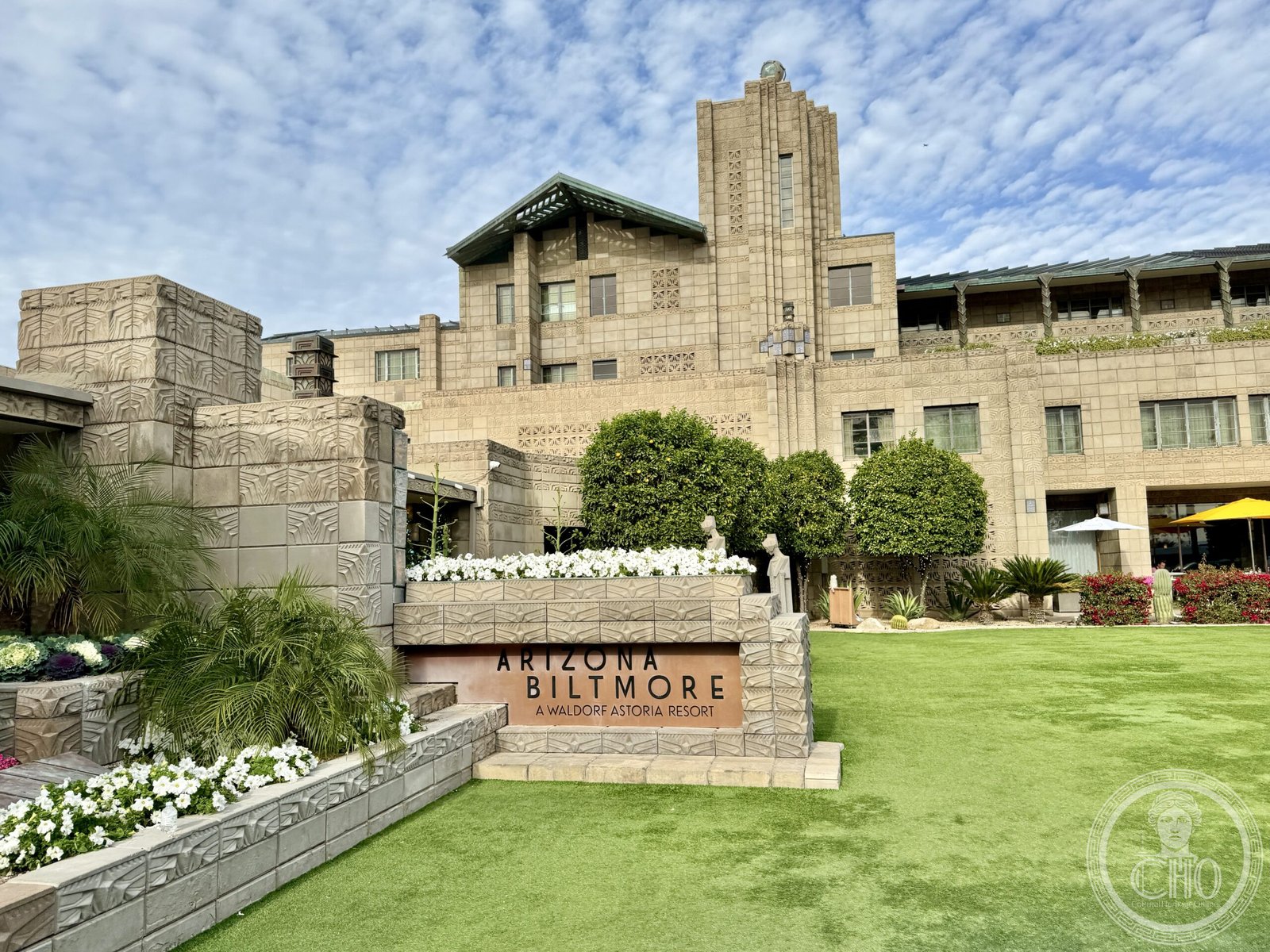
Albert Chase McArthur’s 1929 resort hotel brought Frank Lloyd Wright’s textile-block construction technique to the Arizona desert — geometric concrete panels pressed from local sand, set in a facade that draws simultaneously on pre-Columbian motifs and the hard-edged vocabulary of American Art Deco.
At a glance
The Arizona Biltmore opened in February 1929 as a luxury resort in what was then the outskirts of Phoenix, designed by Albert Chase McArthur with consultation from Frank Lloyd Wright on the textile-block system Wright had developed in his California residential work of the early 1920s. The building’s distinctive concrete-block facade — each unit cast from moulds pressed with geometric patterns — gives the hotel a textured, monumental quality unlike any contemporary American resort. Listed on the National Register of Historic Places, the hotel has operated continuously since 1929, receiving numerous renovations while retaining the essential character of McArthur’s design.
Key facts
- Address: 2400 E. Missouri Avenue, Phoenix, AZ 85016
- Architect: Albert Chase McArthur (1881–1951); Frank Lloyd Wright, consultant on textile-block technique
- Opened: February 1929
- Style: Art Deco with textile-block construction — geometric concrete panels, pre-Columbian ornamental motifs
- Designation: National Register of Historic Places
- Current use: Luxury resort hotel
History
Albert Chase McArthur was a former student of Frank Lloyd Wright and had worked in Wright’s studio before establishing his own practice. When he secured the commission for an ambitious luxury resort near Phoenix, he approached Wright to consult on the textile-block construction method — a system Wright had used in several California houses in the early 1920s, in which concrete blocks were cast with decorative faces, then assembled with reinforcing rods to create structural walls. The method gave McArthur the visual vocabulary he wanted: a surface that looked almost carved rather than poured, with geometric patterns that echoed the angular ornament of pre-Columbian Mesoamerican architecture.
The hotel opened at a moment of optimism, just months before the 1929 financial crisis. William Wrigley Jr., the chewing gum manufacturer, purchased the hotel during the economic difficulties that followed and became closely associated with it; the Wrigley family retained ownership for decades, and the hotel continued to operate as one of Arizona’s prestige addresses through the mid-twentieth century. Subsequent ownership brought renovations that extended the footprint significantly, though the original McArthur-designed building — with its distinctive gold-toned concrete facade, ornamental foyer, and original pool gardens — remains the architectural core of the complex.
The question of authorship has been debated since the hotel opened: Wright promoted his involvement, while McArthur insisted the design was his own. The current historical consensus attributes the design to McArthur and recognises Wright’s contribution as technical consultation on the block system rather than architectural authorship.
What you see
The facade is the defining feature: thousands of individually cast concrete blocks, each pressed from the same mould but laid in alternating orientations, create a surface that reads as a field of repeated geometric forms — diamond-and-cross patterns, angular foliage, and abstract relief that shifts in character as the desert light moves. The blocks are tinted in ochre and gold tones that blend with the surrounding Sonoran landscape; the overall effect is of a building grown from the ground rather than assembled above it.
The interiors continue the geometric programme: ornamental metalwork, stained glass windows, and tiled floors repeat the angular motifs of the exterior. The main lobby and lounge have been restored to a condition close to the original design. The hotel’s grounds include historic pool gardens and mature palm trees that give the resort its characteristic silhouette against the backdrop of Camelback Mountain to the north-east.
Practical information
- Access: The Arizona Biltmore operates as a luxury hotel; the grounds and public spaces are accessible to guests
- Tours: The hotel periodically offers architectural heritage tours of the property; check with the concierge for current availability
- Best viewing: The facade is best appreciated at mid-morning or late afternoon, when the desert light rakes across the concrete block surface and reveals the relief patterns
- Nearest airport: Phoenix Sky Harbor International Airport, approximately six miles south
Getting there
The Arizona Biltmore stands on E. Missouri Avenue in the Biltmore neighbourhood of Phoenix, approximately seven miles north-east of the downtown core. Phoenix Sky Harbor International Airport is approximately six miles to the south; the Valley Metro Light Rail connects Sky Harbor to central Phoenix, with bus connections to the Biltmore area. The hotel is most easily reached by car or taxi from the city centre; self-parking and valet are available on the hotel grounds.
Nearby
- Camelback Mountain — the prominent desert landmark, immediately north-east of the hotel; hiking trails to the summit accessible from the Echo Canyon trailhead
- Heard Museum — major Native American art and culture museum, approximately five miles west in downtown Phoenix
- Phoenix Art Museum — the largest art museum in the south-western United States, approximately five miles west
- Scottsdale — the adjacent city with its own concentration of mid-century modern and desert architecture, approximately three miles north-east
Sources
- National Register of Historic Places nomination, Arizona Biltmore Hotel
- Kathryn Smith, Frank Lloyd Wright: America’s Master Architect (1998) — Wright–McArthur attribution discussion
- Robert Sweeney, Wright in Hollywood: Visions of a New Architecture (1994) — textile block technique context
- Arizona Office of Tourism and Historic Preservation — property records
- Historic American Buildings Survey (HABS) — photographic and measured documentation
Find it on the map
See this place and what’s around it →📷 Become a Cultural Heritage Online photographer
Share your photos of places: they stay published under your name as the author. The more they're seen, the more you get noticed — and soon a contest will reward the most appreciated photos.
Log in or sign up free to add a photoIs this page about you?
This page is read by travellers and heritage enthusiasts who find it on Google. Tell us how you are connected to this place and we will take it from there.