

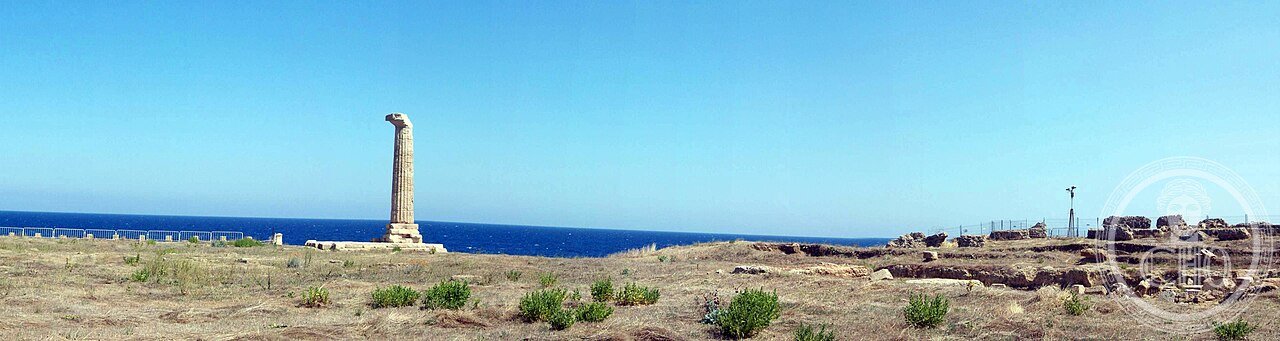
The sanctuary of Hera Lacinia stands on a Magna Graecian promontory, its solitary surviving column rising above the Ionian coast—a landmark that shaped the site’s identity across millennia.
At a glance
This state archaeological site preserves the ruins of one of Magna Graecia’s most significant sanctuaries, dedicated to the goddess Hera. Built at the end of the 6th century BC on a strategic coastal promontory, the sanctuary remained a religious and political centre until the 4th century BC. Today a single standing column dominates the landscape, giving Capo Colonna its modern name.
History
The sanctuary of Hera Lacinia was established at the end of the 6th century BC on the promontory of Lacinion, which gave the goddess her distinctive epithet. Dependent on the ancient city of Crotone, the sanctuary served as one of Magna Graecia’s principal religious centres from the archaic period until the 4th century BC.
The site held strategic importance along coastal trade routes connecting Taranto to the Strait of Messina. Its prominence grew when it became the seat of the Italiota league—a confederation of southern Italian Greek cities—before the league relocated to Taranto. An inscription on the Lacinion cippus, now housed in Crotone’s National Archaeological Museum, reveals the sanctuary was also known as Hera of Eleytheria.
In the 16th century, systematic looting stripped the sanctuary of most of its material remains, which were repurposed as building stone elsewhere.
What you see
The archaeological area centres on the ruins of the ancient temple, of which a single column stands as the defining landmark. This solitary survivor gives the site its enduring name—Capo Colonna, literally “cape of the column.” The name “Capo Nao,” used until recent times, derives from the Greek word naos, meaning temple.
The site occupies a dramatic coastal promontory overlooking the Ionian Sea, where the strategic position that once made it crucial to ancient trade networks remains visually apparent.
Cultural significance
Capo Colonna represents a vital chapter in the history of Greek colonial settlement in southern Italy. As the seat of the Italiota league and a major sanctuary of Magna Graecia, it embodied the religious and political aspirations of Greek communities in the western Mediterranean.
The site is listed among Italy’s national monuments and remains an essential resource for understanding the development of sanctuary architecture, coastal settlement patterns, and inter-city political structures in the classical world.
Key facts
- Address: Strada Provinciale 49, 88900 Crotone
- Coordinates: 39.0263421, 17.2042485
- Phone: 0962 934814
- Website: https://www.beniculturali.it/mibac/opencms/MiBAC/sito-MiBAC/Luogo/MibacUnif/Luoghi-della-Cultura/visualizza_asset.html?id=151762&pagename=157031
- Admission: Free entry
Practical information
Museum hours: Tuesday–Sunday, 9:00–13:00 and 15:00–19:00. Park hours: Monday–Sunday, 9:00–18:00. The museum is closed Mondays. No advance booking is required. The site is accessed via Strada Provinciale 49 from Crotone.
Getting there
The archaeological area is located near Crotone on the Calabrian coast. It is reachable via the provincial coastal road from Crotone, which serves as the regional capital. Parking and facilities are available at the site.
Sources & resources
Find it on the map
See this place and what’s around it →📷 Become a Cultural Heritage Online photographer
Share your photos of places: they stay published under your name as the author. The more they're seen, the more you get noticed — and soon a contest will reward the most appreciated photos.
Log in or sign up free to add a photo