
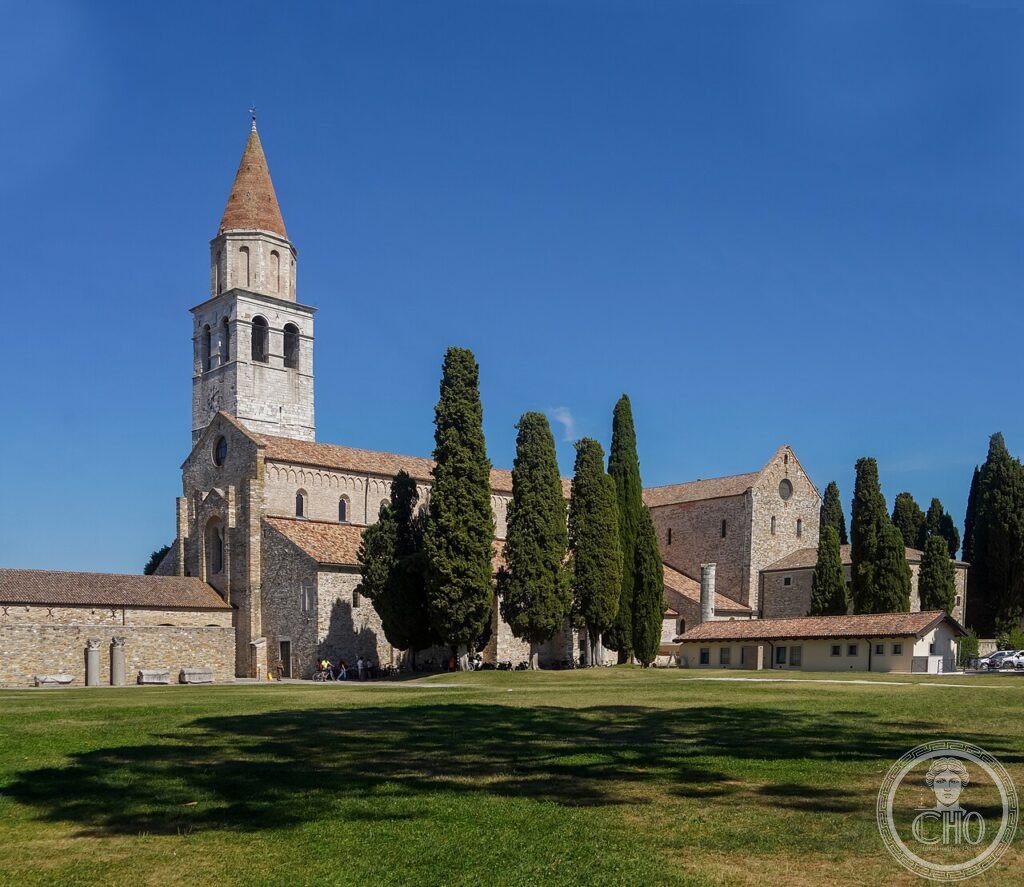
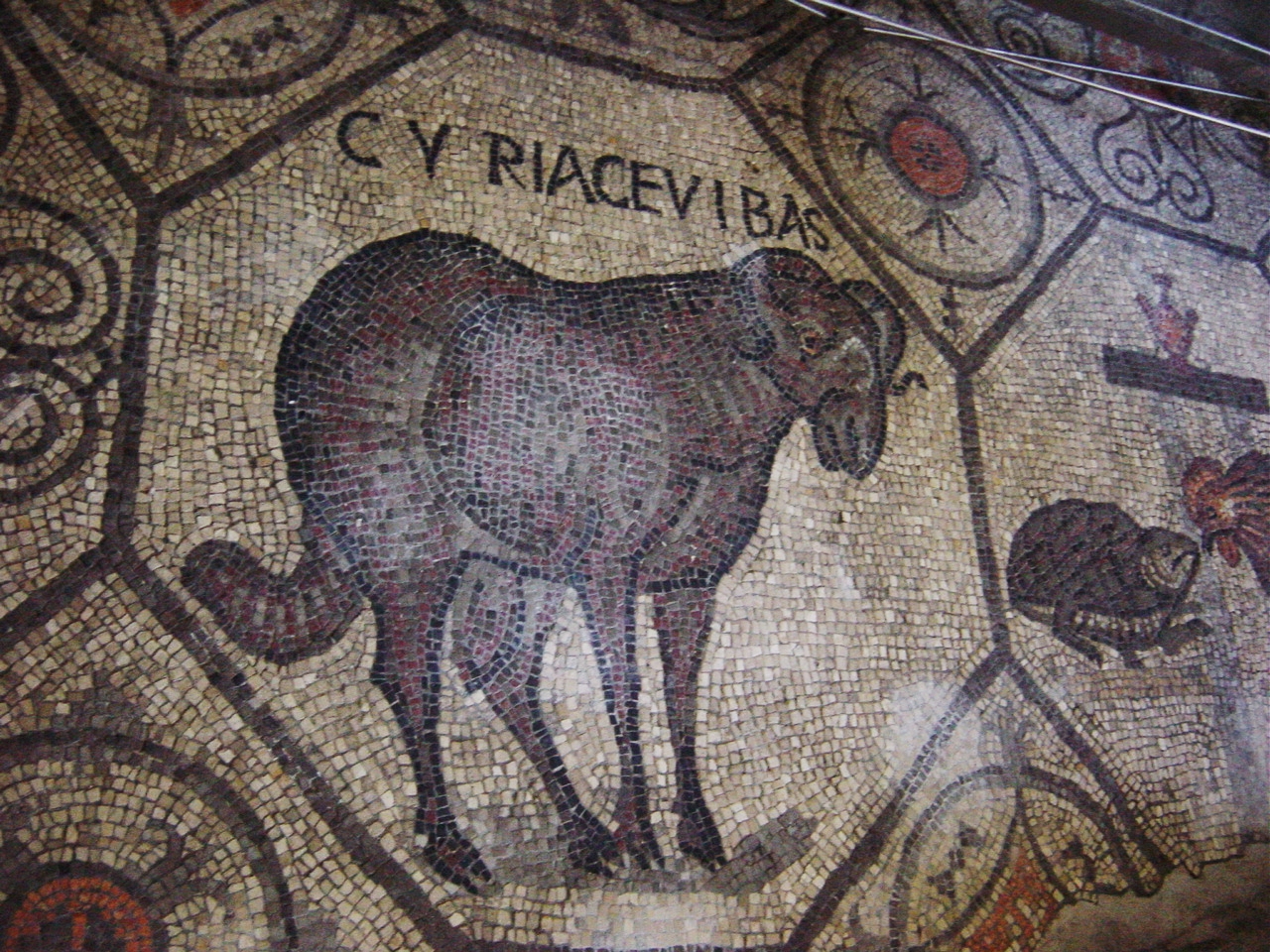
Aquileia was the fourth city of the Roman Empire at its peak — greater than London, greater than Lyon, the capital of the northeastern provinces, the wealthiest port on the Adriatic north of Ravenna — and when it was sacked by Attila the Hun in 452 CE and declined afterward to a small village, it preserved under its fields the largest surviving Roman floor mosaic in the world: 760 square metres of fourth-century CE polychrome stone tessellations under the floor of the patriarchal basilica, depicting fish, birds, Jonah and the whale, portraits of the donors, and geometric patterns of such quality and scale that they have no equal anywhere in the Roman world.
At a glance
Aquileia is a small town (approximately 3,500 inhabitants) in the province of Udine, Friuli-Venezia Giulia, on the plain between the Isonzo river and the lagoon of Grado. Founded as a Roman colony in 181 BCE, it became one of the most important cities of the Roman Empire (the capital of the province Venetia et Histria, one of the ten administrative regions of Augustus) and remained the largest and wealthiest city in northeastern Italy until its sack by Attila in 452 CE. It was inscribed on the UNESCO World Heritage List in 1998 (ref. 875) as “Aquileia, Archaeological Area and the Patriarchal Basilica of Aquileia.” The UNESCO inscription covers the archaeological zone (the Roman city), the Patriarchal Basilica, and the early Christian cemetery (necropolis).
Key facts
- Roman city: Founded 181 BCE as a Latin colony (3,000 settlers) on the Via Postumia (the road from Genoa to Aquileia); expanded to c. 100,000 inhabitants at its height (2nd century CE); the largest city in northeastern Italy and one of the five largest cities in the western Roman Empire
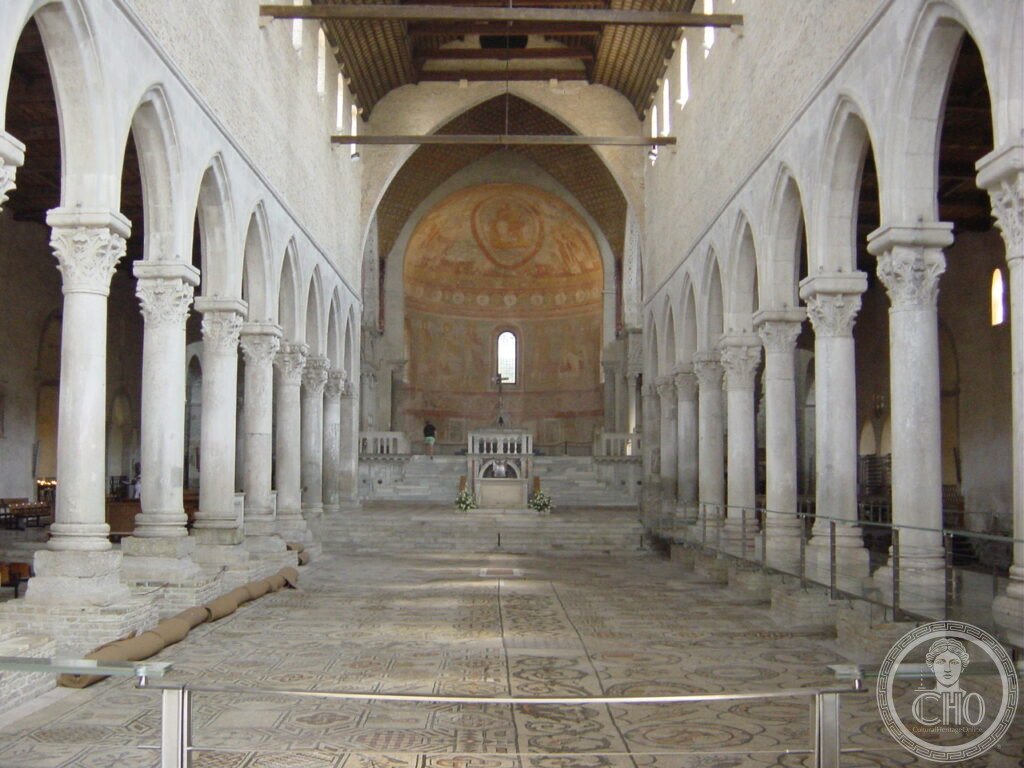
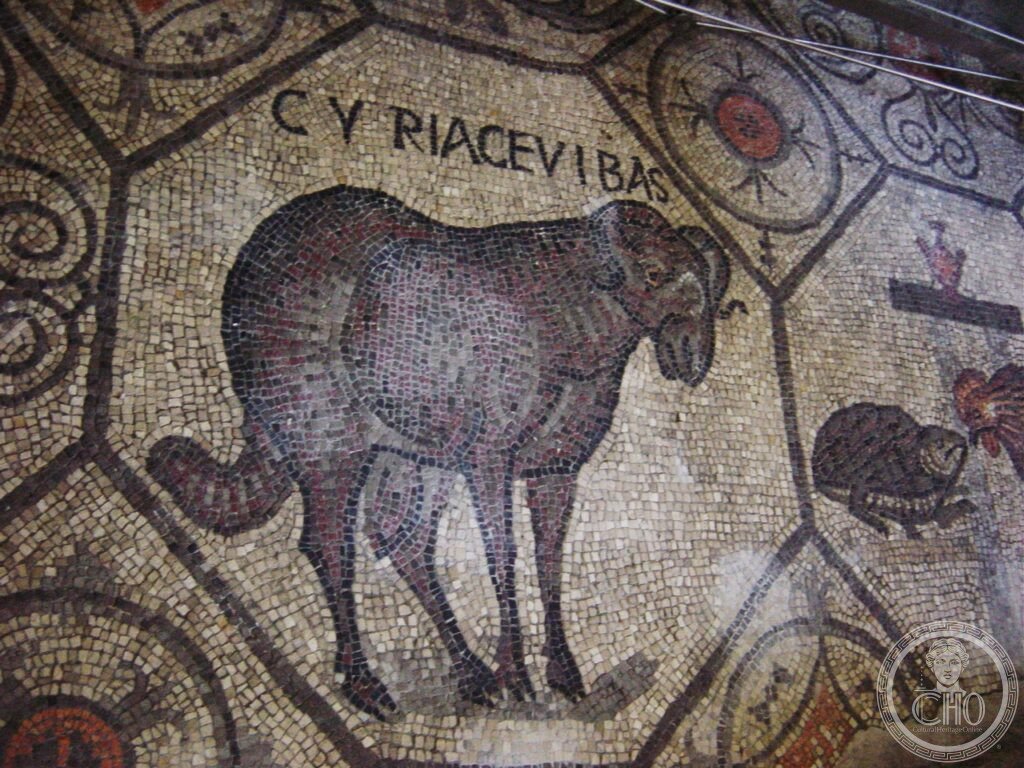
- The mosaic floor (354 CE): 760 m² of polychrome floor mosaic in the nave of the Basilica Patriarcale — the largest Roman floor mosaic in the world still in its original location; dated by inscription to the patriarchate of Theodore (314-319 CE), with later additions to 354 CE; the programme includes: the “Theodore mosaic” (the earliest securely dated Christian floor mosaic in the world, 314-319 CE); the “Jonah cycle” (the earliest surviving narrative mosaic of the Jonah story); representations of fish (a Christian symbol), birds, marine life, seasons, and portraits of donors
- Basilica Patriarcale: Founded in the 4th century CE by the patriarch Chromatius (388-408 CE) over the earlier Theodore mosaic; rebuilt in the 11th century in Romanesque style (the current building); the campanile (1031 CE) and the Romanesque crypt (with a fresco cycle, 12th century) are the major visible features of the post-Roman phase
- Archaeological zone: The Roman forum, the port area (the Natissa river was canalised as a harbour), and the early Christian cemetary (Cripta degli scavi, under the Basilica) are all visible
- UNESCO: 1998, ref. 875 — “Aquileia, Archaeological Area and the Patriarchal Basilica of Aquileia”
- GPS: 45.7731, 13.3700 — Google Maps
History
Aquileia was founded in 181 BCE as the easternmost Latin colony in Italy, intended as both a commercial centre and a military base for Roman expansion into Illyricum and Pannonia. Its position at the head of the Adriatic — on the road from Rome to the Danubian frontier — made it uniquely valuable as the transit point for soldiers, trade goods, and imperial communications; it became the capital of the Regio X (Venetia et Histria) in the Augustan reorganisation of Italy and the commercial gateway between the Mediterranean economy and the northern European trade routes (amber from the Baltic, slaves from the north, grain from Pannonia).
The Christian community in Aquileia was among the earliest in the western Roman world — tradition holds that the Evangelist Mark preached here in approximately 40 CE, and the patriarchate of Aquileia claims apostolic foundation. Whether or not the Marcan connection is historical, the documentary evidence for a Christian community in Aquileia is early (mid-3rd century CE); the first patriarch, Theodore (314-319 CE), built the first basilica complex (the domus ecclesiae, or house-church) that is the foundation of the current cathedral, and in the floor of this building laid the earliest dated Christian floor mosaic programme in the world.
What you see
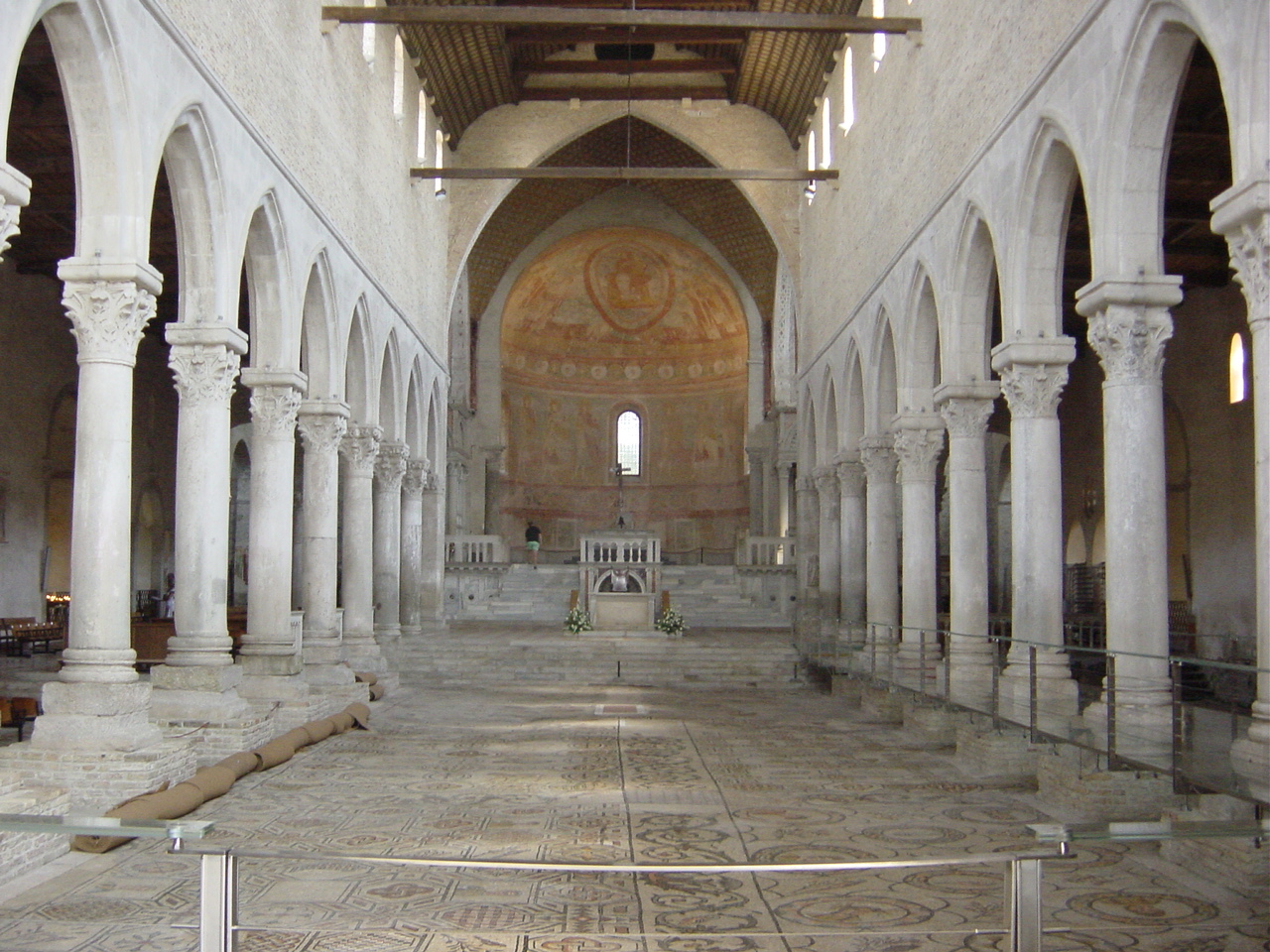
The mosaic floor is visible in the nave of the current Romanesque basilica through glass panels set flush with the medieval floor: an extraordinary effect, as the 4th-century tesselated surface appears below the present floor level, lit from above through the 11th-century windows. The most important sections of the mosaic are: the “Jonah cycle” (on the south side of the nave) — a complete pictorial narrative of the story of Jonah, with the whale represented as a sea serpent in the Roman manner; the “Theodore mosaic” (in the centre of the nave) — the geometric frame surrounding a dedicatory inscription naming the patriarch Theodore and the co-patriarch Crispus; and the portrait heads of donors (around the perimeter of the nave) — high-quality individual portraits in tesserae, representing the wealthy Aquileian families who funded the mosaic.
The Cripta degli scavi (crypt of the excavations, beneath the apse) is the most archaeologically complex space in the visit: three levels of construction are visible — the current Romanesque floor (11th century), the early Christian floor level (4th century CE), and below that the pre-Christian Roman building (2nd century CE) — in a sequence that shows 900 years of continuous religious use of the same site. The crypt also contains the most important fresco cycle in the building (12th century CE, Byzantine-influenced).
Gallery
Practical information
- Basilica Patriarcale (UNESCO site): Piazza Capitolo, Aquileia; open daily 9:00-19:00 (summer) / 9:00-17:30 (winter). Free admission to the basilica interior; the Cripta degli scavi (below the apse) requires a ticket (~€3). The mosaic floor in the nave is always visible (included in free admission).
- Museo Archeologico Nazionale di Aquileia: Via Roma 1; open Tuesday-Sunday 8:30-19:30; admission ~€6. The most important collection of early Roman and early Christian material from northeastern Italy (amber objects, glass, gold work, sculpture, inscriptions).
- Duration: 2 hours minimum (basilica + cripta + exterior); 4 hours with the Museo Nazionale. Allow a full day if visiting the port area and the early Christian basilica of Santa Maria in Beligna.
Getting there
Piazza Capitolo, Aquileia (UD), Friuli-Venezia Giulia. By train: from Udine, 35 km south via Cervignano del Friuli; Trenitalia regional service to Cervignano (25 min), then bus to Aquileia (15 min) or taxi. From Trieste, 40 km west via Monfalcone and SS14. By car: from Udine, SS352 south to Aquileia (35 km, 40 min); from Trieste, A4 west to Villesse exit then SS351 (40 km, 40 min). From Venice, A4 east to Palmanova exit then SS352 south (100 km, 1h30).
Nearby
- Grado — 10 km south; the “island city” on the Adriatic lagoon; the Basilica di Sant’Eufemia (6th century CE; one of the best-preserved early Christian basilicas in Italy; 6th century mosaic floor) and the Baptistery (6th century) are on the same architectural level as Aquileia; the Grado lagoon is one of the most important wetland ecosystems in northeastern Italy
- Cividale del Friuli — 35 km north-east; Forum Iulii (Julius Caesar 56 BCE); Tempietto Longobardo (VIII century CE, UNESCO 2011); the Museo Nazionale with the Lombard treasure and the Altar of Ratchis
- Palmanova — 17 km north; the star-fortress city founded by Venice in 1593 (UNESCO 2017, as part of the “Venetian Works of Defence” inscription); the perfectly regular nine-pointed star plan is visible from any elevated point or drone; the historic centre preserves the original Renaissance military urban design intact
Sources
- UNESCO: whc.unesco.org/en/list/875
- Wikipedia EN: Aquileia
- Tavano, Sergio: Aquileia e Grado: Storia, Arte, Cultura, Lint, Trieste, 1986
- Fondazione Aquileia: fondazioneaquileia.it
Gallery
Find it on the map
See this place and what’s around it →📷 Become a Cultural Heritage Online photographer
Share your photos of places: they stay published under your name as the author. The more they're seen, the more you get noticed — and soon a contest will reward the most appreciated photos.
Log in or sign up free to add a photoIs this page about you?
This page is read by travellers and heritage enthusiasts who find it on Google. Tell us how you are connected to this place and we will take it from there.