
Overview
The Antico Caffe San Marco on Via Cesare Battisti is one of the finest surviving Liberty-era cafes in Europe and a defining institution of Trieste’s literary culture. The building’s exterior dates from 1902; the celebrated cafe interior was designed in 1914, combining elements of the Vienna Secession with the Italian Liberty style. For over a century the San Marco has served as a meeting place for writers, intellectuals, and artists, welcoming James Joyce, Italo Svevo, Umberto Saba, and generations of Triestine cultural life. It was declared a caffe storico d’Italia in 2005.
Architecture
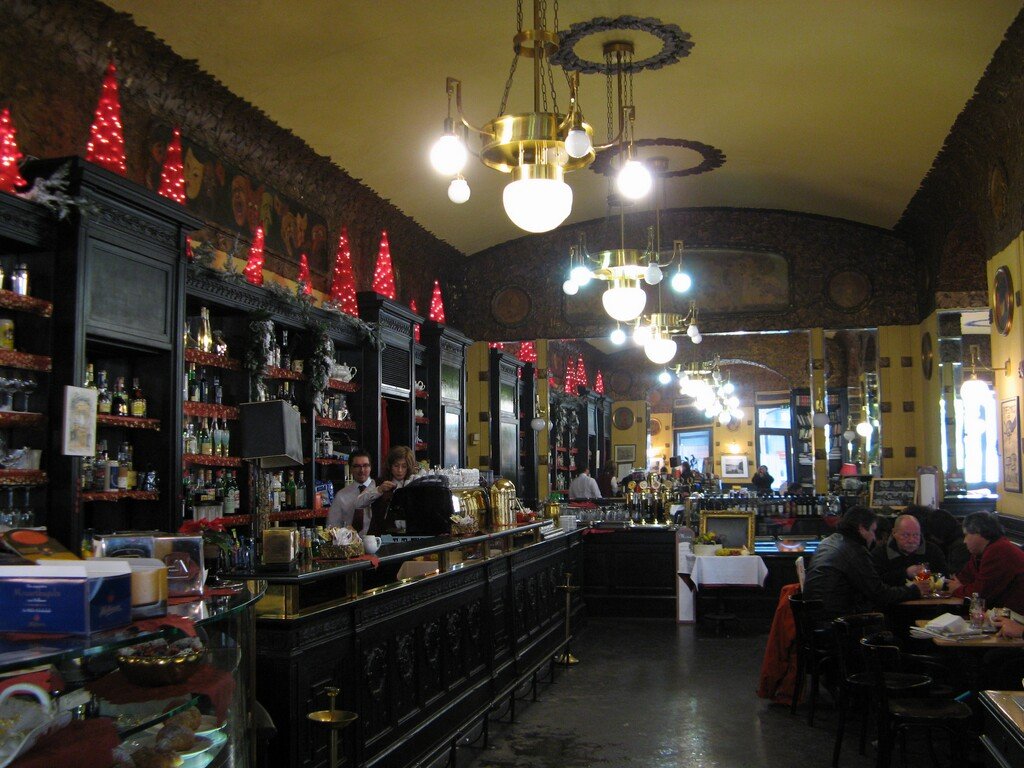
The Liberty interior of 1914 is a masterwork of the style, designed with great attention to the integration of art and furniture into a total decorative environment. The long main room is lined with ornate wooden panelling, mirrored and gilded surfaces, and a painted decorative programme directed by Napoleone Cozzi, with work attributed to Vito Timmel, frescoes by Guido Marussig, and decoration by Ugo Flumiani. Carved woodwork frames the bar and the bookshelves that give the cafe its secondary identity as a literary salon. The coffered ceiling, mosaic floors, and period light fittings survive intact. The building’s exterior, designed by Giorgio Polli in 1902, presents a sober classicising facade that contrasts with the ornate interior.
History
A cafe on the Via Battisti site dates to around 1830, though the current building was erected in 1902 and the Liberty interior installed in 1914. The cafe occupied a central role in Trieste’s intellectual life during the early twentieth century: James Joyce frequented it while living in Trieste from 1904 to 1915, and Italo Svevo was a regular customer. The San Marco served as a gathering point for the irredentist movement before World War I and for literary circles through the interwar years. Briefly closed in the late twentieth century, it was restored and reopened in October 2013 by the Delithanassis family — the café is owned by Assicurazioni Generali — who added the bookshop that defines its literary character today.
Interior
The main salon stretches the length of the building, its walls hung with large oil paintings commissioned specifically for the space in 1914 and remaining in their original positions today. Antique wooden bookcases along one wall display titles from the cafe’s small lending library, a tradition maintained from the early twentieth century. The original marble tables, bentwood chairs, and ornate espresso machines contribute to an atmosphere of authentic period elegance. A secondary reading room towards the rear provides a quieter space for patrons with books. The cafe serves the full range of Triestine coffee culture, from caffe nero to capo in b.
Visiting
The Antico Caffe San Marco is open from morning until late evening, typically 08:00 to 23:00. It functions as both a working cafe and a cultural venue, hosting literary events, book launches, and concerts. Entry is free; the menu features traditional Triestine pastries alongside the celebrated coffee. The adjacent bookshop section is open to browsing without purchase obligation.
Getting There
Via Cesare Battisti 18, 34122 Trieste, Friuli-Venezia Giulia, Italy. A 10-minute walk from Trieste Centrale railway station. Bus lines 6 and 9 stop on Corso Italia, one block away. The cafe is in the centre of the historic city between Piazza Unita and the Canal Grande.
In the Area
The Piazza Unita d’Italia, Europe’s largest sea-facing square, is a 10-minute walk south. The Canal Grande and the Serbian Orthodox Church of San Spiridione are nearby. The Museo Revoltella and the Miramare Castle are both accessible by tram or bus from the city centre.
Find it on the map
See this place and what’s around it →📷 Become a Cultural Heritage Online photographer
Share your photos of places: they stay published under your name as the author. The more they're seen, the more you get noticed — and soon a contest will reward the most appreciated photos.
Log in or sign up free to add a photo