

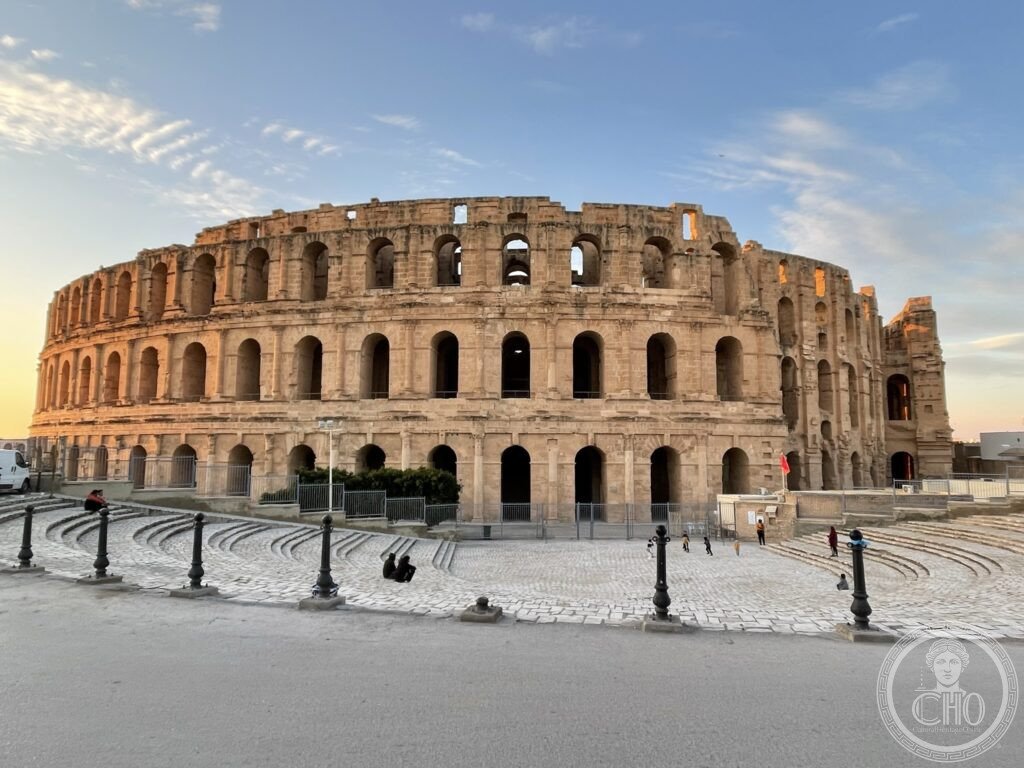
The most unexpected Roman monument in Africa. Rising from the flat olive-oil plain of central Tunisia in a town of 18,000, the Amphitheatre of El Jem (ancient Thysdrus) is the third largest Roman amphitheatre in the world by seating capacity (35,000; after Rome’s Colosseum at 50,000+ and the amphitheatre of Capua at 40,000+), yet it is almost unknown outside Tunisia. Built approximately 238 AD when the Roman proconsul Gordian declared himself emperor here, the amphitheatre’s three surviving exterior levels of arcades make it the best-preserved monumental Roman amphitheatre exterior anywhere outside mainland Europe.
At a glance
El Jem (population approximately 18,000) is in the Mahdia Governorate of central Tunisia, 50 km north of Sfax (the second largest city in Tunisia) and 200 km south of Tunis. The amphitheatre rises incongruously from the centre of the modern town, its three surviving levels of arcaded façade visible from more than 10 km away on the flat Sahel coastal plain. The UNESCO inscription (1979) covers the amphitheatre and the adjacent archaeological site of ancient Thysdrus. The amphitheatre is best combined with the El Jem Archaeological Museum (500m from the amphitheatre, in a 1960s building) which houses the finest collection of Roman floor mosaics in Tunisia and among the finest in the world.
Key facts
- Scale and construction (c. 238 AD): the amphitheatre of Thysdrus measures 148 metres long, 122 metres wide, and 36 metres high (the original four-storey elevation). The elliptical arena measures 64.5 x 38.5 metres. The seating capacity (approximately 35,000) would have accommodated the entire population of Roman Thysdrus and its surrounding region. An astonishing investment that demonstrates the extraordinary wealth of Roman North Africa in the olive oil boom of the 2nd–3rd centuries AD. The building material is limestone quarried at Tebourba (200 km north, the nearest suitable source), transported by cart and shipped down the coast. The logistics of the construction are as remarkable as the building itself. The construction technique uses the same system as the Colosseum: a freestanding structure (unlike the many Greek theatres and Roman amphitheatres built into hillsides) with a complex system of barrel-vaulted corridors and stairways supporting the seating (the seating itself is entirely gone; only the structural skeleton survives). Three of the original four exterior arcaded levels survive. The fourth level (the top floor, an attic storey with rectangular windows in place of arched openings) is almost entirely destroyed.
- The Gordian Connection (238 AD): the amphitheatre’s construction is linked to the proclamation of Gordian I as Roman Emperor at Thysdrus in March 238 AD. The so-called “Year of the Six Emperors” (238 AD was a year of extraordinary political instability in Rome, when six different individuals were proclaimed emperor). The proconsul of Africa Marcus Antonius Gordianus (Gordian I, then approximately 80 years old) was proclaimed emperor by a mob at Thysdrus following an insurrection against the tax collector of the Emperor Maximinus Thrax. Gordian immediately co-emperored his son (Gordian II) and they were recognised by the Senate. However, Gordian II was defeated and killed in battle against the governor of Numidia (who remained loyal to Maximinus) at Carthage within 22 days. Gordian I hanged himself on hearing the news. The amphitheatre may have been commissioned by the Gordian family before or during this brief imperial episode.
- The Thysdrus mosaics and El Jem Museum: ancient Thysdrus was one of the most prosperous cities of Roman North Africa, its wealth based on olive oil production for export to Rome and the Mediterranean. 22 olive presses have been identified archaeologically in and around the ancient city. The villas of the wealthy Thysdrus landowners were decorated with extraordinary floor mosaics, many of which were excavated in the 20th century and moved to the El Jem Museum (500m from the amphitheatre). The museum collection is exceptional: the “Sea Triumph of Neptune” mosaic (3rd century AD, a large-format floor mosaic showing the sea god in his chariot surrounded by sea creatures and tritons, extraordinarily detailed), the Orpheus mosaic (Orpheus playing his lyre surrounded by entranced animals, in the characteristic circular-panel format of Thysdrus mosaic-making), the Bacchic procession mosaics, and the theatrical mask mosaic panels. The Thysdrus school of mosaic is now recognised as one of the most distinctive and productive in the Roman world.
- The vaults and underground galleries: beneath the amphitheatre, a system of underground galleries and vaulted corridors (the hypogeum) served as storage for animals (lions, bears, crocodiles, ostriches — for the venationes, the wild animal hunts), gladiators awaiting their turn in the arena, and stage machinery. The underground galleries at El Jem are accessible to visitors and give an immediate sense of the operational reality of the Roman spectacle. Standing in a narrow vaulted corridor where caged lions were held before being hoisted to the arena above is a more visceral experience than any museum reconstruction.
- Heritage: UNESCO World Heritage Site, Amphitheatre of El Jem, inscribed 1979.
- GPS: 35.2965° N, 8.6899° E.
History
Thysdrus (the Roman city whose Arabic name El Jem is a corruption of “Thysdrus” via the medieval Arabic form “al-Jam”) was a Berber settlement before Roman colonisation and grew into an important city of the province of Africa Proconsularis (the Roman province covering most of modern Tunisia) during the 1st–3rd centuries AD. The city’s wealth came from the olive oil economy of the Sahel (the coastal plain between Sousse and Sfax, still one of the world’s largest olive-producing regions). Thysdrus had its own smaller amphitheatre (known as the “Small Amphitheatre”, partially excavated north-west of the main amphitheatre) before the great amphitheatre was built. The great amphitheatre was constructed in approximately 238 AD. The city declined in the late 3rd century AD after the Vandal sack of North Africa (429–439 AD) and the disruption of the olive oil trade. The amphitheatre survived because its massive walls made it a defensive fortress (the Berber queen Dihya, the “Kahina”, used it as her fortress during her resistance to the Arab conquest of North Africa, approximately 698 AD). A section of the north side was demolished in 1695 by the Beys of Tunis to extract cannon balls from the masonry. The gap in the north exterior wall dates from this deliberate demolition.
What you see
The amphitheatre is entered from the museum ticket office (100m south). Walk the exterior perimeter first to appreciate the three surviving levels of arcade (the second level preserves the most complete sequence of arched openings and engaged columns). Enter the interior arena and look up at the surviving seating terraces (the west side preserves several surviving stone seating rows). Descend to the underground galleries (the most atmospheric experience: the vaulted corridors, the animal storage cells, and the trapdoor shafts through which animals were hoisted to the arena above). The El Jem Archaeological Museum (500m walk from the amphitheatre, signed) requires a separate ticket but is essential: the Thysdrus mosaics are among the greatest Roman floor mosaics in existence and are displayed in a building (no air conditioning, no crowds) where you can walk on the access walkways over them and look closely at the individual tesserae. Allow 2 hours for the amphitheatre, 1 hour for the museum.
Practical information
- Admission: combined amphitheatre + museum approximately 18 TND (approximately €5.50). Amphitheatre alone approximately 12 TND. The site is open daily (8am–7pm in summer, shorter in winter). No advance booking required. The amphitheatre is never crowded (tourists from the coastal resorts rarely visit; the site is primarily visited by Tunisian school groups and the occasional independent European traveller).
- Getting there: El Jem is on the main Tunis-Sfax railway line. Trains from Tunis (2h 30 min, several per day, approximately 15 TND), from Sfax (45 min), and from Sousse (1h 10 min). The railway station in El Jem is 500m from the amphitheatre. By car from Tunis 200 km south on the A1 motorway then GP1 road (2h 30 min). From Sfax 60 km north on the GP1 (50 min). From Sousse 70 km south (1h). The amphitheatre is an obvious road landmark (visible from the motorway approach road) and is signposted. The E-1 national route passes the town centre.
- Combining with the coast: El Jem is most efficiently combined with the coastal resort of Mahdia (45 km east; a relaxed Tunisian beach town on a peninsula with a medieval Fatimid-era fortified medina and a Friday market) or with Sfax (50 km south; Tunisia’s second city and main commercial port, with an intact Aghlabid-era medina considerably less touristified than Tunis or Sousse) or with Kairouan (80 km north-west; the fourth holiest city of Islam, with the Great Mosque of Kairouan, the oldest mosque in North Africa, founded 670 AD; UNESCO WHS 1988).
Getting there
Train from Tunis (2.5h), Sousse (1h 10min), Sfax (45 min). Railway station 500m from amphitheatre. By car from Sfax (60 km, 50 min). GPS: 35.2965, 8.6899.
Nearby
- Kairouan. 80 km north-west of El Jem (1h by car). The fourth holiest city of Islam and the historic capital of Islamic North Africa (UNESCO WHS 1988). The Great Mosque of Kairouan (Masjid Uqba) was founded in 670 AD and is the oldest mosque in the Maghreb and one of the oldest in the world; its distinctive minaret of 836 AD is the oldest surviving minaret in the world, and the extraordinary hypostyle prayer hall carries 414 ancient columns plundered from Roman Carthage and other sites. The Aghlabid Pools (9th century) are two large rain-water retention basins of the Aghlabid dynasty, built for Kairouan’s water supply and the finest surviving examples of early Islamic hydraulic engineering. The mosque of the Three Doors (Masjid Thalatha Abwab, 866 AD) is one of the oldest Islamic mosques with an inscribed and decorated façade still in existence. Together they make Kairouan the richest single-day Islamic heritage destination in the Maghreb.
- Sbeitla (ancient Sufetula). 120 km west of El Jem (1h 30 min by car). The most impressive complete Roman forum and temple complex in Tunisia. Sufetula was a prosperous city of Byzantine Africa Proconsularis (capital of the governor who declared himself emperor of Roman Africa for less than a year in 647 AD, before being defeated and killed by the Arab invasion force under Abdullah ibn Saad). The three adjacent Roman temples (Temples of Jupiter, Juno, and Minerva, 2nd century AD) standing on a single podium with a triple gateway in front of them is the most photogenic Roman monumental group in North Africa after Leptis Magna. The temples are remarkably intact (all three cellas survive to the roofline). The forum in front of them (80 x 70 metres) and the adjacent baths, arch of Diocletian, and early Christian basilicas form a complete reading of a prosperous provincial Roman city at the moment of its transition from pagan to Christian in the 4th–5th centuries.
- Sousse Medina. 70 km north of El Jem (1h by car or train). The most completely preserved medieval Islamic medina in Tunisia (UNESCO WHS 1988). The Sousse medina (inscribed with the Ribat/Great Mosque/Kasbah complex) is a compact walled city with the finest Great Mosque of the Aghlabid period outside Kairouan (the Mosque of Sousse, 851 AD), the remarkable Ribat (a 9th-century Muslim fortified monastery on the seafront, with a distinctive circular watchtower, one of the oldest surviving Islamic military buildings in North Africa), the covered souks, and the Kasbah Museum (which contains the best collection of Roman mosaics in coastal Tunisia, including the remarkable mosaic portrait of the God Dionysus from the 2nd century AD).
Sources
- Wikipedia, El Djem. Thysdrus. Gordian I, accessed June 2026.
- UNESCO, Amphitheatre of El Jem, WHS reference 38, inscribed 1979.
- Hédi Slim et al., Histoire générale de la Tunisie, vol. 1 (L’Antiquité), Maisonneuve et Larose, 2003.
- Katherine M. D. Dunbabin, Mosaics of Greek and Roman World, Cambridge University Press, 1999.
Find it on the map
See this place and what’s around it →📷 Become a Cultural Heritage Online photographer
Share your photos of places: they stay published under your name as the author. The more they're seen, the more you get noticed — and soon a contest will reward the most appreciated photos.
Log in or sign up free to add a photo