
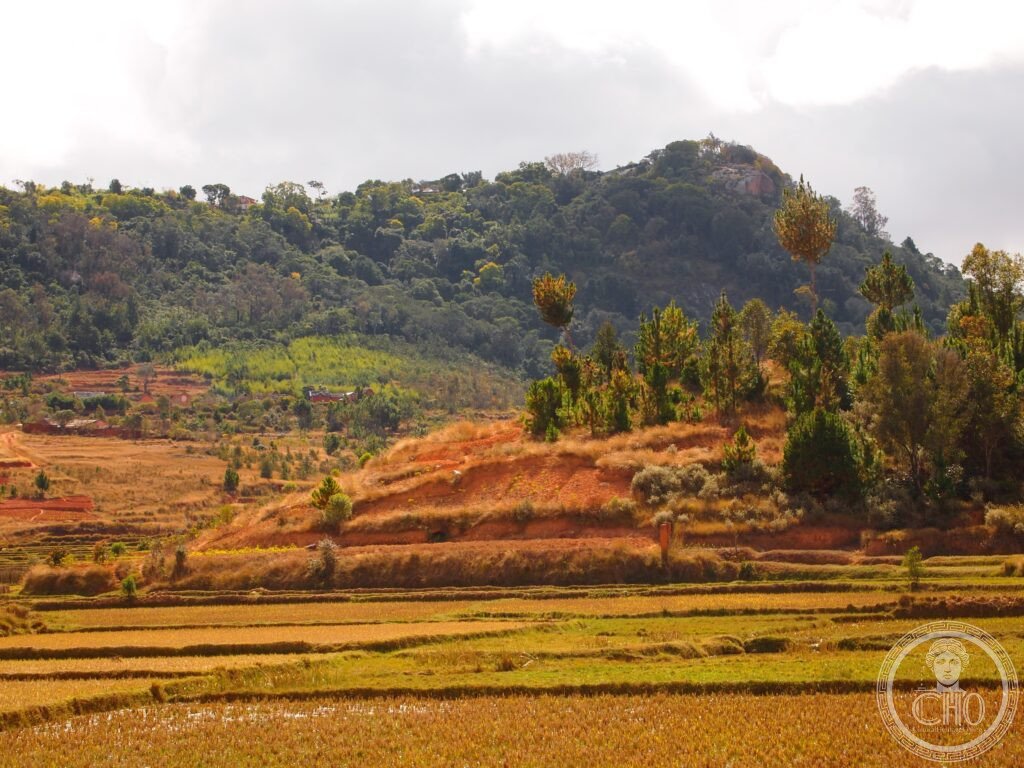
The Royal Hill of Ambohimanga, north-east of Antananarivo, is the cradle of the kingdom that made Madagascar a modern state: a fortified royal city, the burial ground of sovereigns, and an ensemble of sacred places that has kept its spiritual character for some five centuries. Madagascar’s first cultural UNESCO World Heritage Site, inscribed in 2001, it is still a living place of pilgrimage.
At a glance
Ambohimanga — the “blue hill” of the Malagasy highlands — was the sacred capital of the Merina kingdom, the power that unified Madagascar from the central plateau. UNESCO inscribed the hill as an exceptional witness to the civilisation that developed in the central highlands between the fifteenth and nineteenth centuries, and to the cult of kings and ancestors bound up with it.
What sets Ambohimanga apart from most royal sites is that its sacredness never lapsed: pilgrims from across Madagascar and beyond still climb the hill to seek the blessing of the ancestors, and the site remains closely tied to Malagasy national identity.
Key facts
- What it is: a royal city and burial site with an ensemble of sacred places, on a fortified hilltop north-east of Antananarivo
- Kingdom: sacred and religious capital of the Merina kingdom of Madagascar
- Key figure: King Andrianampoinimerina (reigned 1787–1810), who reunited the divided kingdom around 1797 and launched the unification of Madagascar; his house survives on the hill
- Defences: walled enclosures and gateways that could be sealed with massive stone discs
- Living heritage: a place of worship and pilgrimage continuously for around 500 years
- Heritage status: UNESCO World Heritage Site, inscribed 2001 (ref. 950)
History
The hill was fortified and settled by the Merina, the people of Madagascar’s central highlands, and rose to become one of the sacred hills of Imerina. Its defining moment came in the late eighteenth century, when Andrianampoinimerina made Ambohimanga his base, reunited a kingdom divided among rival rulers around 1797, and set in motion the unification of the island that his son Radama I carried forward — a kingdom internationally acknowledged from 1817.
Political power settled at Antananarivo, but Ambohimanga remained the kingdom’s religious capital and the burial ground of its sovereigns through the nineteenth century — the sacred counterpart to the administrative capital, so revered that the hill was long closed to foreigners. After the French conquest of the kingdom in the mid-1890s, the colonial administration transferred the royal relics from the hill to Antananarivo in an attempt to break its hold on Malagasy loyalty; the attempt failed, and the pilgrimages never stopped.
In 2001 UNESCO inscribed the Royal Hill as Madagascar’s first cultural World Heritage Site, recognising both its buildings and the living traditions — the cult of kings and ancestors — that continue around them.
What you see
The approach itself is part of the monument: the hill is ringed by defensive works, and its gateways were designed to be sealed by enormous stone discs rolled across the opening — one of the most striking surviving examples of Merina military architecture, still to be seen at the main gate.
Within the walls, the rova (royal enclosure) preserves the simple wooden house of Andrianampoinimerina, royal pavilions of the later nineteenth century, tombs, sacrificial stones and the sacred enclosures that gave the hill its authority. Around the summit spread the older sacred wood and springs. From the top, the view reaches across the rice terraces and red-earth villages of the Imerina plateau towards Antananarivo.
Visitors share the site with pilgrims: offerings, candles and small ceremonies at the sacred places are part of everyday life on the hill, not a re-enactment.
Practical information
- Visiting: the site is normally visited with a local guide from the gate; allow half a day including the journey from Antananarivo
- Conduct: this is an active sacred site — follow your guide’s advice on where to walk and what to photograph
- Season: the dry season, roughly April to October, is the most comfortable time in the highlands
Getting there
Ambohimanga lies some 20 km north-east of Antananarivo, and is the classic day trip from the capital by taxi or hire car; shared taxis also serve the village below the hill. Madagascar’s international gateway is Antananarivo’s Ivato airport. GPS: -18.7593, 47.5653.
Nearby
- Antananarivo — the capital, its upper town crowned by the Rova of Antananarivo, the royal palace complex gutted by fire in 1995 and since restored
- The sacred hills of Imerina — Ambohimanga is the most celebrated of the traditional sacred hills ringing the capital
- Lake Mantasoa — highland reservoir east of the capital, tied to the nineteenth-century industrial works of Jean Laborde
Sources
- UNESCO World Heritage Centre — Royal Hill of Ambohimanga (ref. 950)
- Encyclopaedia Britannica — Andrianampoinimerina; Merina; history of Madagascar
Find it on the map
See this place and what’s around it →📷 Become a Cultural Heritage Online photographer
Share your photos of places: they stay published under your name as the author. The more they're seen, the more you get noticed — and soon a contest will reward the most appreciated photos.
Log in or sign up free to add a photo