
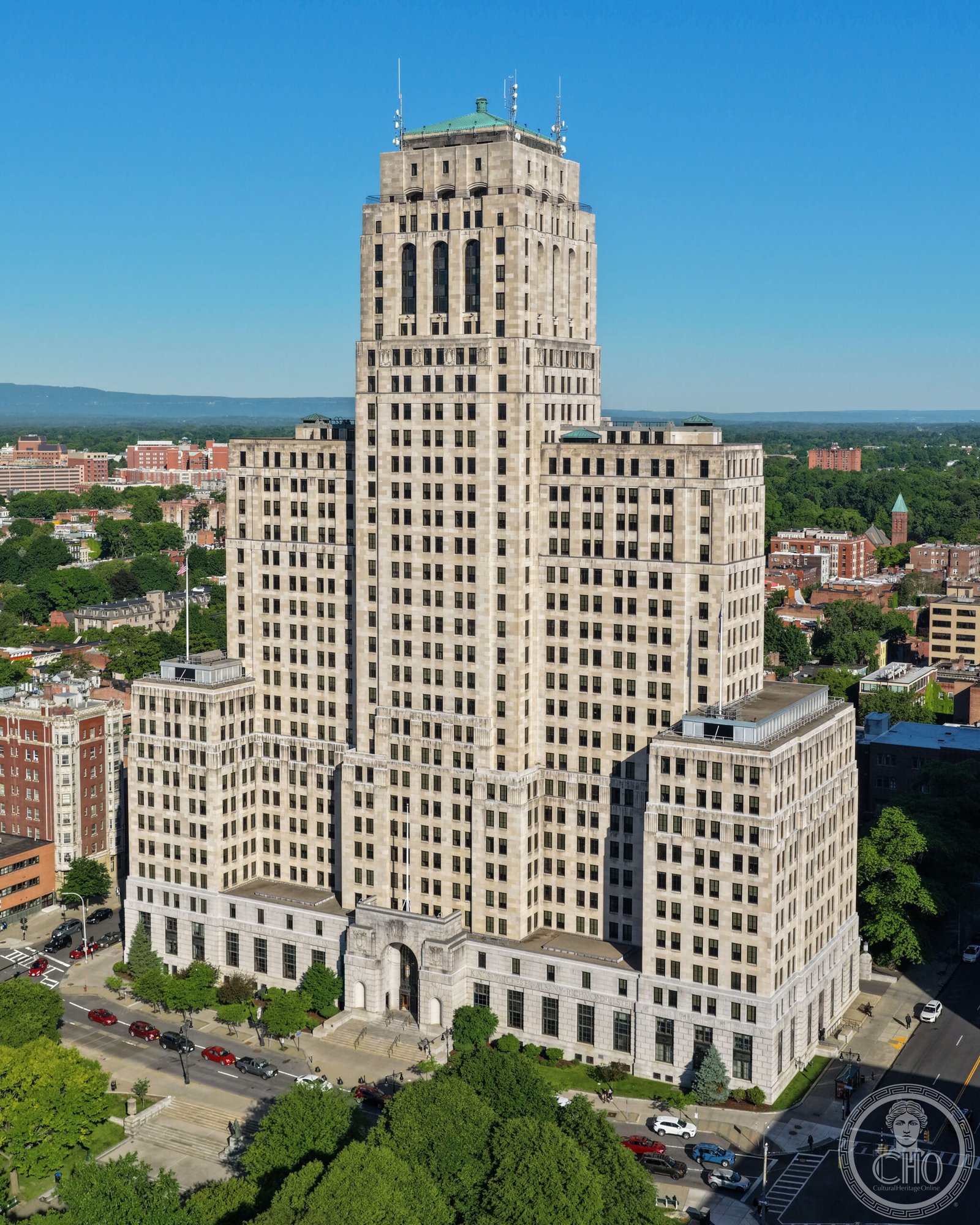
Alfred E. Smith State Office Building
Albany’s defining Art Deco tower rises 34 stories above the state capital, its setback silhouette dominating the skyline at a moment when New York State was asserting its ambitions through architecture.
At a glance
The Alfred E. Smith State Office Building at 80 South Swan Street in Albany was completed in 1928 as the tallest building in New York’s capital city, a position it held for decades. Designed in the Art Deco style, the 34-story tower features a series of setbacks that produce its characteristic pyramidal silhouette, capped by an illuminated lantern visible from miles along the Hudson Valley. The building was named in honour of Alfred E. Smith, the four-term Governor of New York who oversaw a period of major public works expansion and who became the Democratic presidential candidate in 1928. It remains a working state government office building and an anchor of Albany’s government district.
Key facts
- Location: 80 South Swan Street, Albany, New York
- Architect: New York State architect (under state commission)
- Completed: 1928
- Height / floors: approximately 388 feet / 34 stories
- Style: Art Deco with pronounced setback profile
- Named for: Governor Alfred E. Smith (served 1923–1928), 1928 Democratic presidential nominee
- Current use: New York State government offices
History
Alfred E. Smith served four terms as Governor of New York between 1919 and 1928, a tenure marked by extensive investment in public works, hospitals, parks, and government buildings. The tower that bears his name was begun during his final term and completed in the year he ran unsuccessfully for president against Herbert Hoover. Its name was a tribute from the state legislature and marked a rare instance of a major government building being named for a living person during their active political career.
The design produced a building that was functional in intent — the tower needed to house a large state government workforce in centralised form — while meeting the Art Deco aesthetic expectations of the period. The setback profile was both a formal choice and a response to the context: Albany’s government quarter had an established scale, and the tower needed to read as a monument from the approaches along State Street and the Hudson embankment without overwhelming the Capitol building itself.
The building remained the tallest in Albany for several decades, and its illuminated lantern became a recognisable element of the Albany skyline. It was renovated in later decades while retaining its original exterior character and continues to serve as a functioning office building for New York State agencies.
What you see
The tower rises from a stone base with restrained Art Deco ornament at the entrance portals before stepping back through a series of setbacks that narrow the massing progressively toward the lantern. The exterior limestone cladding is largely plain at the lower stories, with concentrated ornament at the entrance, the main cornice lines, and the crown. The setback profile, characteristic of the Zoning Resolution-influenced towers of the 1920s, gives the building a sculptural quality when seen from the Capitol Park and from State Street, where the full stack of setbacks is visible.
The lantern at the summit is lit at night, making the tower visible from across the Hudson and from the Rensselaer side of the river. At street level, the South Swan Street entrance retains its original bronze metalwork and carved stone surrounds, providing a moment of concentrated detail in an otherwise clean facade.
Practical information
- Access: Government offices; lobby may be accessible during weekday working hours with valid identification.
- Best viewing: The setback profile is best seen from Capitol Park or from the intersection of State Street and Swan Street.
- Time needed: 15–20 minutes for exterior viewing; combine with the New York State Capitol and the Empire State Plaza for an architectural circuit of Albany’s government quarter.
- Nearest parking: Empire State Plaza parking garage on Madison Avenue.
Getting there
The Alfred E. Smith Building is in the heart of Albany’s government district, a ten-minute walk from Albany–Rensselaer Amtrak station across the Hudson River (with access via the Greenbush bridge shuttle). The nearest bus stops are on State Street and Swan Street. By car from the New York State Thruway (I-87), take Exit 23 for Albany and follow Washington Avenue west to the Capitol area. The building is directly adjacent to the New York State Capitol and within the Empire State Plaza complex.
Nearby
- New York State Capitol (1899) — The Romanesque–Renaissance hybrid capitol building, one of the most architecturally ambitious state capitals in the United States, immediately adjacent on State Street.
- Empire State Plaza — Nelson Rockefeller’s 1960s–1970s modernist government complex, extending south from the Capitol, including the Egg performing arts center and the New York State Museum.
- Albany City Hall (1883) — H. H. Richardson’s Romanesque masterpiece, one block north on Eagle Street.
- New York State Museum — Within the Empire State Plaza complex, with permanent collections on Albany’s architectural and urban history.
Sources
- New York State Office of General Services, Alfred E. Smith Building records.
- New York State Museum, “Albany’s Built Environment” exhibition.
- Waite, John G., ed. Albany Architecture: A Guide to the City. Mount Ida Press, 1993.
- Smith, Alfred E. Up to Now: An Autobiography. Viking Press, 1929.
- Wikipedia, “Alfred E. Smith State Office Building,” https://en.wikipedia.org/wiki/Alfred_E._Smith_State_Office_Building.
Find it on the map
See this place and what’s around it →📷 Diventa un fotografo di Cultural Heritage Online
Condividi le tue foto dei luoghi: restano pubblicate con la tua firma come autore. Più vengono viste, più ti fai conoscere — e presto un concorso premierà le foto più apprezzate.
Accedi o registrati gratis per aggiungere una fotoDo you manage this place?
This page is read by travellers and heritage enthusiasts who find it on Google. Keep it accurate — and make it work for you. Free for non-profit heritage institutions.