
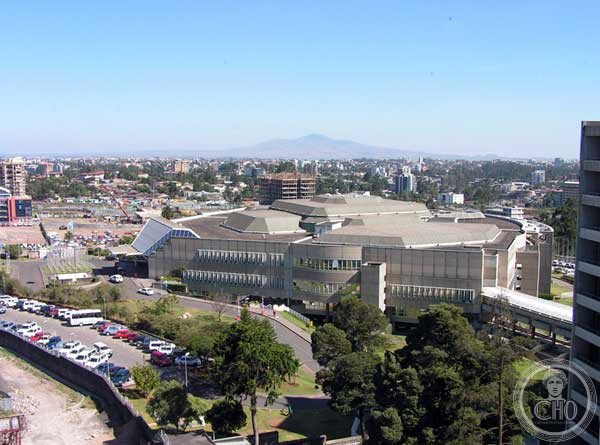
Africa Hall stands as the most politically charged building in sub-Saharan Africa — a mid-century Modernist statement commissioned by Emperor Haile Selassie as a gift to the United Nations Economic Commission for Africa. Completed in 1961, it became the stage for one of the 20th century’s defining moments: on 25 May 1963, thirty-two African heads of state gathered beneath its roof to sign the charter of the Organisation of African Unity, the forerunner of today’s African Union. That date — African Liberation Day — is now commemorated worldwide. The building’s true treasure is the triptych of stained-glass windows by Ethiopian master artist Afewerk Tekle, covering 150 square metres and narrating the continent’s passage from colonialism through struggle to unity. Facing the Entoto Hills, the building remains an active UN campus and a pilgrimage site for pan-African history, architecture, and the memory of independence.
At a glance
- Type
- Public institution / UN headquarters
- Period
- Completed 1961
- Style
- Mid-century Modernism
- Location
- Menelik II Avenue, Addis Ababa, Ethiopia
- Coordinates
- 9.0320° N, 38.7469° E
- Architect(s)
- Emil Werqneh
Overview
Africa Hall is the headquarters of the United Nations Economic Commission for Africa (UNECA), situated on Menelik II Avenue in the heart of Addis Ababa. The building was constructed by the Ethiopian government under Emperor Haile Selassie and donated to the United Nations as a permanent seat for the Commission. It combines rational Modernist planning — generous assembly rooms, symmetrical facades, clean concrete lines — with an interior enriched by African artistry. The compound has expanded over the decades but Africa Hall itself, the original 1961 structure, retains its symbolic primacy as the founding hall of African multilateralism.
History
The United Nations Economic Commission for Africa was established in 1958 to promote economic cooperation across the newly decolonising continent. Emperor Haile Selassie offered Addis Ababa as its permanent home, and construction of Africa Hall began shortly thereafter, completing in 1961. The hall immediately became a theatre of history: on 25 May 1963 it hosted the founding summit of the Organisation of African Unity (OAU), attended by leaders including Kwame Nkrumah, Julius Nyerere, Jomo Kenyatta, and Sékou Touré. The UN Security Council convened here in 1972, one of very few times it has met outside New York or Geneva. The building witnessed Ethiopia’s own turbulent history — the 1974 Derg coup, the Mengistu years, and the country’s post-1991 transition — while remaining under UN protection throughout.
Architecture & Design
Architect Emil Werqneh designed Africa Hall in the International Modernist idiom current among African government buildings of the late 1950s and early 1960s: a rectilinear massing with broad horizontal windows, a ceremonial main entrance under a projecting canopy, and interior volumes scaled for large diplomatic gatherings. The defining interior feature is Afewerk Tekle’s triptych of stained-glass windows, installed in 1967 and measuring 150 square metres — among the largest stained-glass works in Africa. Executed in vivid reds, greens, and golds, the three panels depict the suffering under colonialism, the liberation struggle, and the dawn of African unity. The windows transform the hall’s light into something ceremonial and deeply political, giving a secular governmental building the gravitas of a cathedral.
Cultural significance
Africa Hall is to pan-Africanism what Independence Hall in Philadelphia is to American democracy: the room where the founding document was signed. The OAU Charter of 1963, negotiated and executed here, established the principle of African solidarity and non-interference that has shaped continental diplomacy for sixty years. Afewerk Tekle’s windows — which the artist considered his masterwork — constitute one of the greatest pieces of African public art of the 20th century. The building also marks the extraordinary fact that Addis Ababa, never colonised, became the capital of African diplomacy, a status it retains today as the seat of the African Union.
Visiting today
Africa Hall is an active United Nations facility and access requires advance arrangement through the UNECA public affairs office. Guided tours are occasionally offered to academic groups, diplomats, and cultural visitors, and the stained-glass windows by Afewerk Tekle are the primary draw. The surrounding compound includes the UNECA Conference Centre. The Ethiopian capital is well served by Addis Ababa Bole International Airport, and the hall stands roughly four kilometres from the city centre on Menelik II Avenue.
Getting there
Africa Hall is on Menelik II Avenue in central-north Addis Ababa, approximately four kilometres from Meskel Square. Taxis and ride-hailing services (Ride, inDriver) are the most practical options from the airport or hotel. The light rail’s east-west line passes nearby at Mexico Square, from where the hall is reachable by taxi. The address is recognisable from the imposing UN signage; the nearest landmark is the large Tiglachin Monument (Derg-era memorial) a few hundred metres south.
Sources & resources
Do you know more?
On this page we have published what we were able to verify. If you know Africa Hall first-hand — you work there, have studied it, or remember how it used to be — and can add a detail, a date, a story or an old photograph, write to Sofia, who looks after these pages. Photographs of the place are welcome too: you can send them with the form at the bottom of this page.
Write to Sofia
or send a message on WhatsApp
Please start your message with the title of this page, so it reaches the right file. Every contribution is checked against independent sources before it goes on the page, and we always say where a piece of information came from.
Find it on the map
See this place and what’s around it →📷 Become a Cultural Heritage Online photographer
Share your photos of places: they stay published under your name as the author. The more they're seen, the more you get noticed — and soon a contest will reward the most appreciated photos.
Log in or sign up free to add a photoIs this page about you?
This page is read by travellers and heritage enthusiasts who find it on Google. Tell us how you are connected to this place and we will take it from there.