
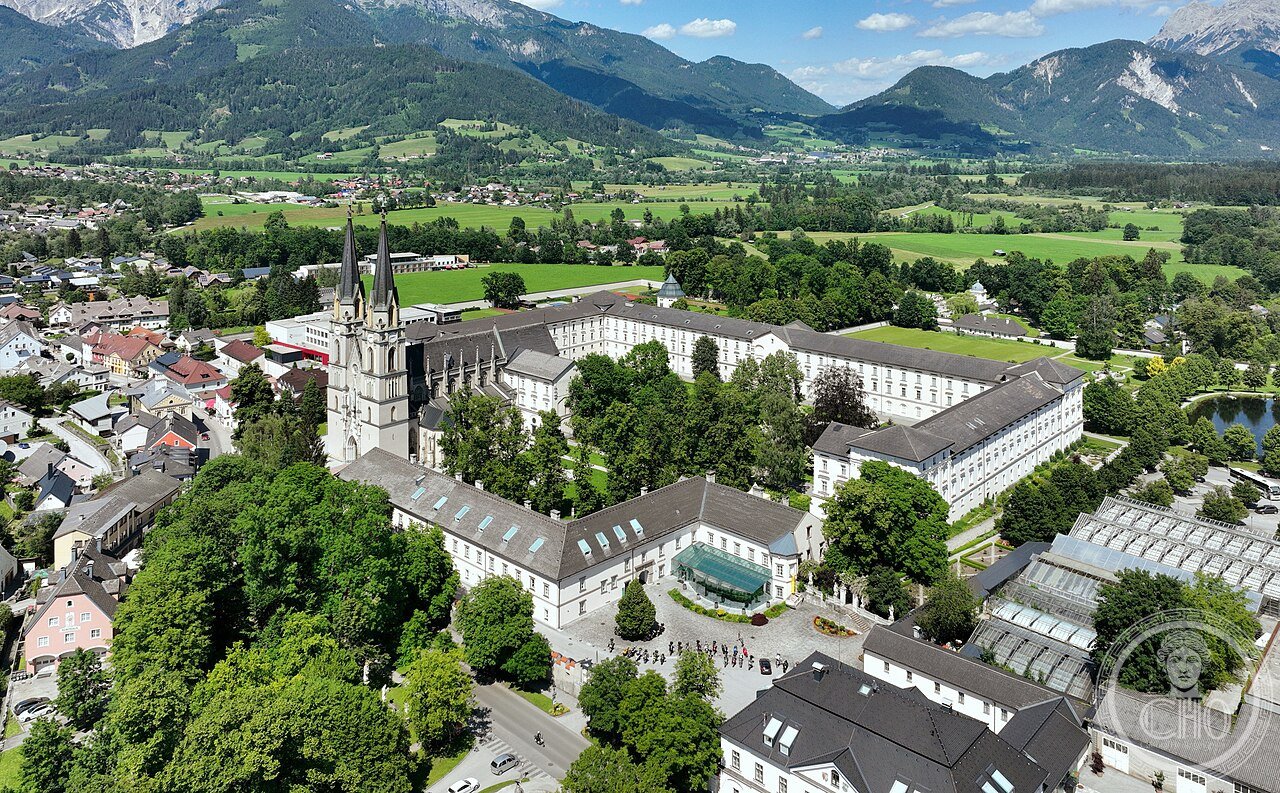
On 27 April 1865 a fire destroyed almost the whole monastery. The archives burned, but the library — built almost a century earlier, in 1776, to a design by Joseph Hueber — was saved. Seventy metres long, it remains today the largest monastic library in the world, holding some 70,000 of the abbey’s 200,000 volumes.
About Admont Abbey
Admont Abbey, a Benedictine monastery on the Enns river in Admont, Styria, dedicated to Saint Blaise, was founded in 1074 by Archbishop Gebhard of Salzburg on land left by Hemma of Gurk, and settled by monks from St. Peter’s Abbey in Salzburg under abbot Isingrin — directly connecting the abbey’s foundation to the same Carinthian saint whose dissolved nunnery had funded the construction of Gurk Cathedral. The abbey’s single most extraordinary feature is its library, universally regarded as the largest monastic library in the world: the library hall itself, built in 1776 to designs by architect Joseph Hueber, measures 70 metres long, 14 metres wide, and 13 metres high, and houses roughly 70,000 of the abbey’s total holdings of approximately 200,000 volumes, including over 1,400 manuscripts and more than 900 incunabula. On 27 April 1865, a catastrophic fire destroyed almost the entire monastery complex; while the monastic archives were lost to the flames, the library itself was successfully saved. Reconstruction of the wider monastery began the following year and was still incomplete by 1890. Suppressed during and after World War II, the monastic community was able to return in 1946, and Admont today is again a thriving Benedictine community.
Key facts
- Foundation: 1074, by Archbishop Gebhard of Salzburg, on land donated by Hemma of Gurk; settled by monks from Salzburg’s St. Peter’s Abbey under abbot Isingrin
- Library hall: built 1776, designed by Joseph Hueber; 70m long, 14m wide, 13m high
- Holdings: c. 200,000 volumes total, c. 70,000 housed in the library hall, over 1,400 manuscripts, more than 900 incunabula
- 1865 fire: destroyed almost the entire monastery on 27 April; archives lost, library saved; reconstruction begun 1866, still incomplete by 1890
- Postwar history: monastic community able to return in 1946 after WWII-era suppression
- Significance: the largest monastic library in the world
History
Admont’s direct foundational link to Hemma of Gurk — her donated land funding the abbey’s 1074 establishment, just years before her own dissolved nunnery would fund Gurk Cathedral’s construction — situates both institutions within the same specific web of 11th-century Carinthian and Styrian ecclesiastical patronage centred on Archbishop Gebhard of Salzburg’s broader diocesan reorganisation project, giving the two sites a genuine, documented historical connection beyond mere geographic proximity within the same Salzburg archdiocese sphere.
The library’s survival of the catastrophic 1865 fire, while the monastery’s own archives were lost, represents an especially fortunate outcome given how frequently major fires at comparable European monastic institutions destroyed irreplaceable manuscript and book collections alongside the buildings housing them — Admont’s specific good fortune in this respect helps explain why its library collection, despite the surrounding building’s near-total destruction, retained enough of its historic holdings to be recognised today as the largest of its kind anywhere in the world. The nearly quarter-century gap between the fire and the reconstruction’s still-incomplete state as late as 1890 illustrates the sheer physical scale of what needed rebuilding after the disaster, extending well beyond a single or even a few years’ restoration effort.
What you see
The library hall itself, at 70 metres the essential single destination, offers visitors direct access to what is recognised as the world’s largest monastic library, its scale and Baroque decorative programme — including ceiling frescoes by Bartolomeo Altomonte — rewarding a slow, extended visit. The reconstructed monastery complex, rebuilt over decades following the 1865 fire, gives visitors a legible record of the disaster and its long institutional recovery. The abbey’s continuing active Benedictine community, restored after 1946, situates the site as a living monastery rather than a purely historical monument.
Practical information
- Opening hours: generally open daily during the visitor season, check current hours before visiting; admission fee for the library and museum
- Address: Kirchplatz 1, 8911 Admont, Austria
Getting there
Admont is reachable by regional train from Selzthal or Graz, with a change typically required. By car, Admont sits on the B146 road in the Enns valley, Styria. GPS: 47.5750° N, 14.4632° E.
Nearby
- Gesäuse National Park — immediately adjacent to Admont, a rugged Alpine national park along the Enns river
- Enns river gorge — scenic hiking and rafting terrain around Admont
- Graz — Styria’s capital, reachable by regional train
Sources
- Wikipedia — “Admont Abbey” (en.wikipedia.org)
- Totally Historic — “Admont Abbey Library: The Eighth Wonder of the World” (totallyhistoric.com)
- The Vintage News — “Admont Abbey: the Benedictine monastery in Austria that contains the largest monastic library in the world” (thevintagenews.com)
Find it on the map
See this place and what’s around it →📷 Become a Cultural Heritage Online photographer
Share your photos of places: they stay published under your name as the author. The more they're seen, the more you get noticed — and soon a contest will reward the most appreciated photos.
Log in or sign up free to add a photo