
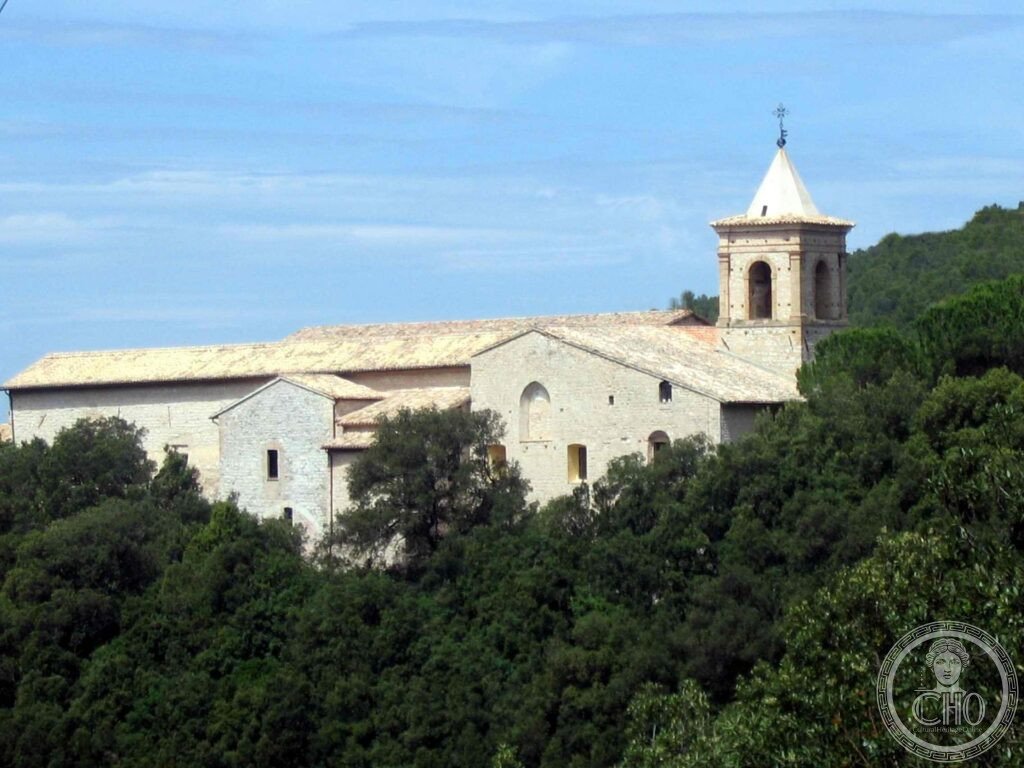
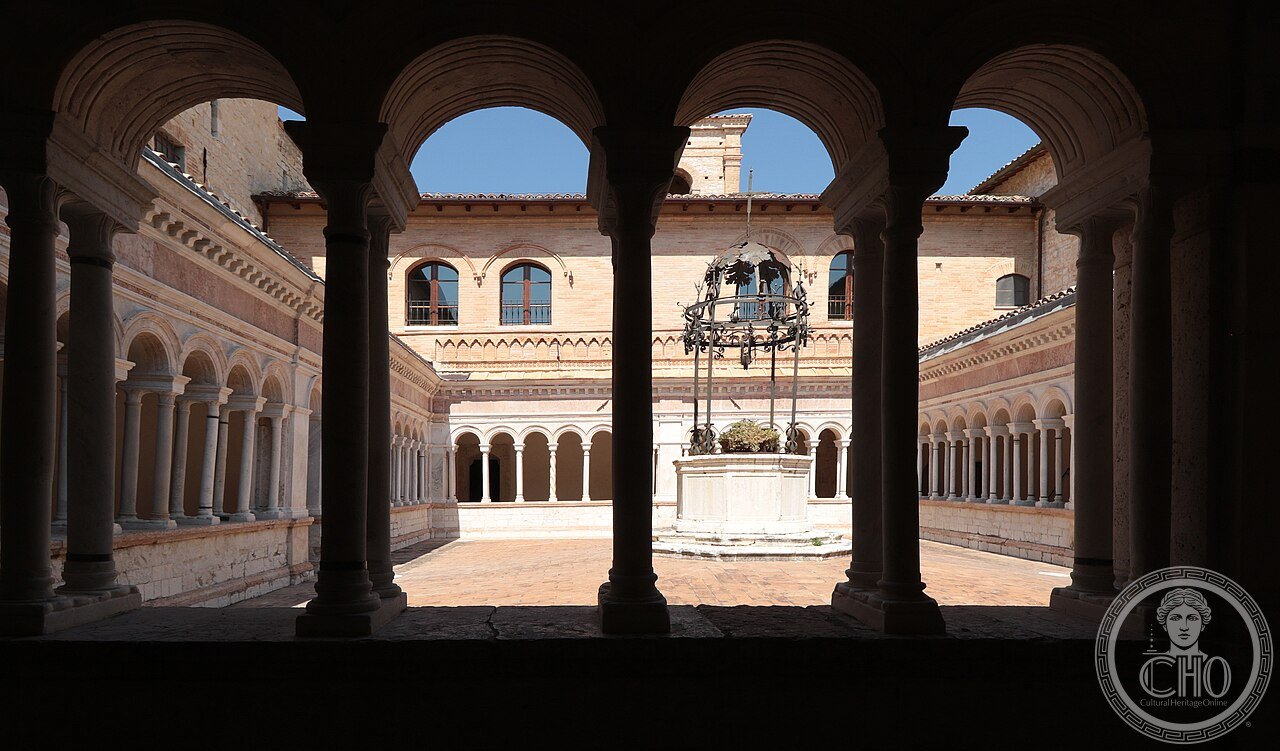
The cloister of Sassovivo is one of those works of the Italian Middle Ages that most surprise for their precision and decorative richness: 58 paired columns in white Carrara marble, with polychrome inlay in opus sectile, built in 1229 by Pietro de Maria, a Roman marble craftsman. The setting is the Umbrian forest, the silence, the wind.
At a glance
Sassovivo Abbey stands in the wooded hills above Foligno, 5 km south-east of the city centre in the province of Perugia, Umbria. It was founded in the early 11th century (the exact date is uncertain; the first documented mention is from around 1070) as a Benedictine monastery, probably by the local Offreducci family. The abbey grew quickly in the 11th and 12th centuries, accumulating landholdings throughout the central Umbrian plain, and at its height controlled some fifty dependent churches and priories. The chief artistic monument is the cloister, built in 1229 by the Roman marble-worker Pietro de Maria (whose name and the date are inscribed on the cloister arch): 58 double columns in white Carrara marble, each pair linked at the capital with polychrome Cosmatesque intarsia work in red and green porphyry, serpentine, and gilded glass tesserae. This cloister is considered one of the finest examples of Cosmatesque workmanship in central Italy — comparable to the cloisters of San Giovanni in Laterano and San Paolo fuori le Mura in Rome.
Key facts
- Founded: early 11th century, probably c. 1070, by the Offreducci family of Foligno; Benedictine; first documented mention c. 1070
- Cosmatesque cloister: built 1229 by Pietro de Maria (Roman marble-worker; his name and the date are inscribed); 58 double columns in Carrara marble; polychrome intarsia capitals in porphyry, serpentine, and glass; one of the finest Cosmatesque cloisters in Italy
- Peak wealth: 12th–13th century; controlled about 50 dependent churches and priories in Umbria; major landowner in the Foligno territory
- Church: Romanesque church (mostly 12th century), with later additions; frescoes in the apse (13th–14th century)
- Suppressed: 1860 at Unification; buildings became private; the cloister and church survived
- Today: managed by the Foligno diocese; accessible to visitors; minor monastic community
History
The foundation of Sassovivo in the 11th century was part of the Benedictine expansion that followed the Gregorian Reform: local noble families competing with each other in pious patronage, and the Church encouraging the multiplication of monastic houses in the hills above the Umbrian plains as a network of spiritual and agricultural nodes. Sassovivo grew steadily through the 12th century, receiving privileges from popes and emperors (Frederick Barbarossa confirmed the abbey's landholdings in 1177) and extending its influence across the Foligno territory.
The commissioning of the cloister in 1229 from the Roman marble-worker Pietro de Maria is the key event in the abbey's artistic history. Pietro de Maria belonged to the Cosmati school — the network of Roman marble-workers who developed the characteristic Cosmatesque style of inlaid coloured marble in the 12th and 13th centuries. Bringing a Roman craftsman to Umbria to build a cloister in the most up-to-date Roman style was a statement of wealth and ambition; the result, with its 58 pairs of slender columns and its polychrome capitals, is one of the most accomplished examples of Cosmatesque workmanship outside Rome. The abbey declined in the 14th century under the impact of the Black Death, political disruption, and the gradual erosion of its landholdings; it was suppressed in 1860 at Italian Unification.
What you see
The approach to Sassovivo through the olive groves and forests above Foligno is part of the experience: the abbey sits at the edge of the Umbrian plain, with views south toward the Monti Sibillini. The church, a Romanesque building of the 12th century, has a simple facade and a richly frescoed apse interior (the frescoes, damaged and partially restored, retain their 13th-century composition and palette). But the supreme experience is the cloister: a perfectly proportioned rectangular courtyard with 58 pairs of marble columns on all four sides, the light playing on the polychrome intarsia of the capitals (red porphyry, green serpentine, gilded glass) and on the pale Carrara shafts. The inscription naming Pietro de Maria and the date 1229 is carved on the inner face of one of the arches. In the centre of the cloister garth, a well.
Practical information
- Opening hours: daily 09:00–12:30 and 14:30–17:30 (check seasonal variations); closed Monday
- Admission: small charge for the cloister
- Time needed: 1 hour
Getting there
By car from Foligno (5 km south-east): SP403 toward Sassovivo; signed from Foligno. No public transport to the abbey. GPS: 42.9380° N, 12.7286° E.
Nearby
- Foligno — 5 km north-west; medieval cathedral (12th c.), Palazzo Trinci with Gothic frescoes, giostra della quintana tournament (September)
- Spello — 8 km south-west; Pinturicchio's Baglioni Chapel in Santa Maria Maggiore; Roman gates; flowering infiorata (Corpus Christi)
- Montefalco — 15 km south-west; Benozzo Gozzoli's Life of St Francis in the Museo Civico; Sagrantino wine country
Sources
- Wikipedia — “Sassovivo Abbey” (en.wikipedia.org/wiki/Sassovivo_Abbey)
- Attilio Bartoli Langeli, Sassovivo: una grande abbazia medievale, Foligno, 2003
- Diocesi di Foligno — official abbey page
Find it on the map
See this place and what’s around it →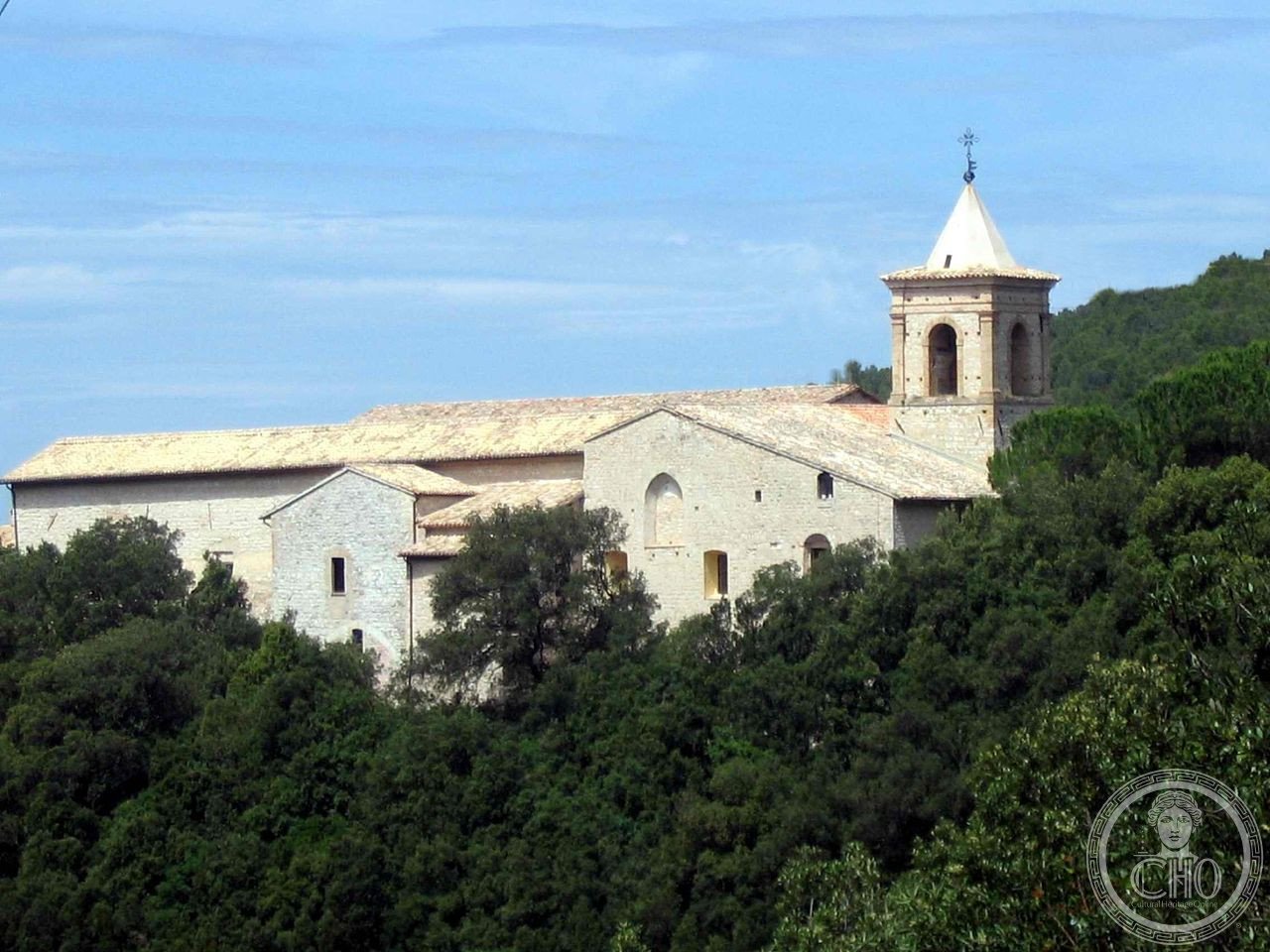
📷 Become a Cultural Heritage Online photographer
Share your photos of places: they stay published under your name as the author. The more they're seen, the more you get noticed — and soon a contest will reward the most appreciated photos.
Log in or sign up free to add a photoIs this page about you?
This page is read by travellers and heritage enthusiasts who find it on Google. Tell us how you are connected to this place and we will take it from there.