
William of Vercelli founded Montevergine in 1124 and Goleto in 1133, but it is the latter that carries the most singular architectural mark in the Italian South: the Tower of Febronia, a Romanesque tower that bears a dovecote at its top — sacred doves, by tradition, that announced the death of the nuns — and that held in its crypt the tomb of the first abbess.
At a glance
The Abbey of Goleto stands in the valley of the Ofanto river, 2 km from Sant'Angelo dei Lombardi, in the Irpinia region of Campania (province of Avellino). It was founded in 1133 by William of Vercelli (1085–1142), the hermit-monk who had already founded the sanctuary of Montevergine (1124) on the mountain above Avellino. Unlike Montevergine, Goleto was a community of Benedictine nuns; William appointed a woman, Febronia, as the first abbess and gave the community of sisters precedence over the attached male monastery. This was unusual for the 12th century and reflects both William's personal vision of gender equality in monastic life and the influence of the emerging Fontevraud model (established by Robert d'Arbrissel in France a generation earlier). The abbey's most remarkable feature is the Torre di Febronia, a 12th-century Romanesque tower that serves simultaneously as a belfry, a devotional monument to the first abbess (buried in the crypt at its base), and a dovecote (the chamber at the top houses a colombario — niches for pigeons). The tower is unique in southern Italy.
Key facts
- Founded: 1133 by William of Vercelli (San Guglielmo), also founder of Montevergine (1124); female Benedictine community under Abbess Febronia.
- Torre di Febronia: 12th-century Romanesque tower, three stories; ground floor = crypt with tomb of Febronia; middle stories = belfry; top = colombario (dovecote with niches for pigeons); unique in southern Italian architecture.
- Gender structure: female community with priority over the attached male monastery; abbess governed both; unusual for the 12th century; influenced by the Fontevraud model (Robert d'Arbrissel).
- Earthquake 1980: the Irpinia earthquake of 23 November 1980 severely damaged the abbey; reconstruction and partial restoration followed; the tower survived.
- Today: partially restored; administered by the Montevergine congregation; occasional visits; annual pilgrimage to the tomb of Febronia.
History
William of Vercelli (born 1085 in Vercelli, died 1142 at Goleto) is one of the most fascinating figures of 12th-century Italian monasticism: a wandering hermit who spent years in Galicia (at Santiago de Compostela) and in the Apulian mountains before settling in the Irpinia in the 1120s. His foundation of Montevergine on the mountain above Avellino (1124) created a Marian sanctuary that would become one of the most important in southern Italy; his foundation of Goleto in the valley below (1133) was his final project, and it was here that he spent the last decade of his life and is traditionally held to have died.
The unusual structure of Goleto — a female community with authority over a male one, under the personal direction of Abbess Febronia — reflects William's spirituality, which emphasized the equality of souls before God and the spiritual capacity of women as well as men for monastic perfection. Febronia, the first abbess, is venerated as a local saint; her tomb in the crypt of the tower became a pilgrimage point within a generation. The Torre di Febronia was built over her tomb as a combined monument and functional building: the colombario at the top, according to popular tradition, housed pigeons whose behaviour announced the death of abbesses (a tradition also found at a few French medieval monasteries). The Irpinia earthquake of 1980 destroyed much of the later fabric of the abbey but left the 12th-century tower largely intact.
What you see
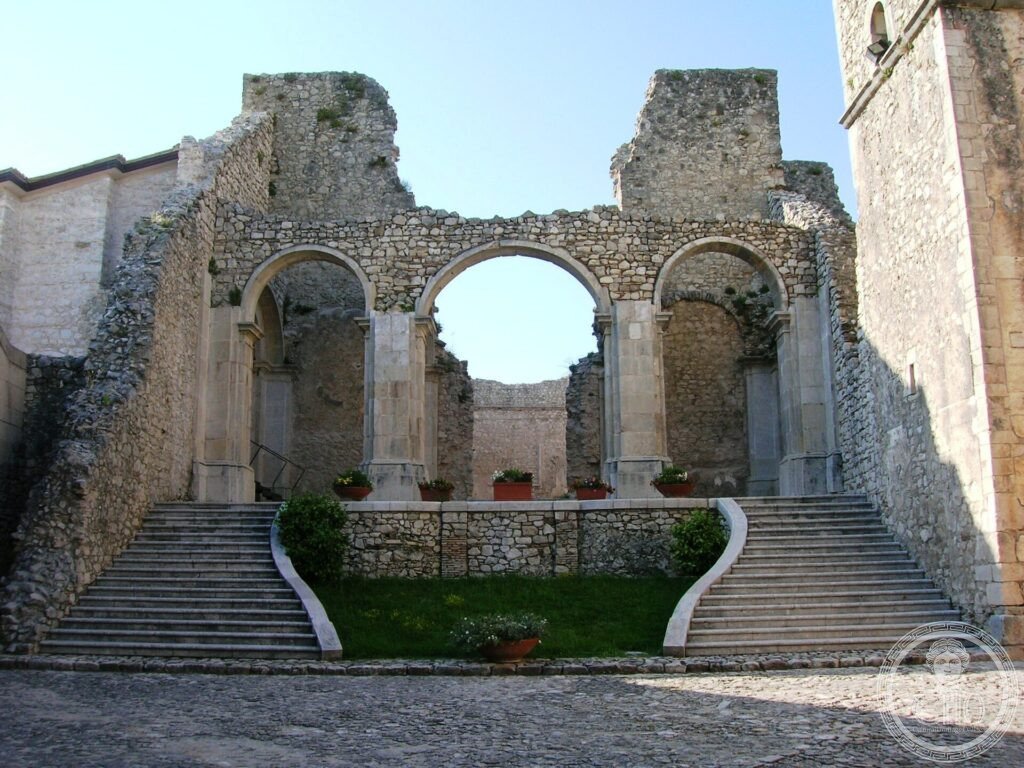
The approach to Goleto is through the small town of Sant'Angelo dei Lombardi and down a valley road to the abbey, which sits in a secluded position on the east bank of the Ofanto. The complex is partially ruined and partially restored, with the 12th-century tower as the dominant and best-preserved element. The tower rises in three distinct stages: the crypt at the base (with the tomb of Febronia, accessible by steps), a middle section with Romanesque paired windows, and the colombario at the top (the niches for pigeons clearly visible, still sheltered by small stone covers). The church beside the tower is largely a modern reconstruction following the 1980 earthquake. The overall atmosphere is one of isolation and devotion: this is not a tourist site but a place of continuing pilgrimage.
Practical information
- Opening hours: contact the Monastero di Montevergine for current visiting arrangements.
- Admission: free.
- Time needed: 45 minutes to 1 hour.
Getting there
By car from Avellino (50 km east): A16 motorway to Lacedonia/Sant'Angelo, then SS303 and local road. GPS: 40.9264° N, 15.1919° E.
Nearby
- Santuario di Montevergine — William's other great foundation, 40 km west; the most visited Marian shrine in southern Italy.
- Sant'Angelo dei Lombardi — 2 km away; medieval Lombard castle; rebuilt after the 1980 earthquake; small earthquake museum.
- Nusco — 12 km south-west; panoramic hill town with medieval cathedral; birthplace of John Paul I's secretary Arturo Zardini.
Sources
- Wikipedia — “Abbey of the Goleto” (en.wikipedia.org/wiki/Abbey_of_the_Goleto).
- Monastero di Montevergine — benedettini di Montevergine official publications.
- Giovanni Vitolo, Guglielmo da Vercelli e l'abbazia del Goleto, Salerno, 1983.
Find it on the map
See this place and what’s around it →📷 Become a Cultural Heritage Online photographer
Share your photos of places: they stay published under your name as the author. The more they're seen, the more you get noticed — and soon a contest will reward the most appreciated photos.
Log in or sign up free to add a photoIs this page about you?
This page is read by travellers and heritage enthusiasts who find it on Google. Tell us how you are connected to this place and we will take it from there.