
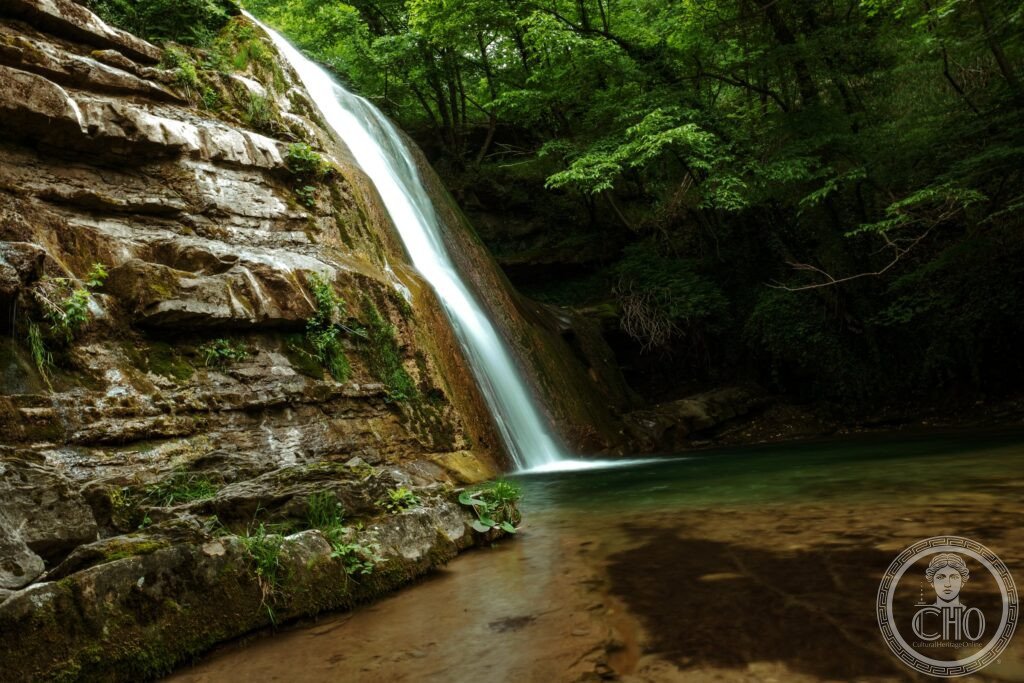
In the Tuscan-Romagnol Apennines, where the Montone drops from a ledge in a single white blade, a village has grown up around a Benedictine abbey. Little remains of the medieval monastery — the present church is of 1723, over a surviving crypt and tower — but the place has a disproportionate literary fame: Dante named the Acquacheta waterfall in the sixteenth canto of the Inferno, and tradition has it that the exiled poet stopped here.
At a glance
High in the Tuscan-Romagnol Apennines, where the upper Montone river drops over a cliff in a single white sheet, the village of San Benedetto in Alpe grew up around a Benedictine abbey. The medieval monastery is largely gone — the present church was rebuilt in 1723 over its crypt and a surviving defensive tower — but the place keeps a literary fame far larger than its size. Dante named the nearby Acquacheta waterfall in the sixteenth canto of the Inferno, and tradition holds that the exiled poet himself stopped at the abbey. The site sits inside the Foreste Casentinesi National Park, and the falls are one of its most popular walks.
Key facts
- Location: a frazione of Portico e San Benedetto (Forlì-Cesena, Emilia-Romagna), inside the Parco Nazionale delle Foreste Casentinesi
- Founded: Benedictine; tradition cites origins as early as 853, while the abbey took organised form in the first half of the 11th century, associated with St Romuald of Ravenna
- Peak: 11th–13th centuries, with lands reaching the territories of Forlì, Forlimpopoli, Faenza and Florence; in 1499 the abbey surrendered its remaining assets to Pope Alexander VI
- Surviving fabric: a Romanesque crypt, a defensive tower, an arched portal and stretches of wall; the present single-nave church was built in 1723
- Literary landmark: Dante’s Inferno XVI compares the infernal cascade to the Acquacheta “above San Benedetto”
History
Sources disagree on the abbey’s beginnings: local and tourism tradition cites a date as early as 853, while its effective, organised form belongs to the first half of the 11th century and is linked to St Romuald of Ravenna, founder of Camaldoli, who is said to have gathered earlier groups of hermits here. Within a century it was among the richest abbeys of the Tuscan-Romagnol Apennines, its holdings reaching the dioceses and valleys of Forlì, Forlimpopoli, Faenza and Florence.
Fortunes turned from the 14th century. In 1499 the abbot was forced to surrender the few remaining assets and privileges to Pope Alexander VI; later accounts report the Vallombrosans holding the house until 1529, when it was annexed to the college of San Lorenzo in Florence. The medieval abbey was largely demolished, and the present church — now the parish church, at the locality called Il Poggio — was built in 1723 in its place.
What you see
The 1723 church is a single nave with five 18th-century altars set against the walls; a barrel-vaulted space beside the presbytery is, according to the national heritage catalogue, the right arm of the transept of the far larger medieval church, which had three naves, a transept and a semicircular apse. The principal medieval survival is the Romanesque crypt beneath the presbytery, vaulted on masonry pillars of varying size. Outside, a defensive tower and an arched portal in exposed stone, with narrow loophole openings, recall the fortified character of the original abbey.
Dante and the Acquacheta
In Canto XVI of the Inferno, Dante and Virgil reach the roaring waterfall by which they descend to the Eighth Circle, and Dante reaches for a sound he knew from the Apennines:
… rimbomba là sovra San Benedetto
de l’Alpe per cadere ad una scesa
ove dovea per mille esser recetto…“Reverberates there above San Benedetto / From Alps, by falling at a single leap, / Where for a thousand there were room enough.” — trans. Henry Wadsworth Longfellow, 1867
Treccani’s Enciclopedia Dantesca identifies the Acquacheta as the upper course of the river Montone, which takes the name Montone lower down. The poetic reference is certain; the tradition that Dante lodged at the abbey around 1302, during his exile, is biographical tradition rather than documented fact. Boccaccio is also said to have paused here while writing his commentary on the Inferno, and the modern Cammino di Dante walking route passes through the valley.
Practical information
- Abbey church: the church of San Benedetto serves as the parish church of the village (locality Il Poggio)
- The waterfall: a marked footpath climbs from the village to the Cascata dell’Acquacheta, within the Foreste Casentinesi National Park; sturdy footwear is needed, and the falls are most powerful after rain or snowmelt
- Time needed: allow a half-day to combine the abbey church and the walk to the falls
Getting there
San Benedetto in Alpe lies on the SS67 Tosco-Romagnola, the road over the Passo del Muraglione between Forlì and Florence, about 40 km south-west of Forlì. GPS of the abbey: 43.9836° N, 11.6866° E; the Acquacheta waterfall: 43.9906° N, 11.6460° E.
Nearby
- Portico di Romagna — a medieval village on the SS67, traditionally linked to the family of Dante’s Beatrice Portinari
- San Godenzo — on the Tuscan side of the pass, the Romanesque abbey where Florentine exiles met in 1302
- Foreste Casentinesi National Park — ancient beech and fir forests, the Sanctuary of La Verna and the Camaldoli hermitage
Sources
- MiC — Catalogo generale dei beni culturali (ICCD), record for the abbey church
- Parco Nazionale delle Foreste Casentinesi — official site, “Il Poggio e l’abbazia di San Benedetto in Alpe”
- Treccani — Enciclopedia Dantesca, “Acquacheta” and “Montone”
- Travel Emilia Romagna / Romagna Toscana Turismo — abbey and history pages
- Dante Alighieri, Inferno, Canto XVI (English trans. H. W. Longfellow, 1867)
Find it on the map
See this place and what’s around it →📷 Become a Cultural Heritage Online photographer
Share your photos of places: they stay published under your name as the author. The more they're seen, the more you get noticed — and soon a contest will reward the most appreciated photos.
Log in or sign up free to add a photoIs this page about you?
This page is read by travellers and heritage enthusiasts who find it on Google. Tell us how you are connected to this place and we will take it from there.