
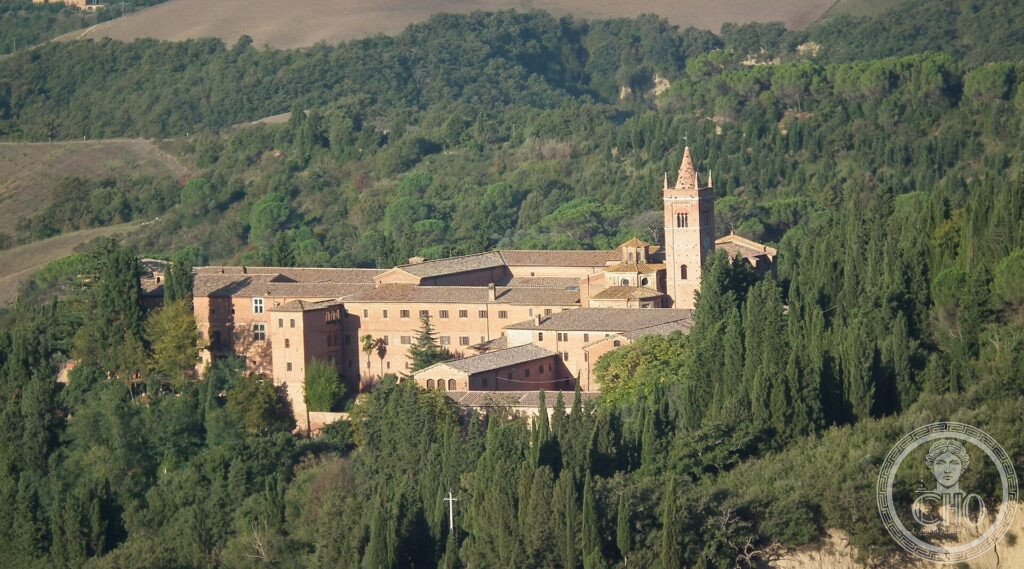
In the lunar desolation of the Crete Senesi, Bernardo Tolomei founded in 1319 an abbey that became the cradle of the Olivetan order and that housed, between 1497 and 1508, one of the colossal undertakings of Renaissance painting: 36 lunettes by Luca Signorelli and Giovanni Antonio Bazzi, known as Sodoma, showing the Life of Saint Benedict in the great cloister.
At a glance
Monte Oliveto Maggiore is the mother house of the Olivetan Congregation (a Benedictine order founded in the region of Siena), set in the dramatically eroded clay badlands known as the crete senesi, 36 km south-east of Siena near the town of Asciano. The abbey was founded in 1319 by Bernardo Tolomei (1272–1348), a Sienese nobleman who abandoned his legal career to live as a hermit on a rocky spur above the white clay gulches. Within thirty years the community had attracted dozens of followers and received papal recognition as a distinct congregation of the Benedictine family. The great cloister, built in the 15th century, is decorated with one of the most ambitious narrative fresco cycles of the Renaissance: 36 scenes from the Life of Saint Benedict painted by Luca Signorelli (1497–98) and Giovanni Antonio Bazzi called “Sodoma” (1505–08). The monastery is still inhabited by an Olivetan Benedictine community and open daily to visitors.
Key facts
- Founded: 1319 by Bernardo Tolomei, a Sienese patrician and future Saint (canonised 2009) who became a Benedictine hermit in the crete senesi
- Order: Olivetan Congregation of the Order of Saint Benedict; the “Olivetans” take their name from the olive groves of their first hermitage
- The frescoes: 36 lunettes in the great cloister (chiostro grande) — 9 by Luca Signorelli (1497–98), 27 by Sodoma (1505–08); subject: Life of Saint Benedict as narrated in Gregory the Great’s Dialogues; cycle continues in the refectory
- Signorelli’s panels: the first 9 scenes (painted first), characterised by strongly modelled figures and dramatic spatial compositions; Signorelli left Oliveto in 1498, possibly called to Orvieto to decorate the cathedral
- Sodoma’s panels: the remaining 27 scenes, more elegant and painterly, with a wider palette and more varied landscape settings; include a self-portrait of Sodoma with two badgers and a raven
- Inlaid choir: early-16th-century wooden choir stalls (Fra Giovanni da Verona) with remarkable intarsia (marquetry) work depicting architectural perspectives and still-lifes — among the finest in Tuscany
- Today: active Olivetan monastery; great cloister, church, and refectory open daily; pharmacy and wine cellars
History
Bernardo Tolomei’s foundation at Monte Oliveto was exceptional in the history of Italian monasticism in one important respect: it was founded by a member of the Sienese ruling class at the height of his city’s political and economic power, not as a retreat from failure but as a voluntary abandonment of success. Tolomei had been a distinguished jurist and member of the governing council of Siena; he lost his sight in 1313, recovered it (an event he interpreted as miraculous), and in 1319 retired to the clay badlands with two companions. The Olivetan Congregation received papal approval in 1344 from Clement VI; Bernardo Tolomei died nursing the sick during the Black Death of 1348 and was canonised by Pope Benedict XVI in 2009.
The great cloister frescoes were commissioned in the late 15th century, when Monte Oliveto had become the richest and most prestigious house of the Olivetan Congregation. Luca Signorelli of Cortona painted the first nine scenes between 1497 and 1498; the remaining twenty-seven were painted by Sodoma (Giovanni Antonio Bazzi, a Lombard artist based in Siena) between 1505 and 1508. The two cycles sit comfortably together — Signorelli’s more severe, Sodoma’s more lyrical — forming a coherent narrative whole that is one of the supreme achievements of Central Italian Renaissance painting outside Florence and Rome.
What you see
The approach to Monte Oliveto is one of the most dramatically staged in Tuscany: the road descends into the crete senesi — an alien landscape of white and grey clay gulches, almost entirely without vegetation, broken by dark cypresses — and arrives at a fortified brick gateway tower whose tympanum bears a majolica lunette of the Risen Christ by Luca della Robbia. Beyond the gate, a cypress-lined avenue leads to the abbey church. The great cloister is entered through the church: a large square court with round arches on simple piers, every wall surface covered with the Signorelli-Sodoma frescoes in the lunette fields above the arcade. The colours are still remarkably fresh: the ochres, blues and greens of the Umbro-Sienese palette, the white of the chalk badlands visible through the painted landscape windows.
The church interior is relatively restrained — a single nave with side chapels, the notable feature being the intarsia choir stalls of the early 16th century (c. 1503-05) by Fra Giovanni da Verona. The marquetry panels include one of the earliest representations of the trompe l’oeil open cabinet — a cupboard door apparently ajar, showing musical instruments, books, and a cage with a partially open door — that influenced woodworkers and painters across northern Italy for a century.
Practical information
- Opening hours: daily 09:15–12:00 and 15:15–17:45 (winter); 09:15–12:00 and 15:15–18:15 (summer)
- Admission: free for the great cloister and church; donation appreciated
- Guided tours: available (book in advance during summer); the cloister can be self-guided
- Shop: the Olivetan pharmacy sells herbal preparations, liqueurs and honeys produced by the community
- Time needed: 1.5–2 hours for the cloister, church and intarsia choir
Getting there
By car from Siena (36 km south-east): SS326 to Asciano, then signs to Monte Oliveto Maggiore; the last 3 km are on a winding road through the crete senesi. By bus from Siena (Tiemme, to Asciano + local taxi or hired car — no direct bus to the abbey). GPS: 43.1644° N, 11.5081° E.
Nearby
- Siena — the great Gothic city and Palio town, 36 km north-west; Museo dell’Opera del Duomo
- Asciano — the main town of the crete senesi; Museo Cassioli with Sienese primitives, 8 km north
- Pienza — the ideal Renaissance city of Pius II, 35 km south; Pecorino cheese country
Sources
- Wikipedia — “Abbey of Monte Oliveto Maggiore” (en.wikipedia.org/wiki/Monte_Oliveto_Maggiore)
- Bruce Cole, Sienese Painting from its Origins to the Fifteenth Century, Harper & Row, 1980
- Olivetan Congregation — official website (olivetani.it)
- Magnolia Scudieri, Il Chiostro Grande di Monte Oliveto, Sillabe, 2006
Find it on the map
See this place and what’s around it →📷 Become a Cultural Heritage Online photographer
Share your photos of places: they stay published under your name as the author. The more they're seen, the more you get noticed — and soon a contest will reward the most appreciated photos.
Log in or sign up free to add a photoIs this page about you?
This page is read by travellers and heritage enthusiasts who find it on Google. Tell us how you are connected to this place and we will take it from there.