

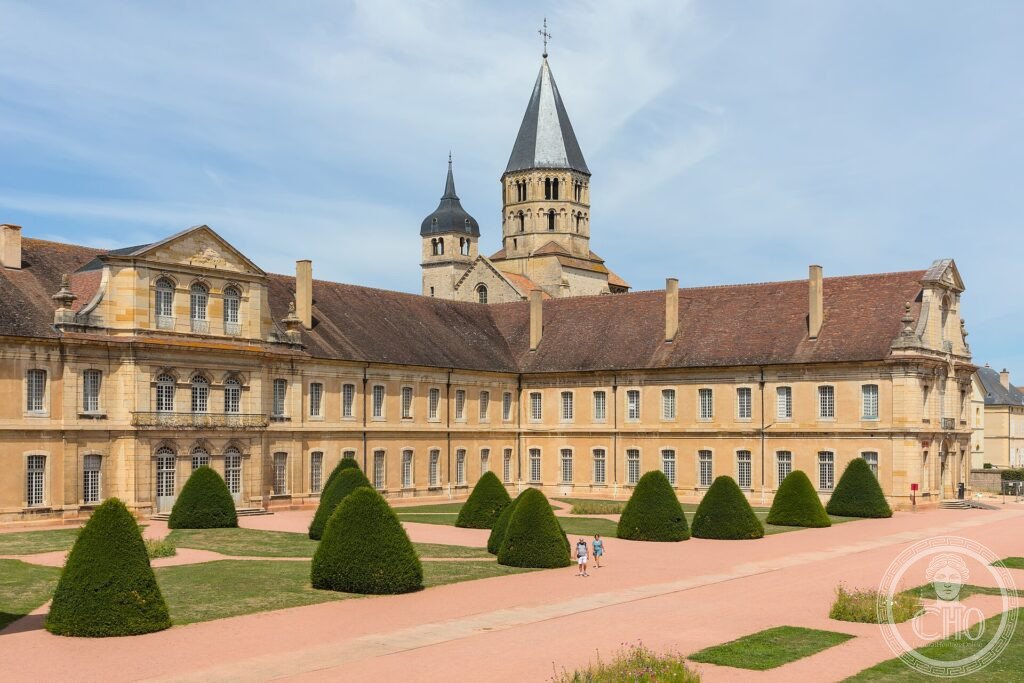
For six centuries Cluny was the heart of the monastic West: twelve hundred daughter monasteries, ten thousand monks, a church — the «Maior ecclesia» — larger than St Peter’s until the sixteenth century. Then the Revolution sold it off as a stone quarry: of that giant only one arm of the transept remains today, but it is enough to make your head spin.
At a glance
The Abbey of Cluny, in southern Burgundy, was for six centuries the most powerful monastery in the Western Church. Founded in 910 by Duke William the Pious of Aquitaine and freed from all lay and episcopal control, it became the head of a vast reform movement — the Cluniac order — that at its height counted around 1,200 dependent houses and some 10,000 monks across Europe. Its third abbey church, the “Maior ecclesia” begun in 1088, was the largest church in Christendom until the rebuilding of St Peter’s in Rome. Sold and demolished as a quarry after the Revolution, Cluny survives only in fragments — but they are enough to convey the scale of what was lost.
Key facts
- Founded: 910 by Duke William I “the Pious” of Aquitaine, who placed the abbey under the Pope alone — free of lay and bishops’ control, a revolutionary independence
- The Cluniac order: the leader of Western monasticism, ~1,200 priories and ~10,000 monks at its peak, all subject to the Abbot of Cluny; great abbots Odo, Odilo, Hugh of Semur and Peter the Venerable
- Cluny III: the third abbey church, begun in 1088 under Abbot Hugh of Semur — about 187 m long with vaults some 30 m high, the largest church in Christendom until the new St Peter’s (16th c.)
- Destruction: suppressed in the Revolution (1790); sold as a stone quarry from 1798 and largely demolished by 1810 — only about a tenth survives
- What remains: the south arm of the great transept with its octagonal tower (the Clocher de l’Eau Bénite), parts of the monastic buildings, and the abbey’s sculpture in the town museum
- Note: Cluny is a French monument historique (not a UNESCO World Heritage site), managed by the Centre des monuments nationaux
History
Cluny’s founding charter of 910 was a turning point: by surrendering his rights and placing the abbey directly under the papacy, Duke William freed it from the local nobility whose meddling had corrupted so many monasteries. Under a remarkable line of long-lived abbots, Cluny became the engine of monastic reform, its observance and liturgy copied across Europe and its abbots advisers to popes and kings. The order’s wealth and the genius of Abbot Hugh produced, from 1088, the colossal third church — the largest building most medieval people would ever see.
Cluny’s influence waned as new orders (the Cistercians above all) answered a hunger for simplicity its grandeur could not. The commendam system drained it; the Revolution dissolved it in 1790, and from 1798 the great church was sold off and quarried for stone, its library scattered and its archives burned. By 1810 the Maior ecclesia was all but gone.
What you see
What survives is a fragment that still astonishes: the south transept of Cluny III, rising to the octagonal belfry called the Clocher de l’Eau Bénite, lets you read the original 30-metre height of the lost nave. Markers on the ground trace the footprint of the vanished church, so vast that the modern town sits partly within it. The abbey buildings (an 18th-century reconstruction) now house an engineering school, while the Musée d’art et d’archéologie, in the former abbot’s palace, keeps the carved capitals of the choir — among the masterpieces of Romanesque sculpture — and the relief of the great portal.
The “Farinier” (the medieval granary) and the surviving Romanesque houses of the town complete the picture of the place that was, for a time, the capital of monastic Europe.
Practical information
- Visiting: the abbey site and the Musée d’art et d’archéologie are run by the Centre des monuments nationaux (ticketed); a 3D reconstruction helps imagine the lost church
- Time needed: 1.5 hours for the abbey, museum and town
Getting there
Cluny is in the Saône-et-Loire, in the Mâconnais hills of southern Burgundy. By train via Mâcon (TGV from Paris) then bus, or via the station at Cluny on the regional line; by car off the A6. GPS: 46.4347° N, 4.6585° E.
Nearby
- Tournus — the great Romanesque abbey church of Saint-Philibert, 30 km east
- Berzé-la-Ville — the “Chapelle des Moines” with Cluniac frescoes, a few km away
- Roche de Solutré & Mâcon — the famous rock and the vineyards of the Mâconnais and Beaujolais
Sources
- Centre des monuments nationaux — Abbaye de Cluny (cluny-abbaye.fr)
- Encyclopaedia Britannica — Cluny / Cluniac order
- Burgundy Tourism — Abbaye de Cluny
Find it on the map
See this place and what’s around it →📷 Become a Cultural Heritage Online photographer
Share your photos of places: they stay published under your name as the author. The more they're seen, the more you get noticed — and soon a contest will reward the most appreciated photos.
Log in or sign up free to add a photoIs this page about you?
This page is read by travellers and heritage enthusiasts who find it on Google. Tell us how you are connected to this place and we will take it from there.