
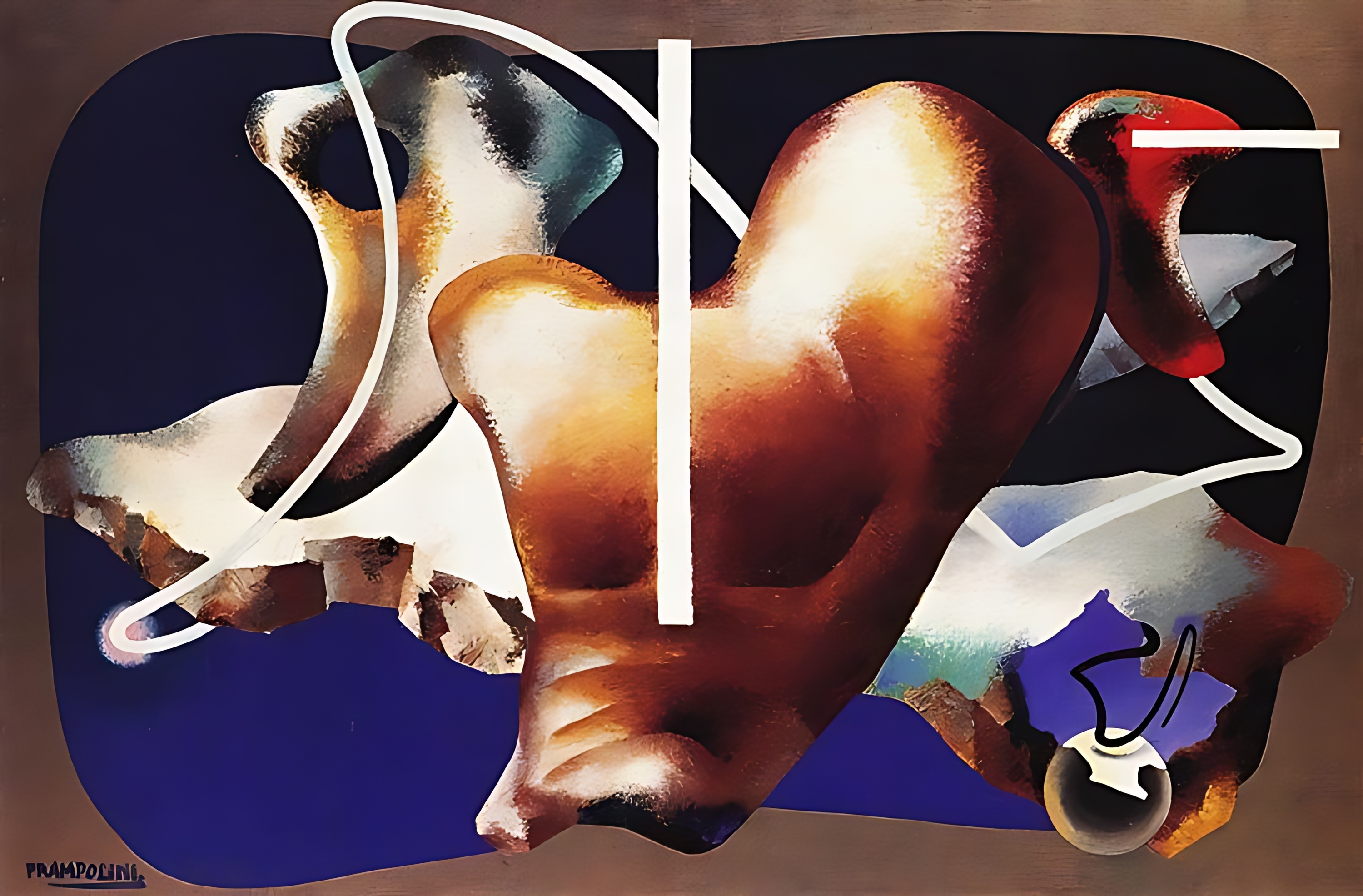
Superamento terrestre is a 1932 painting by Enrico Prampolini, the Italian Futurist painter, sculptor and scenographer. The work dates to the period when Prampolini had adopted cosmic idealism, a biomorphic abstractionism that marked a decisive shift from his earlier decades of experimentation with spatial construction and landscape representation.
By the early 1930s, Prampolini’s artistic programme had moved decisively toward abstract and quasi-abstract expression. Having trained under Duilio Cambellotti at the Academy of Fine Arts in Rome, he emerged as a leading figure in the Futurist movement, pursuing parallel careers in painting, stage design and architecture. Superamento terrestre exemplifies this mature phase of his work, when biomorphic forms and cosmic themes displaced the figural landscapes and bold-coloured compositions of previous years.
About Enrico Prampolini
Prampolini (1894–1956) was a central figure in Italian Futurism who combined abstract painting with an active career in scenography. His artistic trajectory moved from Spatial-Landscape Construction (1919) through total abstraction in Simultaneous Landscape (1922), before returning to figuration in works such as Umbrian Landscape (1929). By 1931 he had embraced cosmic idealism, a biomorphic abstraction evident in works including Pilot of the Infinite (1931). Prampolini also participated in the design of the Exhibition of the Fascist Revolution and was active in Aeropainting.
Details
- Creator: Enrico Prampolini
- Year: 1932
- Medium: Painting
- Movement: Futurism, cosmic idealism
- Period: Italian interwar abstraction
Frequently asked questions
Who was Enrico Prampolini?
Prampolini (1894–1956) was an Italian Futurist painter, sculptor and scenographer trained at the Academy of Fine Arts in Rome under Duilio Cambellotti. He became a leading member of the Futurist movement and was active in Aeropainting and stage design.
What artistic movement does Superamento terrestre belong to?
The work belongs to Italian Futurism and reflects Prampolini’s adoption of cosmic idealism, a biomorphic abstraction he developed in the early 1930s, distinct from his earlier experiments with spatial construction and figural landscape.
What was cosmic idealism?
Cosmic idealism was a biomorphic abstraction approach that Prampolini adopted by 1931, representing a stylistic departure from his previous work; examples include Pilot of the Infinite (1931) and Biological Apparition (1940).