No architect left a deeper mark on the public face of interwar Italy than Marcello Piacentini. A university city, a courthouse in Milan, monuments, churches and the plan of an entire new district south of Rome passed through his studio between the wars. Cultural Heritage Online keeps many of these buildings in its archive. This is the life that connects them.
His father’s Rome
Piacentini was born in Rome on 8 December 1881, the son of Teresa Stefani and Pio Piacentini — the architect of the Palazzo delle Esposizioni on Via Nazionale (1880–83). The younger Piacentini grew up inside the profession. He took a classical diploma at the Liceo Tasso in 1900, followed evening courses at the Museo Artistico Industriale, and completed his degree at Rome’s school of application for engineers in 1912 — two years after designing the Italian pavilion for the Brussels International Exposition of 1910. He was still in his twenties.
Plans, journals, chairs
His career advanced on three fronts at once. As a planner he drew schemes for Bergamo and Brescia. As a builder he worked on the Banca d’Italia block on Piazza del Parlamento in Rome (1914–23). As an organiser of the profession he founded the journal Architettura e arti decorative with Gustavo Giovannoni in 1921, and directed its successor, Architettura, from 1932 to 1943. Teaching followed the same curve: a course on city building at Rome’s new school of architecture in 1920, then a chair of urban planning from 1929. He was a member of the Accademia di San Luca from 1920 and of the Accademia d’Italia from 1929 to 1944.
The state commissions
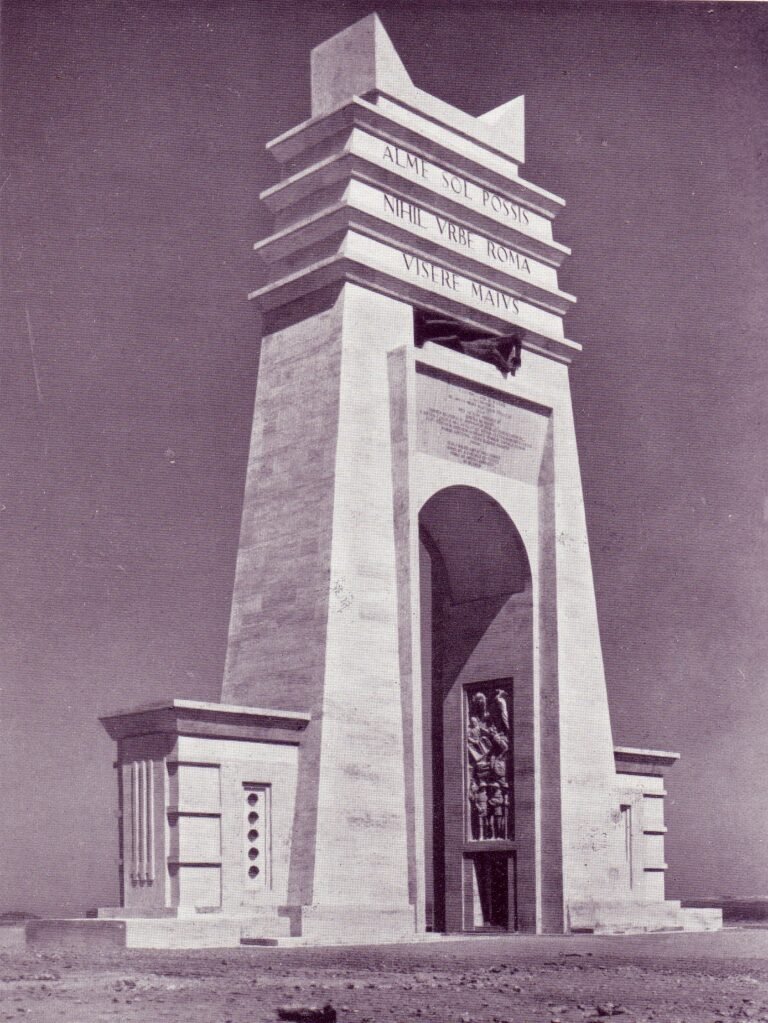
From the mid-1920s Piacentini became the architect to whom the Italian state turned for its largest works. The Monumento alla Vittoria in Bolzano, designed in 1926 and inaugurated in 1928, set the pattern: a classical triumphal form reduced to bare masses, raised as a political statement in a border city annexed only a few years earlier. The church of Cristo Re on Viale Mazzini in Rome (1931–34), the Arch of Victory in Genoa (1931) and the Casa Madre dei Mutilati, the Rome headquarters he built for the association of war-disabled veterans, followed within the decade.
Two commissions dwarfed the rest. In Milan he designed the Palazzo di Giustizia (1931–41, with Ernesto Rapisardi), a courthouse conceived at the scale of a city block. In Rome he was handed the general plan of the Città Universitaria, where he coordinated a team of younger architects — several of them Rationalists whose language he did not share — and delivered the campus in roughly three years, between 1932 and 1935. Critics then and since have described his manner as a rhetorical monumentality suspended between modern architecture and classicism. He never argued the label away; he kept building.
E42 and São Paulo
At the end of the 1930s the regime handed him its most ambitious project: the planning of E42, the universal exposition district south of Rome now known as EUR, which occupied him from 1937 to 1943 and was interrupted by the war. In the same years his hand reached across the Atlantic: in São Paulo he reworked the design of the Matarazzo skyscraper (1937–39).
1943 and after
The fall of the regime tested him. In 1943 Piacentini refused pressure to join the Italian Social Republic; he was arrested, and released after the Vatican intervened through Giovanni Battista Montini, the future Paul VI. After the war he faced purge proceedings at the university. His work did not stop. Via della Conciliazione, the new avenue leading to St Peter’s, was completed by 1950, and his last major building, the Palazzo dello Sport at EUR, designed with the engineer Pier Luigi Nervi, was finished in 1960 — the year Rome hosted the Olympic Games. Piacentini died in Rome on 18 May 1960.
His papers — the records of six decades of practice, from 1903 to 1960 — are held today in the architecture library of the University of Florence. The buildings remain in use: students cross his university city every morning, judges sit in his Milan courthouse, and the Bolzano monument now houses a permanent documentation exhibition on the monument and its era. Few bodies of work pose the question of architecture’s relationship to power so directly. None in Italy poses it at this scale.
In the archive
Follow Marcello Piacentini across Cultural Heritage Online — the buildings he designed, the city context and the anniversaries we mark:
- Città Universitaria, Rome — the campus he planned and delivered in three years (1932–35), with Arturo Martini’s Minerva at its heart.
- Palazzo di Giustizia, Milan — the monumental courthouse of 1931–41.
- Monumento alla Vittoria, Bolzano — the contested 1928 monument, today home to a permanent documentation exhibition.
- Arch of Victory, Genoa — the 1931 arch commemorating Genoese soldiers of the Great War.
- Basilica of Christ the King, Rome — the Viale Mazzini church of 1931–34.
- Casa Madre dei Mutilati, Rome — the headquarters he built for the war-disabled veterans’ association.
- Palazzo Piacentini, Reggio Calabria — the National Archaeological Museum of Magna Graecia.
- Rome — Liberty Romano, EUR and Italian Rationalism — the city context, from the Coppedè quarter to E42.
- 8 December 1881 — the birth of Marcello Piacentini, in the CHO anniversary calendar.
- 18 May 1960 — the death of Marcello Piacentini.
Sources
- S1 — Lupo, Mario. Marcello Piacentini. Editori Laterza, 2004. ISBN 978-88-420-7264-5.
- S2 — De Guttry, Irene, e Maria Paola Maino. Architettura e arti applicate a Roma 1915–1940. Palombi, 2001. ISBN 978-88-7621-197-3.
Spotted an error? Write to editorial@culturalheritageonline.com and we correct it the same day.