

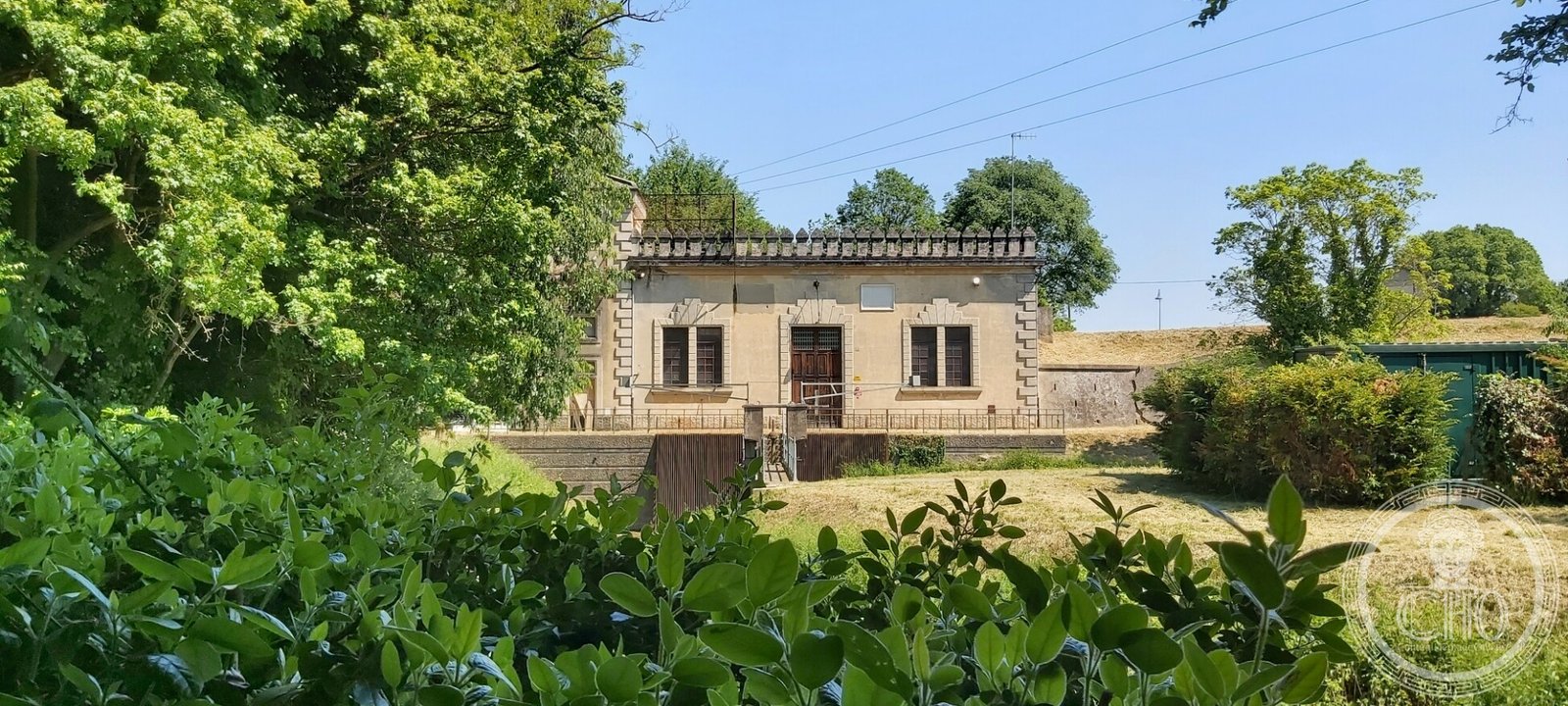
A machine house with battlements. Below the Euganean Hills the fields lie lower than the canals that cross them, and this small building is the reason they are dry: it lifts the water of a whole basin up and over, into a channel running seven metres above the land it drains.
At a glance
Battaglia Terme sits in one of the strangest pieces of hydraulic landscape in Italy. Its twelfth-century canal, dug to link Padua with Monselice, runs on an embankment above the surrounding countryside; the fields on either side are lower still, and some are below the level of the sea. Water cannot leave them by gravity, so it is pumped. The pumping station of the Palù Catajo consortium, built in 1928 near the Catajo castle, is one of the machines that does it, and its designers gave the job a small fortified palace to live in.
Key facts
- Built: 1928, in the mechanical phase of the consortium’s reclamation works
- Designed by: the technical office of the reclamation consortium — engineers, not architects
- Consortium: Paludi Cattajo e Savellon di Bagnarolo, constituted by decree of 25 December 1808
- What it does: lifts the drainage water of the consortium’s basin into the Vigenzone
- Where the water goes: the ponte-canale del Pigozzo near the Catajo castle, where the Rialto collector passes under the Battaglia canal — about seven metres of difference in level
- Today: part of the Consorzio di bonifica Adige Euganeo, formed in 2009
History
The consortium is old: the Paludi Cattajo were constituted as a body in December 1808, under the water and roads administration of Napoleonic Padua, and the marsh they were named after had been fought over for centuries before that. What changed in the twentieth century was the method. Systematic reclamation of the district began in 1926 with works in the Vallata Catajo basin; between 1928 and 1929 the lowest, wettest parts were taken on by machine, because no arrangement of ditches could drain ground that lies beneath its own outfall. Pumping stations went up in those two years, this one among them.
The hydraulic knot they were built to untie is at the ponte-canale del Pigozzo, beside the Catajo castle: there the Rialto collector runs beneath the Battaglia canal, with roughly seven metres between the two water levels, and the drainage water of the consortium is lifted to join what the other consortia send down. It is a junction that has to work every day, in a landscape where, as the local histories put it plainly, the channels run higher than the farmland.
The consortium itself was absorbed into the Consorzio di bonifica Adige Bacchiglione after the regional reform of 1976, and since 2009 belongs to the Consorzio di bonifica Adige Euganeo. The building is still in service.
What you see
A single-storey block, longer than it is tall, standing on a stone platform above the water. The corners are quoined in heavy rusticated blocks, and the same rustication frames the doorway and the two big grated windows on either side; a moulded cornice runs along the top, and above it — entirely without function — a parapet of small square merlons. Over each opening sits a flat fan of stepped stone strips, the one clearly modern touch in an otherwise castle-like elevation: a piece of nineteen-twenties Deco stuck onto a fortress.
The machinery is behind the door, and the water works are in front of it: a concrete apron, a sluice with its screw gear, the channel walled in stone. From the canal side the building is seen across the sluice, framed by plane trees, with a metal stair climbing the embankment behind — the everyday scale of the thing, which is that of a lock-keeper’s house rather than a monument.
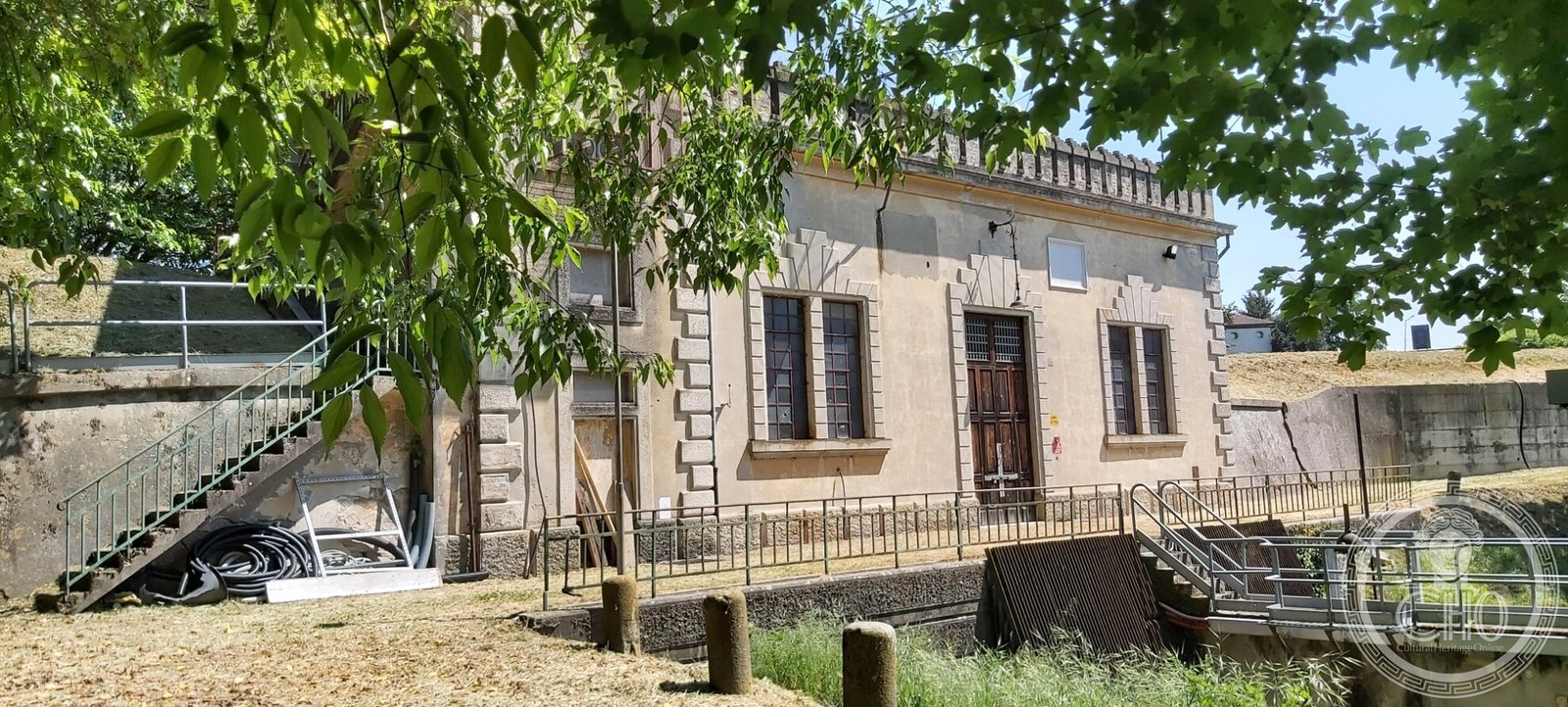
It is worth saying why a pump house was built to look like this at all. Land reclamation in these years was a national programme with a public face, and its buildings were expected to be seen and understood as monuments to the work. The merlons are propaganda. They are also, ninety years on, the reason a working machine shed is worth stopping for.
Practical information
- An operational plant of the reclamation consortium: it is seen from the public path and the canal bank, not entered.
- The embankment walk along the Battaglia canal, between the town and the Catajo castle, is the natural approach.
- Allow 10 minutes here; the Catajo castle and the Museo della Navigazione Fluviale in Battaglia Terme make the half-day.
Getting there
Battaglia Terme is about twenty kilometres south of Padua, on the eastern edge of the Euganean Hills, and has its own station on the Padua–Bologna line. The pumping station stands on the consortium’s channel between the town and the Catajo castle. Approximate GPS: 45.2953, 11.7847 — open in Google Maps. The position is taken from the contributor’s own map reference and should be treated as accurate to within a few hundred metres along the channel.
Nearby
- Castello del Catajo, a few minutes north along the canal — the sixteenth-century Obizzi palace the consortium is named after.
- Wouda pumping station, Netherlands — the same problem, solved on a monumental scale and inscribed by UNESCO.
Sources
- Consorzio di bonifica Adige Euganeo — Storia: the constitution of the Paludi Cattajo consortium on 25 December 1808, the start of systematic reclamation in 1926 in the Vallata Catajo basin, the mechanical drainage of the lower basins in 1928–29, and the mergers of 1976 and 2009.
- Battaglia Terme Storia — Battaglia, problemi idraulici e navigazione: the consortium’s pumping station at the ponte-canale del Pigozzo near the Catajo castle, the lift into the Vigenzone, the Rialto collector passing under the Battaglia canal with about seven metres of difference in level, and the twelfth-century canal itself.
- The description of the building was made from the contributor’s photographs; the 1928 date is his, and matches the consortium’s own account of the 1928–29 mechanical works.
Find it on the map
See this place and what’s around it →Record researched and written by Stefano Vigolo for Cultural Heritage Online, 2026.
📷 Become a Cultural Heritage Online photographer
Share your photos of places: they stay published under your name as the author. The more they're seen, the more you get noticed — and soon a contest will reward the most appreciated photos.
Log in or sign up free to add a photoRequest to use these images
Each photograph is by the person named on it. Cultural Heritage Online is the seller: it runs the payment, handles tax and delivers the file, and the photographer receives 70% of the price net of tax. Buying gives you the right to use the image in your own project — a website, an article, a presentation — with the file and a written licence. Read the Terms of Sale.
What you receive. The file as it is held in our archive: the photographer's own original, without the Cultural Heritage Online watermark, unretouched and not enlarged. This is a working archive built over many years by many people, so the files differ — some were taken recently, others years ago with the equipment of their time. Older pictures are usually smaller: a camera from fifteen or twenty years ago simply recorded fewer pixels than a phone does today, so the resolution is lower and the print comes out smaller. We say so rather than hide it. The size, weight, format and year of each one are printed below it, and the print size is given at 300 dpi. Nothing is upscaled to make a number look better. Where the picture on this page has been cropped for the layout, the file you receive is the full frame, which may be wider or taller than what you see here.
battaglia-terme-idrovora-palu-catajo
Photo: Stefano Vigolo
€3.00
1946 × 876 px · JPG · 1,016.1 KB
prints 16 × 7 cm at 300 dpi · taken 2026
Is this page about you?
This page is read by travellers and heritage enthusiasts who find it on Google. Tell us how you are connected to this place and we will take it from there.