
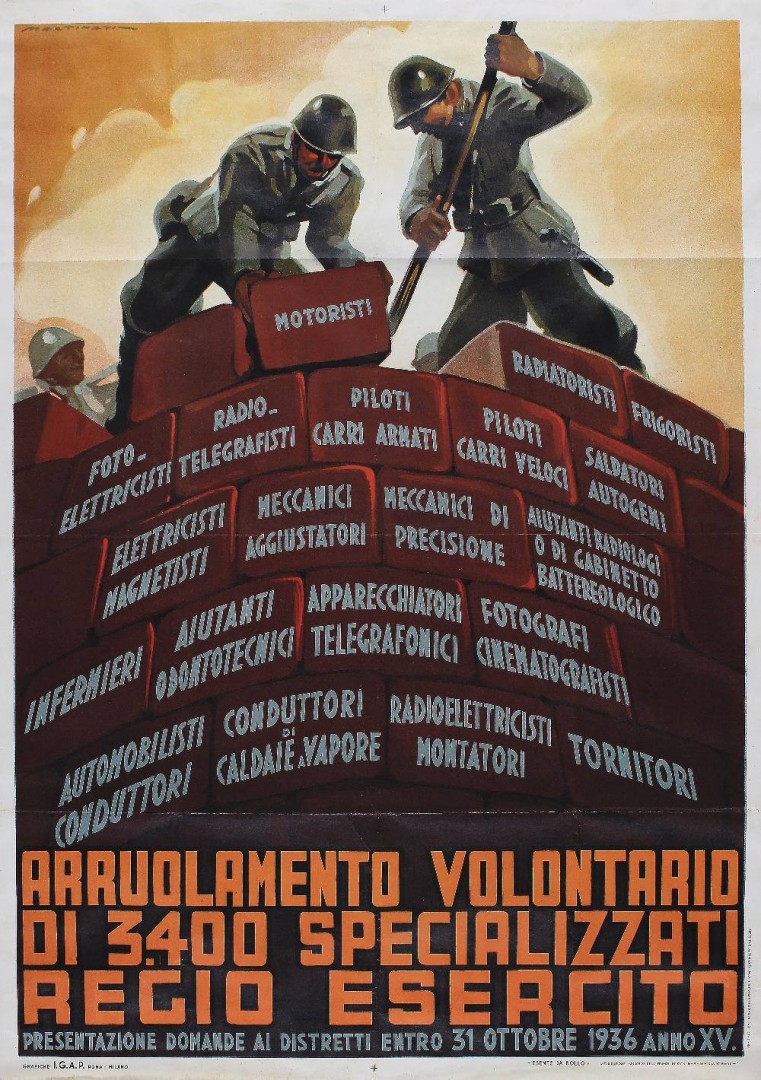
This manifesto dates from 1936 and was created by Luigi Martinati, a Florentine-born illustrator, advertising designer and painter active in Rome.
Martinati enjoyed a prolific career in graphic and commercial art across three decades. After studying at the Academy of Fine Arts in Florence, he moved to Rome in 1911 and apprenticed under the poster painter Federico Ballester. From 1923 onwards, he designed posters across commercial, tourist, political and celebratory themes. By the 1930s, he had relocated to his studio at Via Emanuele Filiberto 190 in Rome, where he worked alongside fellow designer Tito Corbella. The neighbouring A.P.E. printing house in Viale Castrense produced most of his work during this period. Martinati became director of IGAP, one of Rome’s principal advertising agencies, and collaborated with major film studios including Warner Brothers.
About Luigi Martinati
Martinati (Florence, 1893–Rome, 1983) was a central figure in Italian commercial and cinematic illustration. His long career spanned from the 1910s through the 1980s, establishing him as a key designer of Italy’s visual culture during the interwar and postwar periods.
Details
- Creator: Luigi Martinati
- Year: 1936
- Medium: Poster
- City: Rome
Frequently asked questions
Who was Luigi Martinati?
Luigi Martinati was an Italian illustrator, poster designer and painter born in Florence in 1893. He moved to Rome in 1911 and became a leading figure in advertising and commercial art, designing posters from 1923 to 1941 and directing the major advertising agency IGAP.
What kind of posters did Martinati design?
Between 1923 and 1941, Martinati created posters across diverse subjects and themes: commercial advertisements, tourist signage, political propaganda materials and promotional designs for major events and film companies.
Where did Martinati work?
By the 1930s, Martinati operated from his studio at Via Emanuele Filiberto 190 in Rome, which he shared with designer Tito Corbella. Most of his work was printed by the neighbouring A.P.E. printing house.
