
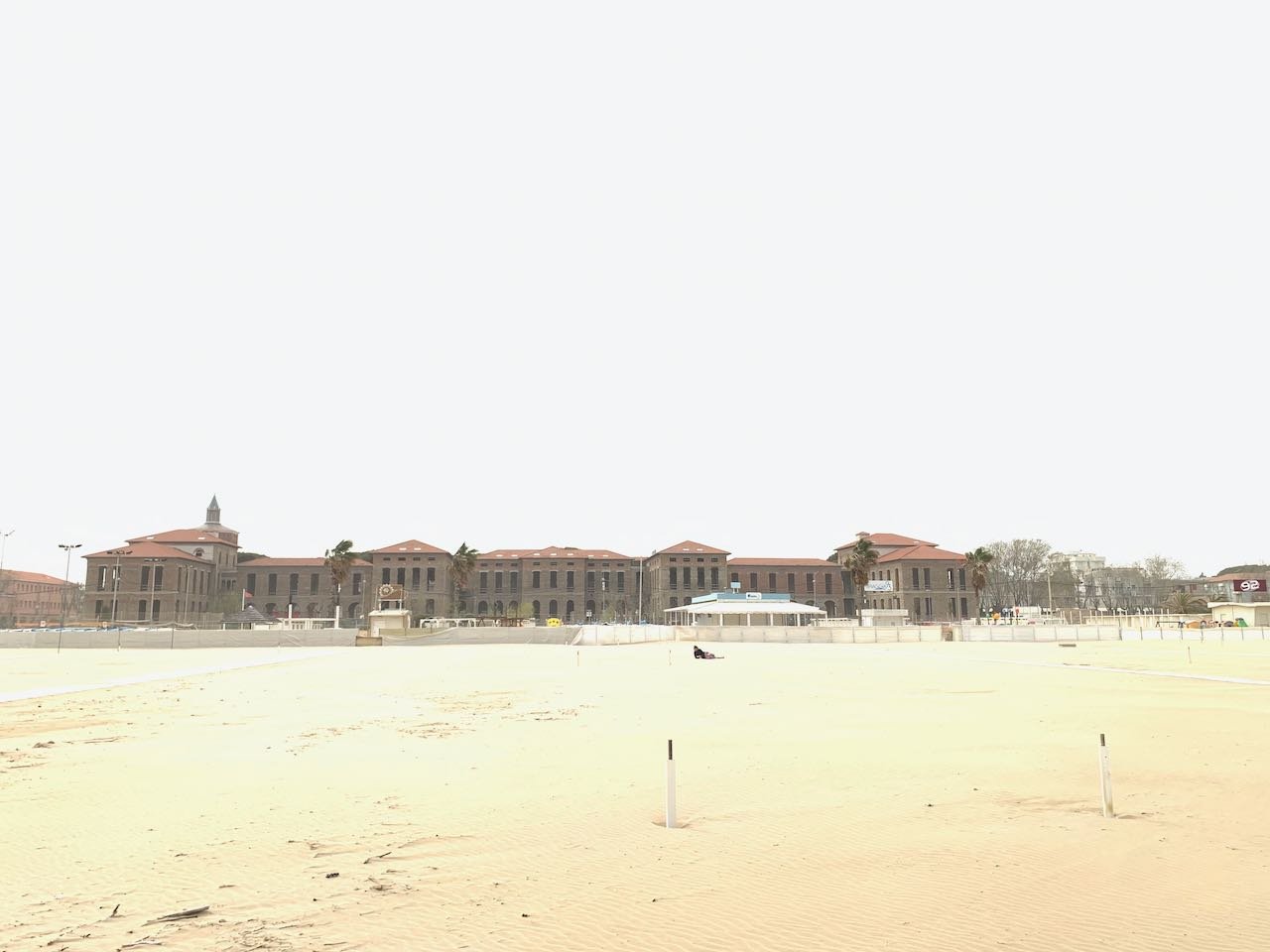
A children’s marine hospice from 1912 that read as a hospital and pointed, decades early, toward the rationalist coast Romagna would become.
At a glance
On Viale Regina Margherita, where the Bellariva shoreline opens to the Adriatic, the long pavilions of the ex Colonia Murri still stand empty. Built in 1912 as the Ospizio Marino Bolognese, it was commissioned by the Opere Pie of Bologna and Imola to treat the tuberculosis that ran through Italy’s young at the turn of the century. The sea air was the cure; the building was the instrument. Today it survives as a roofless testimony to the moment medicine, hygiene and architecture first thought as one.
Key facts
- Built: 1912, on a project by engineer Giulio Marcovigi
- Original name: Ospizio Marino Bolognese
- Commissioned by: Opere Pie di Bologna e Imola
- Purpose: marine hospice for child tuberculosis prevention
- Structure: transverse pavilions joined by a central spine
- Protection: listed by Ministerial Decree, 6 May 1994
- Condition: very poor — recovery begun, left incomplete
History
The colony belongs to a campaign that swept the Romagna coast between the 1880s and the early 1900s. Cities inland funded seaside hospices where pale, undernourished children could be sent for sun, salt and supervised rest. Bologna’s charitable institutions chose Rimini, and in 1912 Marcovigi delivered a building that was studied well beyond the province.
By 1920 the national specialist press held it up as an exemplary case of modern hospital technique, praised for both its plan and its services. The praise was technical, not decorative: this was a machine for health before the phrase existed.
War damage and decades of abandonment then did their work. A restoration was planned that would rebuild the lost parts and add new volumes on the grounds. It stalled. What remains is the carcass of the original ambition.
What you see
The plan is legible from the street: transverse pavilions strung along a central connecting body, arranged so that light and air could reach every ward. The lateral walls are brick, but the spine pillars and the floor slabs use reinforced concrete — among the first applications of the material in Rimini, and the detail that places the building at the edge of a new structural age.
The technical apparatus was the point. Double external walls enclosed an insulating air gap; dedicated ducts drove natural ventilation through the rooms; radiators ran on accelerated circulation; a lifting system carried potable water through the complex. Stand close to the empty window openings and the logic still reads — a building designed to breathe.
Practical information
- Access: the complex is abandoned and unsafe — view from Viale Regina Margherita and the seafront only.
- Best light: late afternoon, when the sun comes off the sea behind the pavilions.
- Time needed: 15–20 minutes as a stop on the Bellariva seafront walk.
- Do not enter: the structure is in very poor condition and legally protected.
Getting there
The site sits on Viale Regina Margherita in the Bellariva district, a few kilometres south of Rimini’s centre along the coast road. Rimini’s railway station and Federico Fellini airport are both within a short drive, and the seafront bus lines run past the colony in season. On foot or by bike, it is an easy detour from the Lungomare.
Nearby
- Romagna Colonie Marine Coast Route — the curated driving itinerary with map and GPX
- Colonie Marine, 1912–1939: Nine Seaside Colonies of the Romagna Coast — by Stefano Vigolo
- The marine colonies of the Romagna coast — Rimini, Riccione, Cesenatico, Cervia — a rationalist itinerary in the making.
- Rimini seafront (Lungomare) and the Bellariva bathing district.
Sources
- Ministero della Cultura — DGABAP, Beni culturali abbandonati: Ex Colonia Murri (beniabbandonati.cultura.gov.it).
- Ministerial protection decree, D.M. 6 May 1994.
- Coordinates cross-checked against OpenStreetMap (44.0465, 12.6041).
Find it on the map
See this place and what’s around it →Record researched and written by Stefano Vigolo for Cultural Heritage Online, 2026.


📷 Become a Cultural Heritage Online photographer
Share your photos of places: they stay published under your name as the author. The more they're seen, the more you get noticed — and soon a contest will reward the most appreciated photos.
Log in or sign up free to add a photoIs this page about you?
This page is read by travellers and heritage enthusiasts who find it on Google. Tell us how you are connected to this place and we will take it from there.