
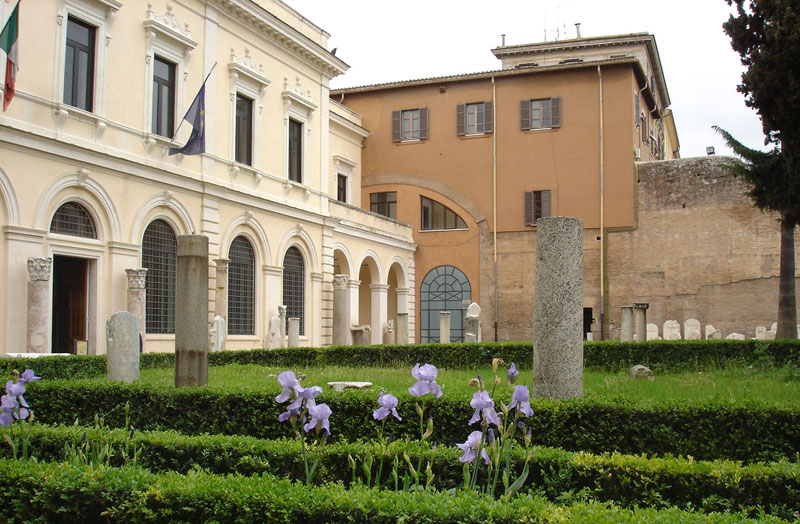
An archaeological museum housing collections from ancient Rome, spread across four distinct venues including the baths of Diocletian and Renaissance palaces in the heart of the city.
At a glance
The National Roman Museum preserves antiquities spanning from the fifth century BC to the third century AD. Its collections are displayed across four locations: the Baths of Diocletian, Palazzo Massimo, Palazzo Altemps, and Crypta Balbi. This distributed model offers visitors a unique perspective on Roman material culture within historically significant buildings.
History
Founded in 1889 and inaugurated in 1890, the museum was created to unite antiquities dispersed across Rome. Collections from the Kircherian Museum and newly discovered artifacts from the city’s urban transformations during Italy’s emergence as a unified nation were consolidated here.
The museum’s permanent home was established in the large cloister of the convent of the Basilica of Santa Maria degli Angeli e dei Martiri, built within the ancient Baths of Diocletian beginning in the sixteenth century. In 1901, the state acquired the Villa Ludovisi collection of ancient sculptures, a major addition that prompted rehabilitation of the thermal baths for the 1911 International Exhibition. Exhibition work continued through the 1930s.
A landmark 1981 special law for Roman antiquities financed a new reorganization and enabled the purchase of Palazzo Massimo and Palazzo Altemps. This led to a radical transformation in the 1990s that distributed collections across the four venues still in use today.
What you see
Visitors encounter Roman artifacts within extraordinary architectural settings. The Baths of Diocletian themselves constitute one of the largest and best-preserved imperial bath complexes. The Renaissance convent cloister housing early collections demonstrates the sixteenth-century transformation of ancient Roman structures.
Palazzo Massimo and Palazzo Altemps showcase Renaissance architecture while displaying sculptures, mosaics, and objects from the Villa Ludovisi acquisition. Crypta Balbi occupies a medieval structure built above a Roman theater complex, offering insight into Rome’s architectural layers.
Cultural significance
The museum’s multi-venue organization reflects modern curatorial practice while celebrating Rome’s continuous inhabitation and transformation. By placing Roman antiquities within post-ancient buildings—including a Renaissance convent and palaces—the display emphasizes how successive cultures have reused and reimagined ancient structures.
The collections document daily life, religion, governance, and artistic achievement across centuries of Roman civilization, providing essential evidence for understanding the ancient world.
Key facts
- Address: Viale Enrico de Nicola, 76, 00185 Roma
- Coordinates: 41.90367844780493, 12.498675584793089
- Phone: 06 3996 7700
- Official website: https://www.museonazionaleromano.beniculturali.it/it/143/il-museo
- Four exhibition venues: Baths of Diocletian, Palazzo Massimo, Palazzo Altemps, Crypta Balbi
Practical information
The museum is organized across four separate locations throughout Rome. Opening hours, admission fees, and current exhibitions vary by venue and season; consult the official website for details specific to each location you plan to visit.
Getting there
The main address (Baths of Diocletian location) is accessible by public transport in central Rome. The museum’s four venues are distributed across the city; plan your route based on which sites you wish to visit. The official website provides directions and transport information for each location.
See the place
Sources & resources
Find it on the map
See this place and what’s around it →Historical events at this place (2)
📷 Become a Cultural Heritage Online photographer
Share your photos of places: they stay published under your name as the author. The more they're seen, the more you get noticed — and soon a contest will reward the most appreciated photos.
Log in or sign up free to add a photoIs this page about you?
This page is read by travellers and heritage enthusiasts who find it on Google. Tell us how you are connected to this place and we will take it from there.