
Before Language: Alessandro D’Aquila at Marignana Project, Venice

An optician’s eye chart is a machine for finding the limit of what you can see. Alessandro D’Aquila has been building them out of poems.
Before Language / Prima del Linguaggio, curated by Simone Marsibilio, is the artist’s first solo exhibition, and it is at Marignana Project as part of the programme of the first Berlendis Venice Art Prize, of which he is one of the winners. At its centre are the Tavole ottometriche poetiche — poetic optometric charts: lightboxes in which a line of verse is set out in the descending sizes of a sight test, from a headline that anyone can read down to characters that most people cannot, with rows of Braille cut through the middle of the sequence.
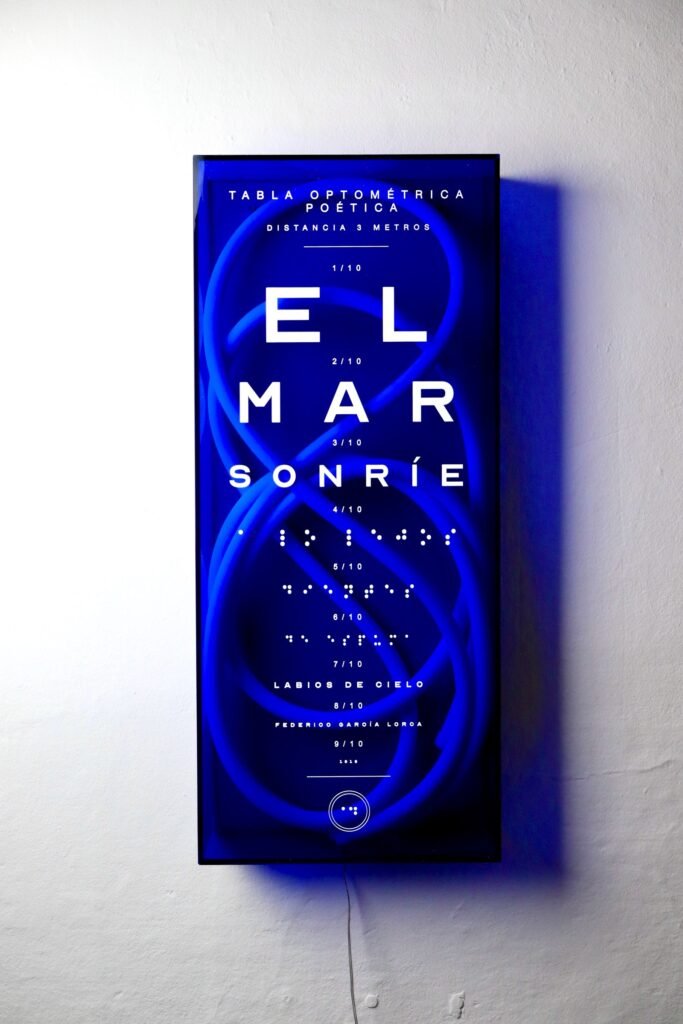
The blue one reads Tabla optométrica poética — distancia 3 metros, and then, line by line: EL / MAR / SONRÍE, three rows of Braille, and at the bottom, in the smallest type, LABIOS DE CIELO and the name Federico García Lorca. The sea smiles in the distance; lips of sky. A reader with normal sight gets the first words and loses the attribution; a reader using the Braille gets the middle and not the display type. Nobody in the room reads the whole poem the same way.
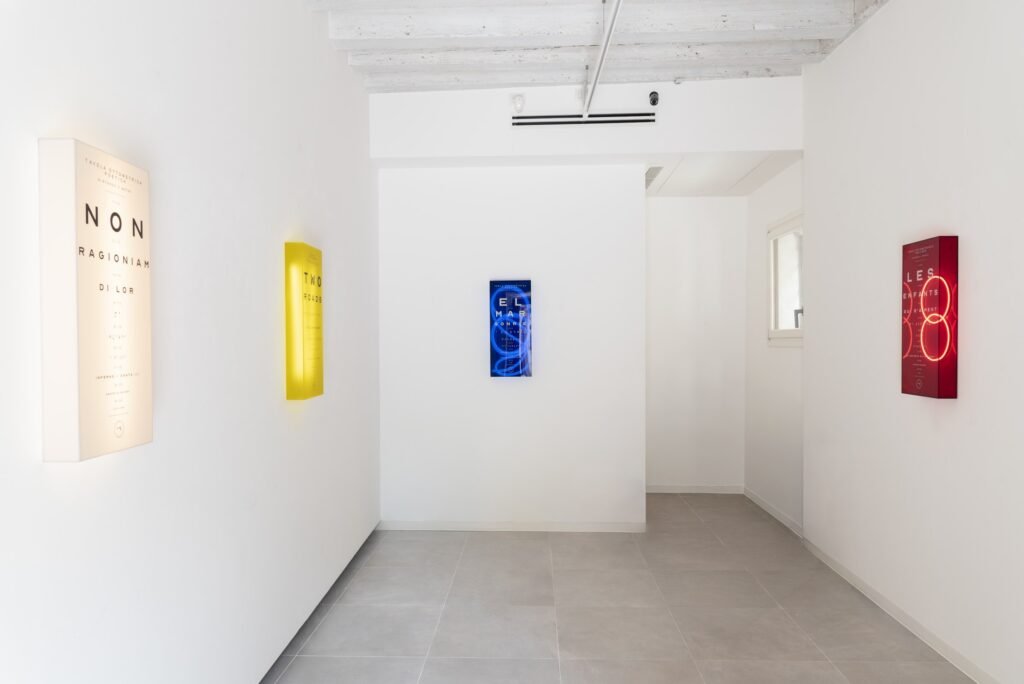
The other charts work the same trick in other languages. A red one carries Jacques Prévert — LES ENFANTS QUI S’AIMENT — with two neon rings crossing the surface and a run of Japanese characters below; a green one has Goethe’s Mailied, WIE HERRLICH LEUCHTET; a cream one opens with NON RAGIONIAM DI LOR, which is Dante on the souls not worth discussing. Robert Frost is among the poets the show names. It is the first time D’Aquila has shown the charts in five languages at once, and the point of that is the exhibition’s argument: what the poems have in common sits underneath the language they were written in.
Which is where the title comes in. The show is built around the moment before a feeling becomes a sentence — the intuition that arrives first and gets translated afterwards, badly, into words. Braille, a script made to be touched rather than seen, and an eye chart, an instrument that measures rather than communicates, are both ways of getting at language sideways: you meet the text as shape, as light, as surface, before you meet it as meaning. Alessandro D’Aquila, born in 1989, has made Braille the centre of his work for exactly that reason.
Practical details
- Run: 22 May – 19 September 2026
- Where: Marignana Project, Dorsoduro 140A, Rio Terà dei Catecumeni, Venice
- Curated by: Simone Marsibilio
- Part of: the exhibition programme of the first edition of the Berlendis Venice Art Prize
- Gallery: marignanaarte.it
- Also on now, next door: I Ritratti Perduti / The Lost Portraits at Marignana Gallery
Cultural Heritage Online lists this exhibition for readers planning a visit; it is organised by Marignana Arte, the curator and the artist.
📷 Become a Cultural Heritage Online photographer
Share your photos of events: they stay published under your name as the author. The more they're seen, the more you get noticed — and soon a contest will reward the most appreciated photos.
Log in or sign up free to add a photo