
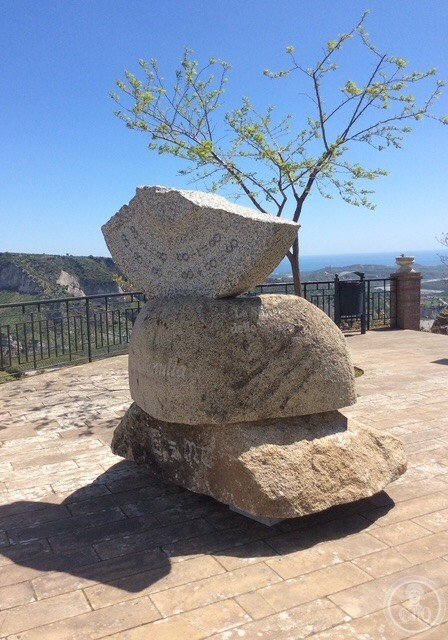
Three blocks of granite, balanced on a belvedere at the edge of a town that produced a philosopher. One face carries the equations of infinity, another a 1 followed by a hundred zeros, the base Einstein’s E = mc². Across the middle stone, in a running hand: dal nulla al nulla.
At a glance
- What — a monumental granite sculpture in three stacked blocks, carved with inscriptions and equations
- Where — Rione Petto, known locally as Piettu: a paved terrace with benches at the eastern entrance to Stilo, province of Reggio Calabria
- Unveiled — Sunday 19 April 2015, at 11 in the morning
- By — Giorgio Taverniti, born in Stilo and working in London, who gave the work to the town
- Access — an open public terrace, free at all hours, with a view down the valley to the Ionian coast
History
Stilo is a hillside town on the eastern slope of the Serre, in the province of Reggio Calabria, and it is known for two things. One is the Cattolica, the small tenth-century Byzantine church of five brick drums that stands above the roofs and is among the best preserved of its kind in Italy. The other is Tommaso Campanella, born here in 1568, the Dominican who wrote The City of the Sun and spent twenty-seven years in Spanish prisons for it. A town of that size does not usually carry two arguments of that weight, and Stilo has made both of them part of how it presents itself.
In April 2015 a third thing arrived, and it was a gift. Giorgio Taverniti, a sculptor born in Stilo who has worked for decades from a studio in London, donated a granite sculpture to the municipality. It was unveiled on Sunday 19 April at eleven in the morning at Rione Petto, in the presence of the mayor Giancarlo Miriello, of artists who had come from across Italy and of art critics; afterwards there was a meeting with the sculptor at the Hotel Città del Sole. The mayor called it homage to “a son of our land who has generously given one of his works”, and noted that the piece added to the artistic holdings of the town.
The gift was not a single gesture. Eighteen months later, on Saturday 1 October 2016, a second donated work by the same sculptor — an installation-sculpture called Pitagora — was unveiled in the Piazza del Palio. The local press, reporting it, described the Sphinx as already installed “at the entrance to the town and set against the backdrop of the historic centre”, which is exactly where it stands: on the paved belvedere where the road comes up from the coast, with the old roofs of Stilo climbing behind it.
What you see
The work is made of three blocks of granite, set one on top of another and each left with its quarried surface almost intact. The proportions are deliberately unstable: a broad, heavy base; above it a rounded mass like a loaf; and on top, balanced on a narrow contact, a wide fan-shaped slab that tips forward as though it were about to slide off. Nothing is polished. The stone keeps the coarse speckled grain of Calabrian granite, and the only worked surfaces are the ones that carry letters.
The middle block is the one that names the piece. On the right, in incised capitals, La Sfinge dello Stilaro; across the left flank, in a large running script, dal nulla al nulla — from nothingness to nothingness. The lowest block, close to the ground and often in shadow, carries three characters and one number: E = mc².
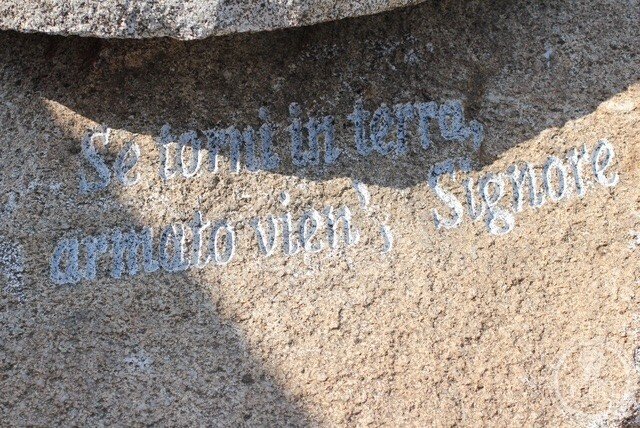
And there is a fourth inscription, cut in the same running hand, which is the one that binds the whole thing to the town. It reads Se torni in terra, armato vien’, Signore — if You return to Earth, come armed, Lord. It is not the sculptor’s own line. It is Tommaso Campanella’s, the opening of the final tercet of his sonnet A Cristo, nostro signore, and what follows it in the poem explains why a man who wrote such things spent twenty-seven years in prison: ch’altre croci apparécchianti i nemici, / non Turchi, non Giudei: que’ del tuo regno — other crosses are being made ready for you by your enemies, and they are not Turks or Jews, but the men of your own kingdom.
The press notice of 2015 spoke of an explicit reference to Campanella without saying where it was. It is here, on the stone: the philosopher born a few hundred metres away, quoted in the one line of his that accuses the powerful of his own Church.
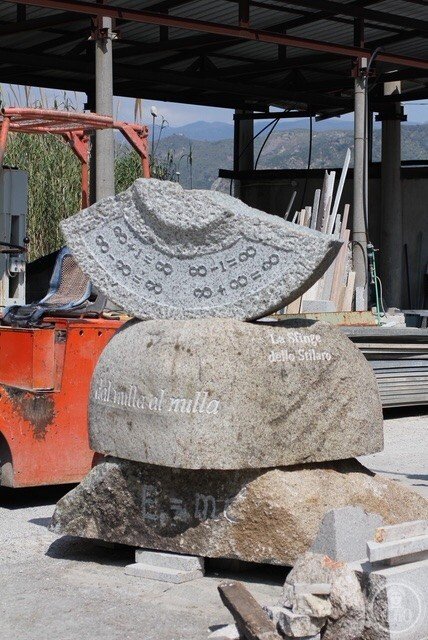
The top slab is carved on both faces. One side is given to the arithmetic of the infinite, laid out in a curve that follows the sweep of the stone: ∞ + 1 = ∞, ∞ − 1 = ∞, ∞ + ∞ = ∞. They are not decoration and they are not a puzzle: they are the ordinary, unsettling statements of what happens when you add to or subtract from something without end.
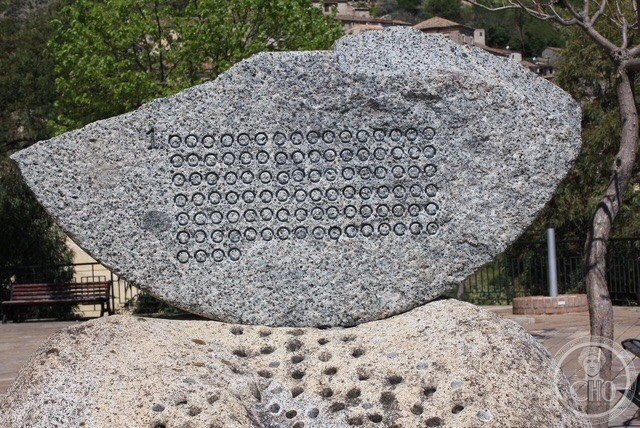
The other face answers the first with a single very large number. A 1 stands at the left margin, and after it the zeros run in ranks across the stone, each one drilled as a small ring rather than cut as a letter, so that the surface reads as texture before it reads as arithmetic. The sculptor gives the count as a hundred: a googol, the number that was coined to be enormous and finite at the same time, and that has therefore always been used to explain what infinity is not.
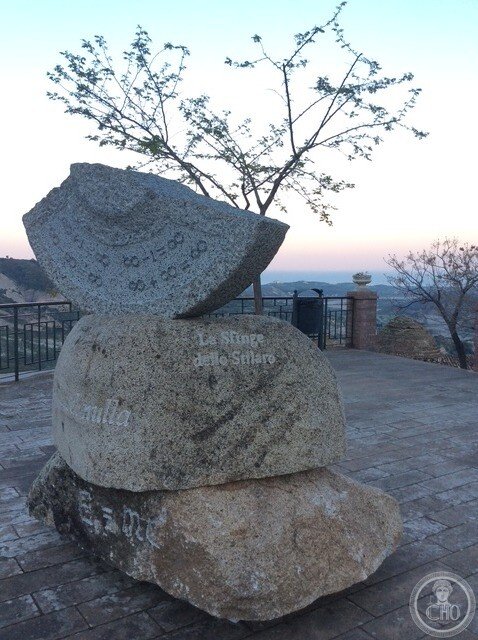
The setting matters as much as the stone. The Piettu is a small pedestrian square paved in stamped concrete, ringed with benches, young trees and a brick lamp pillar, closed on the valley side by a metal railing. Beyond the railing the ground drops away into the Stilaro valley, with eroded clay slopes on one side and, on a clear day, the Ionian Sea in the distance.
Cultural significance
The press notice that announced the unveiling made the reading explicit: the stones “speak with the verb of philosophy and of the other sciences”, and the symbols and epigraphs on them merge with the place of their installation, with an open reference to the philosopher and fellow townsman Tommaso Campanella. That is the sense in which the work belongs to Stilo rather than to anywhere else. Campanella wrote a utopia in a prison cell; the sculpture puts a small anthology of the largest ideas available — the infinite, the unimaginably large number, mass and energy — on a terrace at the edge of his town, and closes it with a sentence that cancels all three: dal nulla al nulla.
Its manner is local too. The announcement described a style that recalls the centuries-old tradition of the old Calabrian stonecutters, with more modern echoes, and that is a fair description of what the piece does: it uses the plainest possible operations of a stone yard — split, stack, incise, drill — and asks them to carry abstract content. The blocks are not carved into a figure. They are left as blocks, and the meaning is put on their surfaces.
Giorgio Taverniti, described in 2015 as having been active for more than half a century, has shown stone and wood sculpture, painting and installation work in many countries. He describes the Sphinx as his first public monumental sculpture, and connects the year of its unveiling to the centenary of Einstein’s relativity; the equation on the base of the work is Einstein’s. He also keeps a studio in the Veneto, in northern Italy, which has its own page on this site.
Practical information & getting there
Stilo is about 45 km up the Ionian coast from Locri and roughly the same distance south of Catanzaro Lido. Coming by car, leave the SS106 coast road at Monasterace Marina and climb inland for some 10 km; the nearest railway station is Monasterace–Stilo, on the Ionian line, from which local buses run up to the town. The Piettu terrace is on the eastern side of the built-up area, on the way in, and there is parking a short walk away. The sculpture is outdoors and always visible; late afternoon light comes from behind the historic centre and puts the inscriptions of the middle block in relief.
The rest of the town is worth the climb: the Cattolica di Stilo stands above the houses on the slope of Monte Consolino, and the monument to Campanella is a few minutes away in the centre.
Sources & resources
- “Stilo, inaugurazione scultura in granito di Giorgio Taverniti”, CN24TV, 18 April 2015 — for the date, hour and place of the unveiling, the donation to the municipality, the words of the mayor Giancarlo Miriello, the reference to Campanella and the description of the sculptor’s manner. Consulted in the Internet Archive copy, the original site being unreachable.
- “Stilo. Inaugurazione della installa-scultura ‘Pitagora’”, Newz.it, 29 September 2016 — for the second donated work, and for the position of the Sphinx at the entrance to the town against the backdrop of the historic centre. Internet Archive copy.
- The photographs published here, taken by the sculptor and supplied by him, for the inscriptions, the drilled zeros and the state of the terrace. The photograph of the Campanella line was sent by him on 27 August 2026, with his own English rendering of it.
- Tommaso Campanella, A Cristo, nostro signore (sonnet 18) — for the wording of the line cut into the middle block and for the tercet it opens.
- OpenStreetMap, for the pedestrian area named Piettu and the position of the sculpture within it.
Find it on the map
See this place and what’s around it →📷 Become a Cultural Heritage Online photographer
Share your photos of places: they stay published under your name as the author. The more they're seen, the more you get noticed — and soon a contest will reward the most appreciated photos.
Log in or sign up free to add a photo