
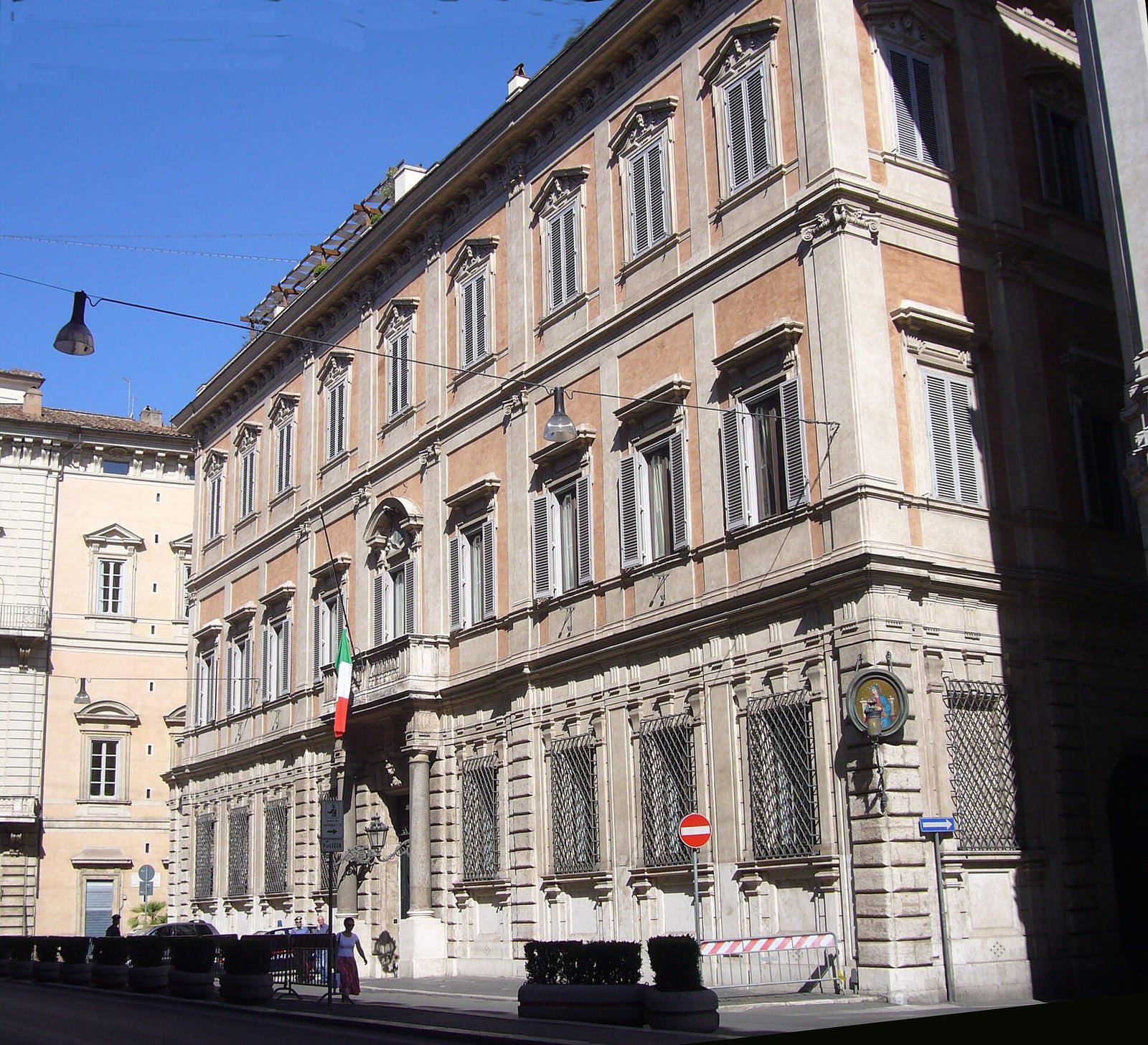
Palazzo Grazioli is a historic aristocratic residence on Via del Plebiscito in central Rome, situated between the Palazzo Doria Pamphilj and Palazzo Altieri in the heart of the ancient city. Built and repeatedly remodelled by successive Roman noble families, the palace occupies a site rich in archaeological remains and has served various distinguished occupants over the centuries, including use as a private residence by prominent Italian political figures in the late twentieth and early twenty-first centuries.
- Address
- Via del Plebiscito 102, 00186 Roma RM, Italy
- Period
- Constructed and remodelled from the 17th to 18th centuries
- Style
- Roman Baroque / Neoclassical
- Location
- Historic centre of Rome, between Largo di Torre Argentina and Piazza Venezia
- Coordinates
- 41.8965° N, 12.4804° E
At a glance
- Type
- Aristocratic urban palace
- Period
- 17th–18th century, with earlier foundations
- Style
- Roman Baroque
- Location
- Via del Plebiscito, Rome historic centre (Rione Pigna)
- Current use
- Private residence; intermittently used for cultural and institutional purposes
Overview
Palazzo Grazioli stands on Via del Plebiscito, one of the principal thoroughfares of Rome’s historic centre, in a district defined by a succession of major noble palaces accumulated over centuries of papal and aristocratic patronage. The building occupies a site where archaeological investigations have revealed substantial ancient Roman remains, a reminder that this zone of the ancient city was densely built during the Imperial period. Like its neighbours the Palazzo Doria Pamphilj and Palazzo Altieri, Palazzo Grazioli embodies the Roman tradition of the great family palace as an instrument of social, political and cultural prestige.
History
The palace was shaped by a succession of Roman noble families who acquired and modified the structure across the seventeenth and eighteenth centuries, each leaving architectural traces in the façade and interior layout. The area around Via del Plebiscito underwent significant urban regularisation during the Counter-Reformation and Baroque periods, when powerful aristocratic clans competed to commission imposing residences close to the political and ecclesiastical centre of the city. In the modern period the palace gained wider public attention through association with prominent Italian political figures who used it as a private residence.
What you see
The exterior presents a refined Roman palace façade with rusticated stone base, regularly articulated upper floors, and the characteristic wrought-iron balconies of the Baroque noble tradition. The building’s massing respects the alignment of Via del Plebiscito while the portal opens onto a cortile typical of Roman aristocratic residences. The interior retains painted halls and period furnishings reflective of its long history as a high-status private household, though the palace is not routinely open to the public.
Cultural significance
Situated within the UNESCO World Heritage buffer zone of Rome’s historic centre, Palazzo Grazioli forms part of the dense palimpsest of noble and ecclesiastical architecture that defines this district. Its position between two of Rome’s most celebrated private galleries — the Doria Pamphilj and the Altieri collections — places it within one of the highest concentrations of Baroque art and architecture in the world.
Practical information
- Address
- Via del Plebiscito 102, 00186 Roma RM, Italy
- Visiting
- Private residence; not open to the public for regular visits
- Nearby
- Palazzo Doria Pamphilj (open to public), Palazzo Altieri, Largo di Torre Argentina
Getting there
The palace is a short walk from Largo di Torre Argentina bus hub, served by multiple lines across central Rome. The nearest metro station is Spagna or Barberini (Line A), roughly 20 minutes on foot; alternatively, tram line 8 stops at Largo di Torre Argentina. Via del Plebiscito runs directly between Piazza Venezia and Corso Vittorio Emanuele II.
Sources & resources
See the place
Find it on the map
See this place and what’s around it →Historical events at this place (2)
📷 Become a Cultural Heritage Online photographer
Share your photos of places: they stay published under your name as the author. The more they're seen, the more you get noticed — and soon a contest will reward the most appreciated photos.
Log in or sign up free to add a photoIs this page about you?
This page is read by travellers and heritage enthusiasts who find it on Google. Tell us how you are connected to this place and we will take it from there.