
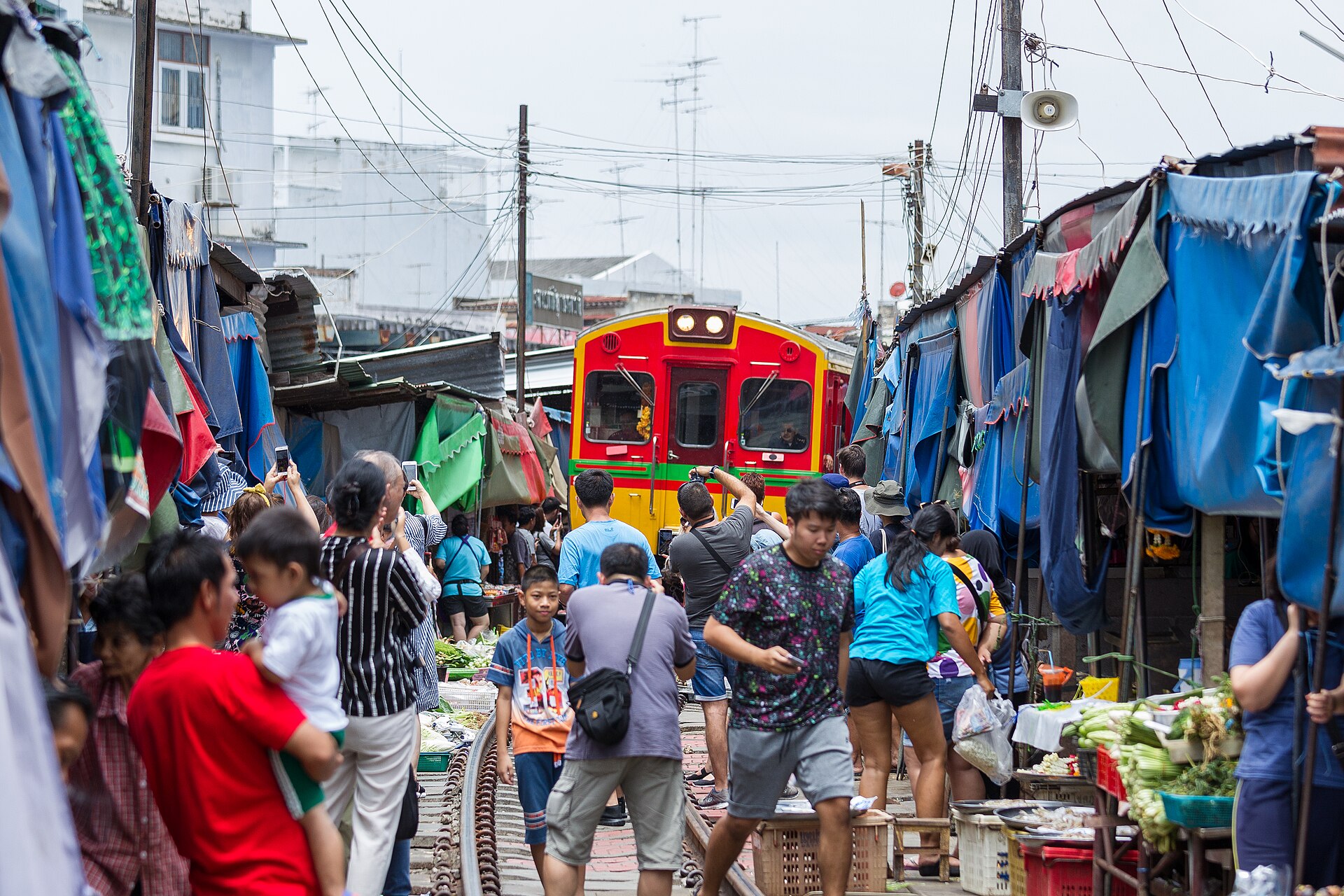
The Maeklong Railway Market — locally known as Talad Rom Hub, meaning “umbrella pulldown market” — is one of Thailand’s most distinctive cultural attractions, situated along the active Maeklong Railway line in Samut Songkhram province. Market stalls line both sides of the metre-gauge track so closely that vendors must retract awnings and pull back produce displays several times daily as trains pass at low speed through the market. Cultural Heritage Online has documented this living heritage site as an exceptional example of adaptive vernacular commerce surviving alongside 20th-century rail infrastructure.
- Type
- Railway market / vernacular heritage site
- Period
- Established alongside the Maeklong Railway (opened 1905); current market configuration 20th century
- Style
- Vernacular Thai market architecture; active railway integration
- Location
- Samut Songkhram province, Thailand; approximately 80 km south-west of Bangkok
- Coordinates
- 13.4088° N, 100.0020° E
At a glance
- Type
- Active railway market
- Period
- 20th century, operating alongside Maeklong Railway (est. 1905)
- Style
- Vernacular Thai commerce integrated with metre-gauge railway
- Location
- Samut Songkhram, Thailand
Overview
The Maeklong Railway Market is a functioning open-air market built directly along the tracks of the Maeklong Railway, a 65-kilometre metre-gauge line connecting Bangkok’s Wongwian Yai station to Samut Songkhram. The market’s nickname, Talad Rom Hub (“umbrella pulldown market”), perfectly describes the daily spectacle: vendors retract their colourful awnings as trains approach, then re-extend them moments after the train passes. The market sells fresh produce, seafood, dried goods, and street food, and has become one of Thailand’s most photographed cultural attractions.
History
The Maeklong Railway was inaugurated in 1905 to serve the coastal provinces south-west of Bangkok, primarily for transporting salt, seafood, and agricultural produce. As the line passed through established market areas, vendors gradually moved their stalls closer to the tracks over decades, optimising space along the narrow right-of-way. By the mid-20th century the market had fully colonised the track corridor, creating the spectacle that survives today. The State Railway of Thailand continues to operate the line, and the eight daily train services through the market have become a cultural institution in their own right.
What you see
Arriving at the market, visitors find stalls of fresh fish, tropical fruits, vegetables, and dried seafood packed to within centimetres of the rail line. Colourful striped canvas awnings form a continuous canopy overhead. When a train approaches — announced by a whistle and the bell of a crossing guard — vendors calmly slide their goods back, fold their umbrellas, and step aside; minutes later everything returns to its position. The surrounding neighbourhood of Samut Songkhram retains traditional wooden shophouses and canal-side life typical of the Gulf of Thailand coast.
Cultural significance
The Maeklong Railway Market represents an enduring form of Thai vernacular commerce and community resilience, where daily life and infrastructure coexist without formal heritage designation. It is widely regarded as one of the world’s most extraordinary living markets, demonstrating how communities adapt and persist around constraints that might elsewhere prompt clearance.
Practical information
Address: Maeklong Railway Station, Samut Songkhram 75000, Thailand. The market is open daily from early morning; peak activity is before midday. Train times vary — check the State Railway of Thailand schedule for current departures. Admission is free; the market is open year-round.
Getting there
From Bangkok, take the BTS Skytrain to Wongwian Yai station, then the Maeklong Railway to its terminus at Samut Songkhram (approximately 1.5 hours total). Alternatively, minivans operate from Bangkok’s Victory Monument to Samut Songkhram. Local songthaew shared taxis connect the town centre to the market.
Sources & resources
See the place
Find it on the map
See this place and what’s around it →📷 Become a Cultural Heritage Online photographer
Share your photos of places: they stay published under your name as the author. The more they're seen, the more you get noticed — and soon a contest will reward the most appreciated photos.
Log in or sign up free to add a photo