
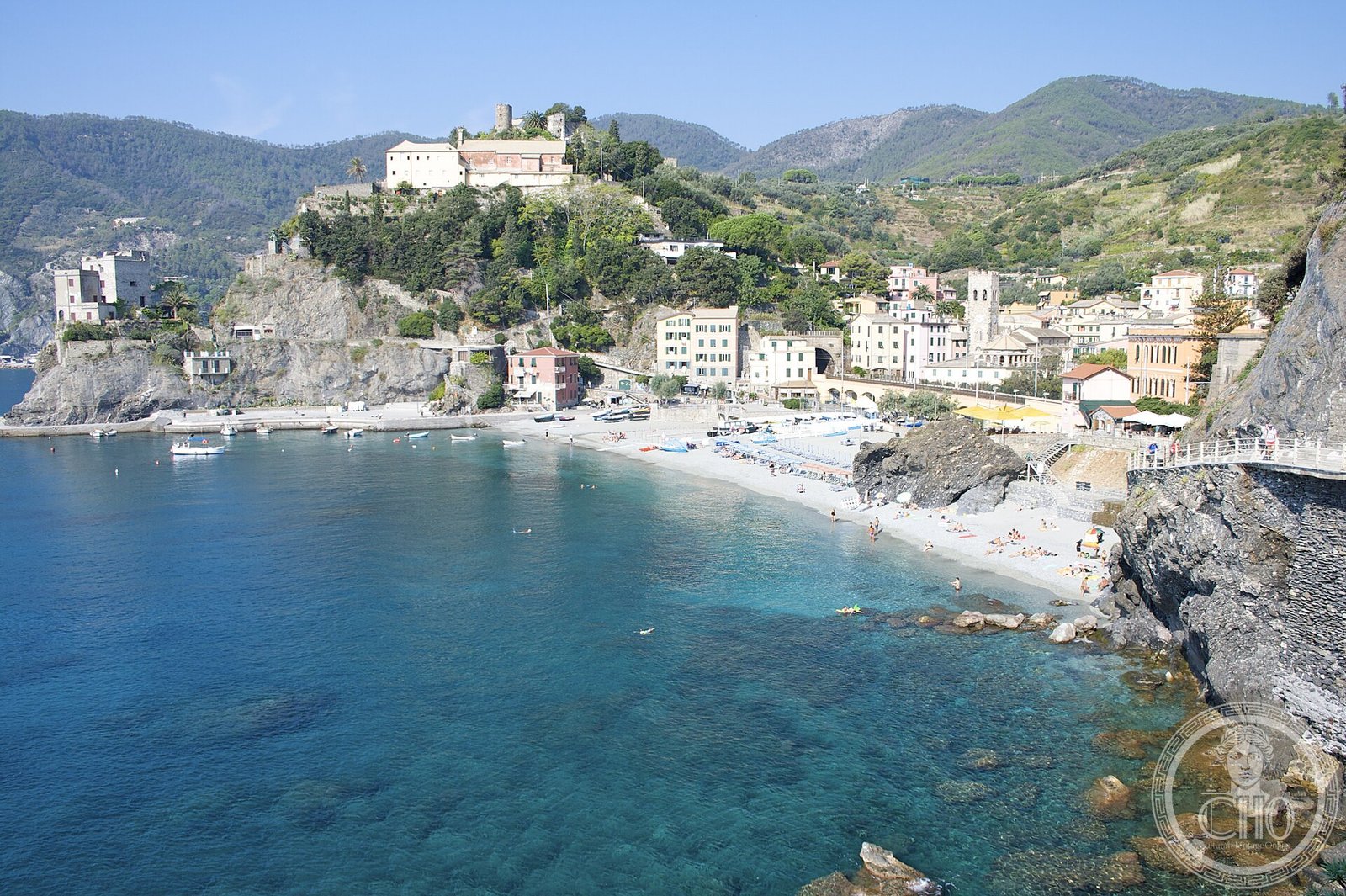
Monterosso al Mare is the northernmost and largest of the five villages that form the Cinque Terre, a UNESCO World Heritage Site on the Ligurian coast of north-western Italy. Set between steep terraced hillsides and a sheltered bay, it is the only Cinque Terre village with a broad sandy beach, and its historic centre preserves a 14th-century Gothic church, a medieval tower, and a network of dry-stone terrace walls that are themselves recognised as outstanding examples of traditional land management.
- Type
- Coastal village and comune, Cinque Terre
- Period
- Medieval origins; continuous settlement documented from the 11th century
- Style
- Ligurian vernacular; coloured rendered facades, terraced hillside cultivation
- Location
- Province of La Spezia, Liguria, north-western Italy
- Coordinates
- 44.1463° N, 9.6557° E
- UNESCO status
- Part of the Cinque Terre UNESCO World Heritage Site (inscribed 1997)
At a glance
- Type
- Coastal village, comune, Cinque Terre
- Period
- Medieval to present; documented from the 11th century
- Style
- Ligurian vernacular architecture with coloured facades
- Location
- La Spezia Province, Liguria, north-western Italy
- Architect
- Vernacular tradition; no single architect attributed
Overview
Monterosso al Mare is a town and comune in the province of La Spezia, part of the region of Liguria in Northern Italy. It is the northernmost and largest of the five villages that collectively form the Cinque Terre, a stretch of rugged coastline protected as a national park and inscribed on the UNESCO World Heritage List in 1997. The village is divided into the historic old town (Paese Vecchio) and the more modern Fegina district connected by a short tunnel through the headland.
History
Settlement at Monterosso is attested from at least the 11th century, when the Fieschi noble family controlled much of the Ligurian Levante coast. The village grew under Genoese protection from the 13th century onward, and its dry-stone terraces — painstakingly built to create agricultural land on near-vertical hillsides — were laid out over many centuries by local farming communities. The 1966 flood and the 2011 landslide caused significant damage to the village and its terracing, but extensive restoration has returned Monterosso to its characteristic appearance.
What you see
The old village clusters around the Church of San Giovanni Battista (consecrated 1307), a Gothic structure with distinctive black-and-white striped marble typical of Ligurian ecclesiastical architecture. A medieval Aurora Tower divides the old town from the Fegina seafront, where a broad sandy beach — unique among the Cinque Terre — stretches beneath the coastal cliffs. The terraced hillsides above the village, planted with Sciacchetrà wine grapes and lemon trees, offer dramatic panoramic views across the Gulf of La Spezia.
Cultural significance
Monterosso al Mare and its sister villages represent a centuries-old tradition of human settlement in a challenging coastal landscape, recognised by UNESCO as an outstanding example of man–environment interaction. The Cinque Terre’s system of dry-stone terrace walls extends over 6,700 km — greater than the Great Wall of China — and continues to shape local viticulture and biodiversity.
Practical information
- Address
- Monterosso al Mare, 19016 La Spezia SP, Italy
- Opening hours
- Village open year-round; check official website for seasonal park trail closures
- Admission
- Village access free; Cinque Terre Card required for hiking trails
Getting there
Monterosso al Mare is served by the Cinque Terre railway line (La Spezia–Levanto). Trains run frequently from La Spezia Centrale and from Levanto, with direct connections to Genoa and Pisa. Ferry services operate seasonally from La Spezia and Lerici. Private cars cannot enter the historic centre; parking is available at the Fegina seafront.
Sources & resources
See the place
Find it on the map
See this place and what’s around it →📷 Become a Cultural Heritage Online photographer
Share your photos of places: they stay published under your name as the author. The more they're seen, the more you get noticed — and soon a contest will reward the most appreciated photos.
Log in or sign up free to add a photo