
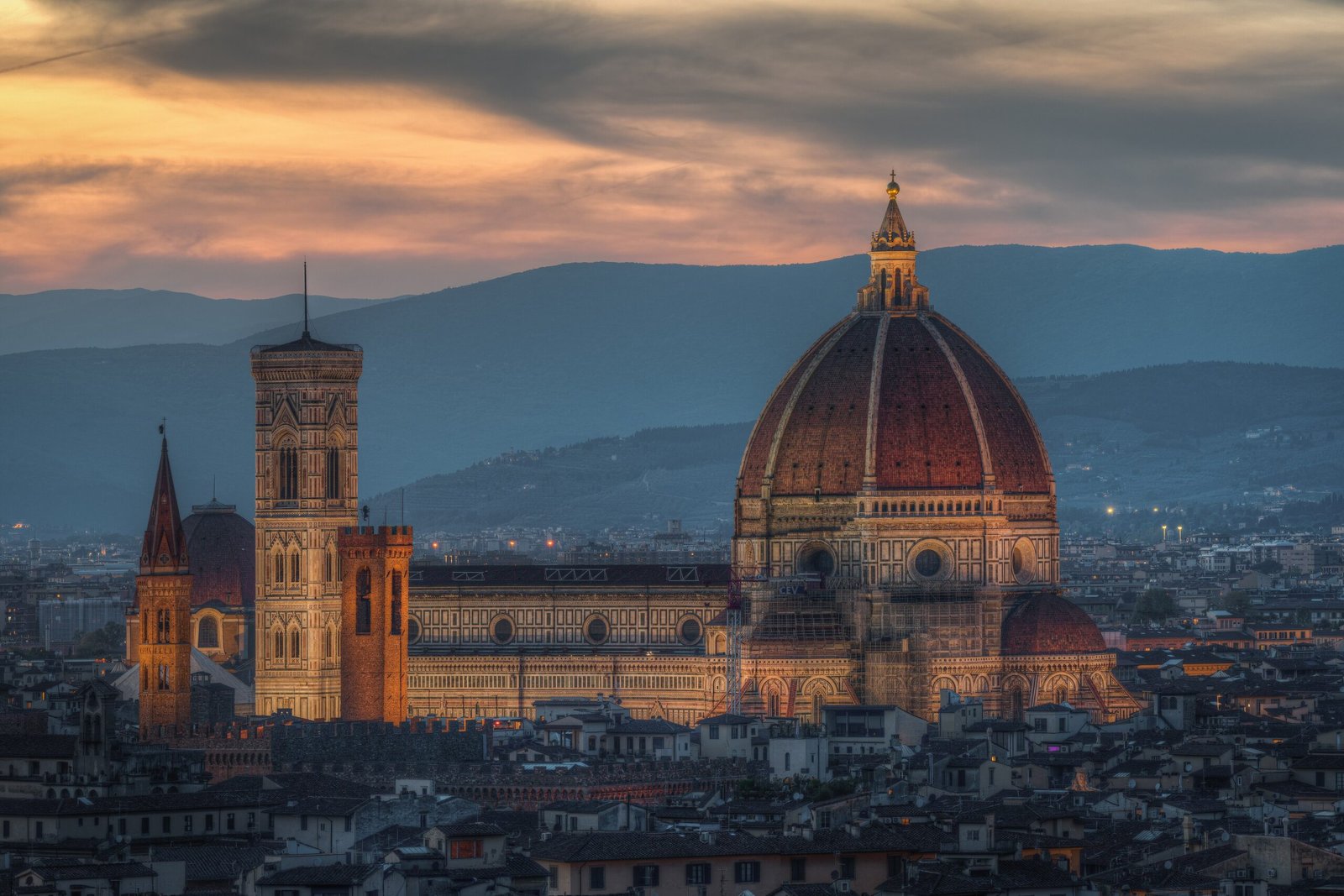
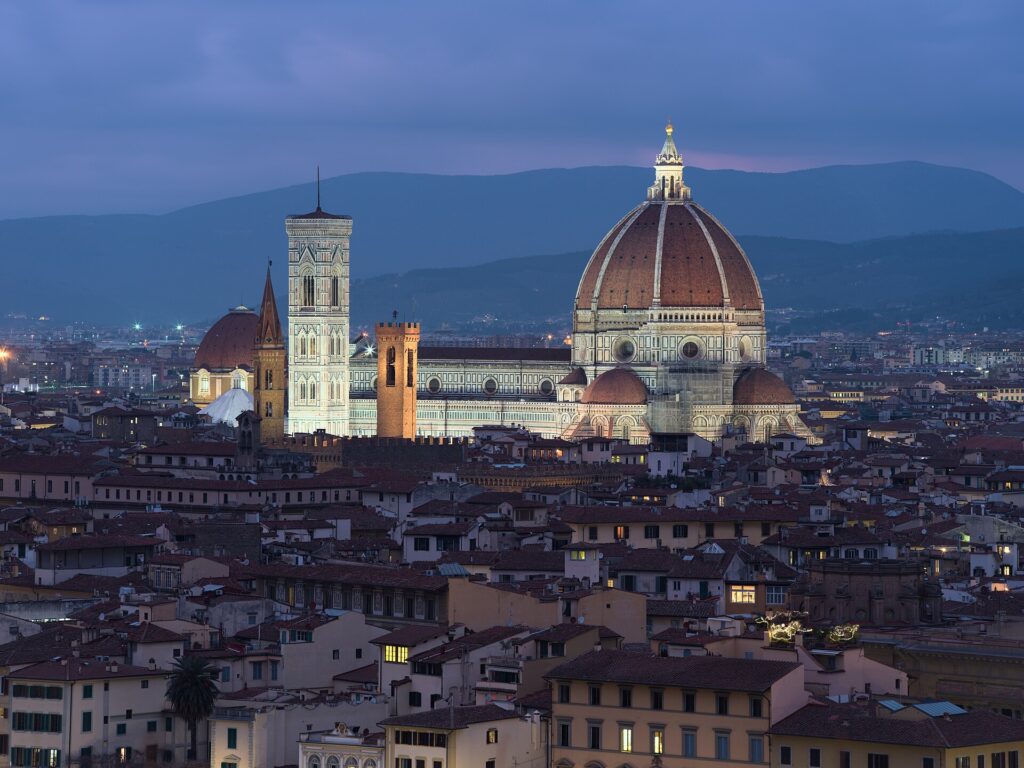
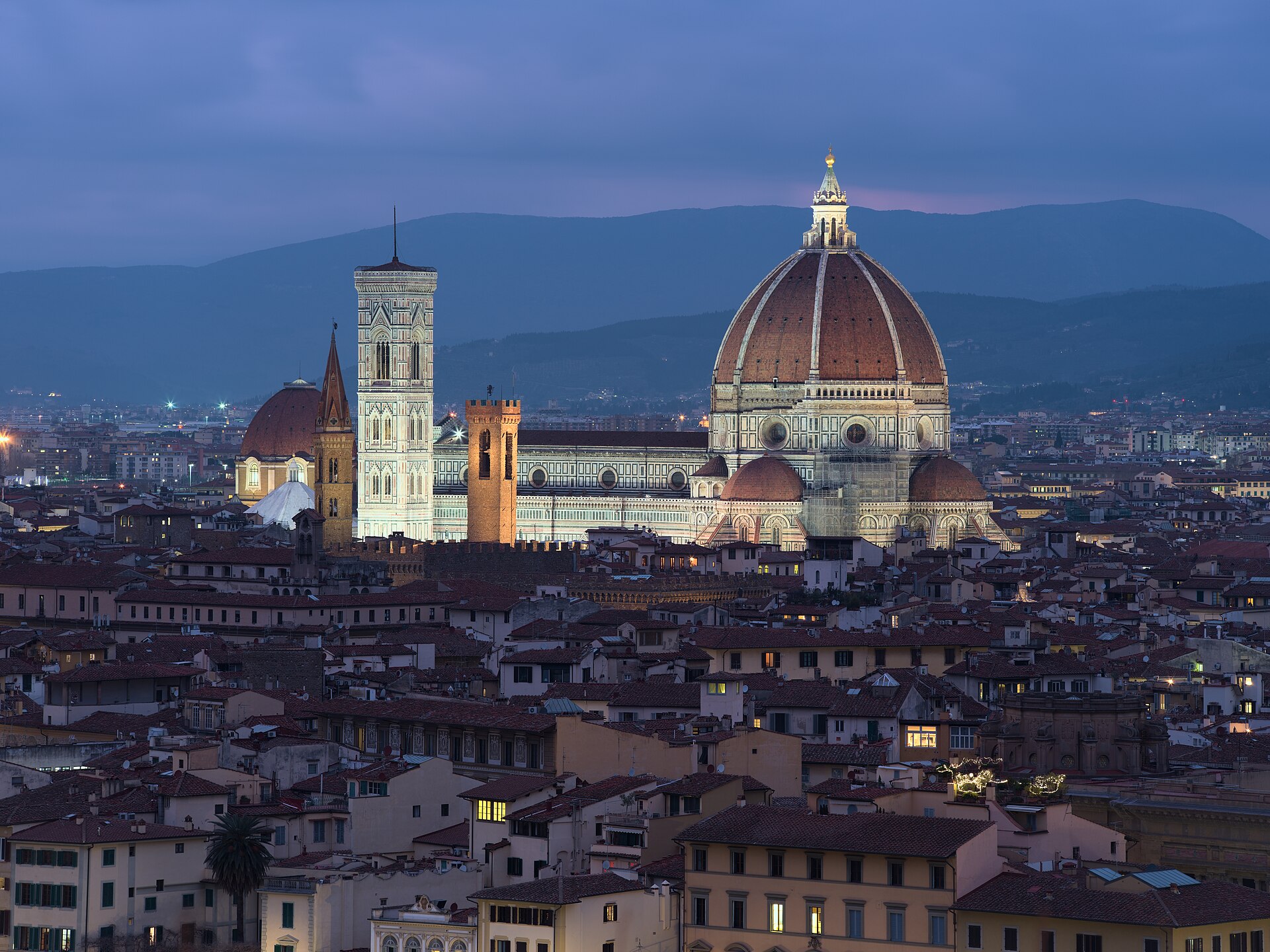
Florence Cathedral, formally the Cathedral of Santa Maria del Fiore, is the mother church of the Catholic Archdiocese of Florence and one of the most celebrated buildings in Western architecture. Begun in 1296 to a design by Arnolfo di Cambio and completed structurally in 1436 with Filippo Brunelleschi’s revolutionary self-supporting dome, the basilica combines Gothic proportions with Renaissance engineering in a way that defined the ambition of Florentine art for two centuries. Its polychrome marble exterior — alternating green, pink, and white panels — and Brunelleschi’s terracotta-tiled dome remain the defining elements of the Florence skyline.
- Type
- Cathedral; seat of the Archbishop of Florence
- Period
- Construction began 1296; dome completed 1436; facade completed 1887
- Style
- Italian Gothic with Renaissance dome
- Location
- Piazza del Duomo, Florence, Tuscany
- Coordinates
- 43.7731° N, 11.2566° E
- UNESCO status
- Part of the Historic Centre of Florence UNESCO World Heritage Site (inscribed 1982)
At a glance
- Type
- Cathedral, Catholic Archdiocese of Florence
- Period
- 1296–1887 (construction and facade completion)
- Style
- Italian Gothic; Renaissance dome
- Location
- Piazza del Duomo, Florence, Tuscany, central Italy
- Architects
- Arnolfo di Cambio (original design); Filippo Brunelleschi (dome); Emilio De Fabris (19th-century facade)
Overview
Florence Cathedral, formally the Cathedral of Saint Mary of the Flower, is the cathedral of the Catholic Archdiocese of Florence. Commenced in 1296 in the Gothic style to a design of Arnolfo di Cambio and completed by 1436 with a dome engineered by Filippo Brunelleschi, the basilica’s exterior is faced with polychrome marble panels in various shades of green and pink, alternated by white. The cathedral forms the centrepiece of the Piazza del Duomo, which also includes the Baptistery of San Giovanni and Giotto’s Campanile, the entire complex being a UNESCO World Heritage Site.
History
Construction began in 1296 on the site of the older Santa Reparata cathedral, under the direction of Arnolfo di Cambio, who envisioned a building that would surpass all others in Tuscany. Work continued under Francesco Talenti and others throughout the 14th century, and the nave was largely complete by the 1370s. The great central dome posed an apparently insoluble structural challenge until Filippo Brunelleschi proposed and executed his double-shell herringbone brick solution between 1420 and 1436, without the use of temporary wooden centering — an achievement that remained unmatched for over a century. The elaborate neo-Gothic marble facade was added only in 1887, designed by Emilio De Fabris after a lengthy competition.
What you see
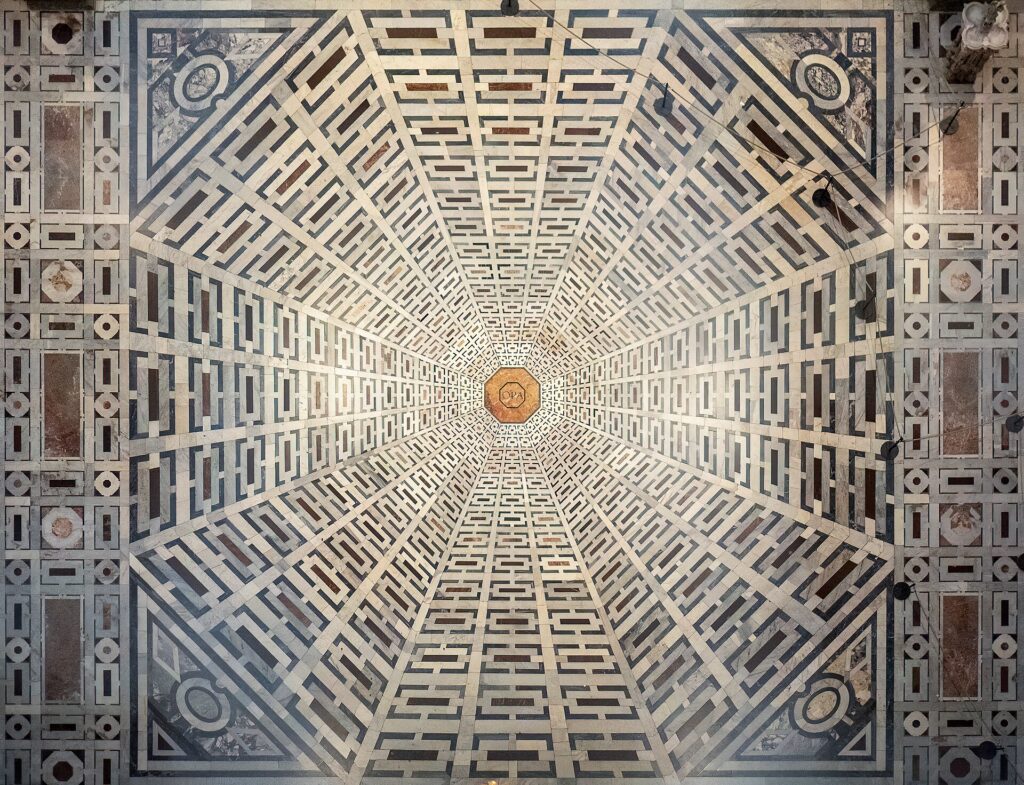
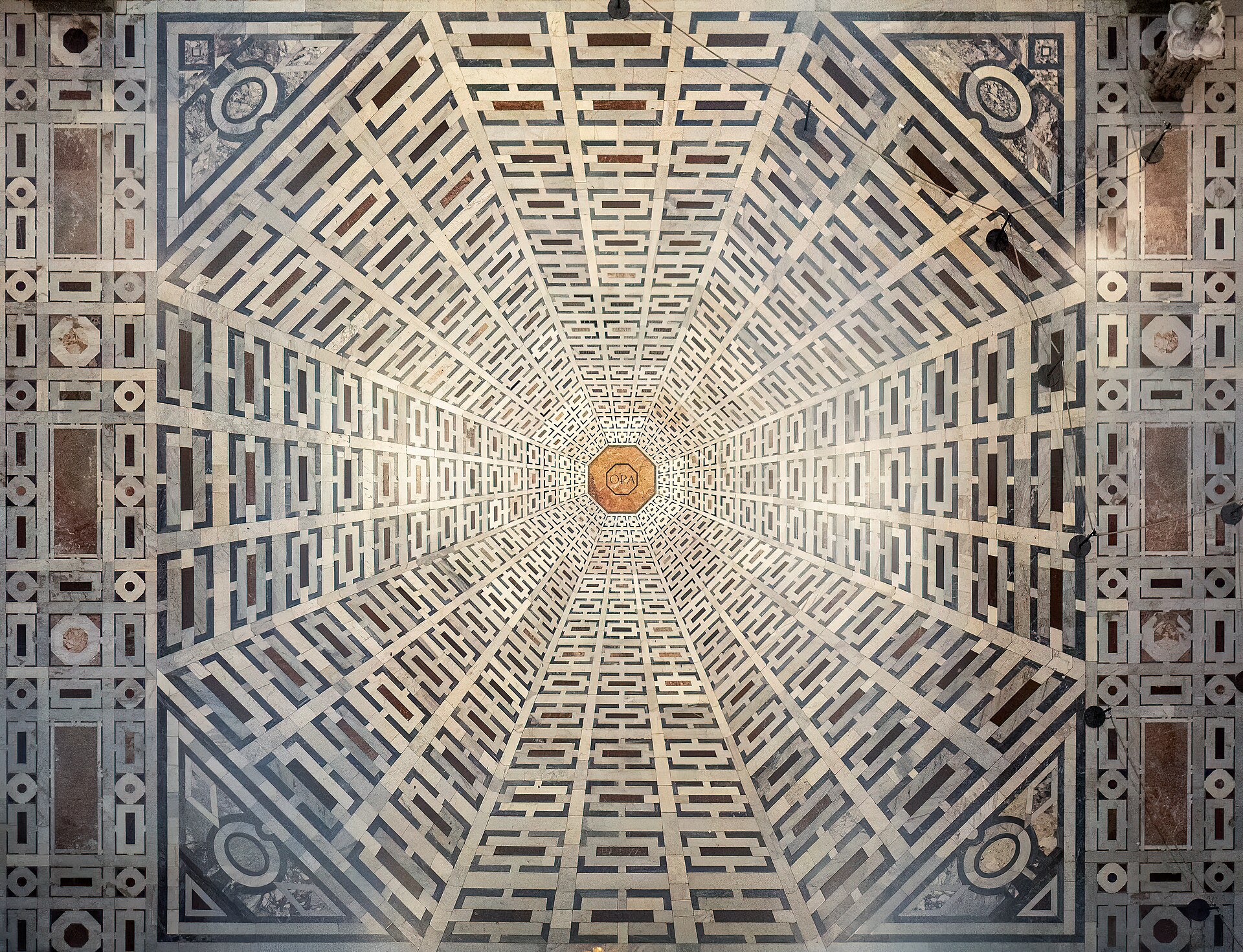
The cathedral’s interior is austere by Italian standards, its vast nave stripped of much decoration during Vasari’s 16th-century renovation, but notable for Paolo Uccello’s equestrian portraits of John Hawkwood and Niccolò da Tolentino, and Domenico di Michelino’s painting of Dante before the Florentine skyline. The cupola’s interior is covered by Giorgio Vasari and Federico Zuccari’s fresco of the Last Judgement (1572–1579). Visitors may climb 463 steps to the lantern atop the dome for panoramic views over Florence, or descend to the crypt to see excavations of Santa Reparata and Brunelleschi’s tomb.
Cultural significance
Brunelleschi’s dome is widely regarded as the first great building of the Renaissance and a foundational achievement of European architectural history. The cathedral complex as a whole represents the civic ambition of medieval and early-Renaissance Florence, and its influence on subsequent cathedral design — from St Peter’s in Rome to St Paul’s in London — is incalculable. Cultural Heritage Online considers it one of the essential monuments for understanding the Italian artistic tradition.
Practical information
- Address
- Piazza del Duomo, 50122 Firenze FI, Italy
- Opening hours
- Cathedral Mon–Fri 10:00–17:00, Sat 10:00–16:45, Sun 13:30–16:45; dome and campanile have separate hours — check official website
- Admission
- Cathedral entry free; combined ticket required for dome, campanile, baptistery, museum
- Booking
- Advance booking strongly recommended for dome climb; official website: operaduomo.firenze.it
Getting there
The cathedral is in the heart of Florence’s historic centre, a 15-minute walk from Santa Maria Novella railway station. Numerous city bus lines stop nearby; the ZTL restricted traffic zone covers most of the centre, so visitors arriving by car should use park-and-ride facilities on the city outskirts. The tramway T1 line connects Santa Maria Novella to the western suburbs.
Photographs
Sources & resources
See the place
Gallery
Find it on the map
See this place and what’s around it →

📷 Become a Cultural Heritage Online photographer
Share your photos of places: they stay published under your name as the author. The more they're seen, the more you get noticed — and soon a contest will reward the most appreciated photos.
Log in or sign up free to add a photoIs this page about you?
This page is read by travellers and heritage enthusiasts who find it on Google. Tell us how you are connected to this place and we will take it from there.