
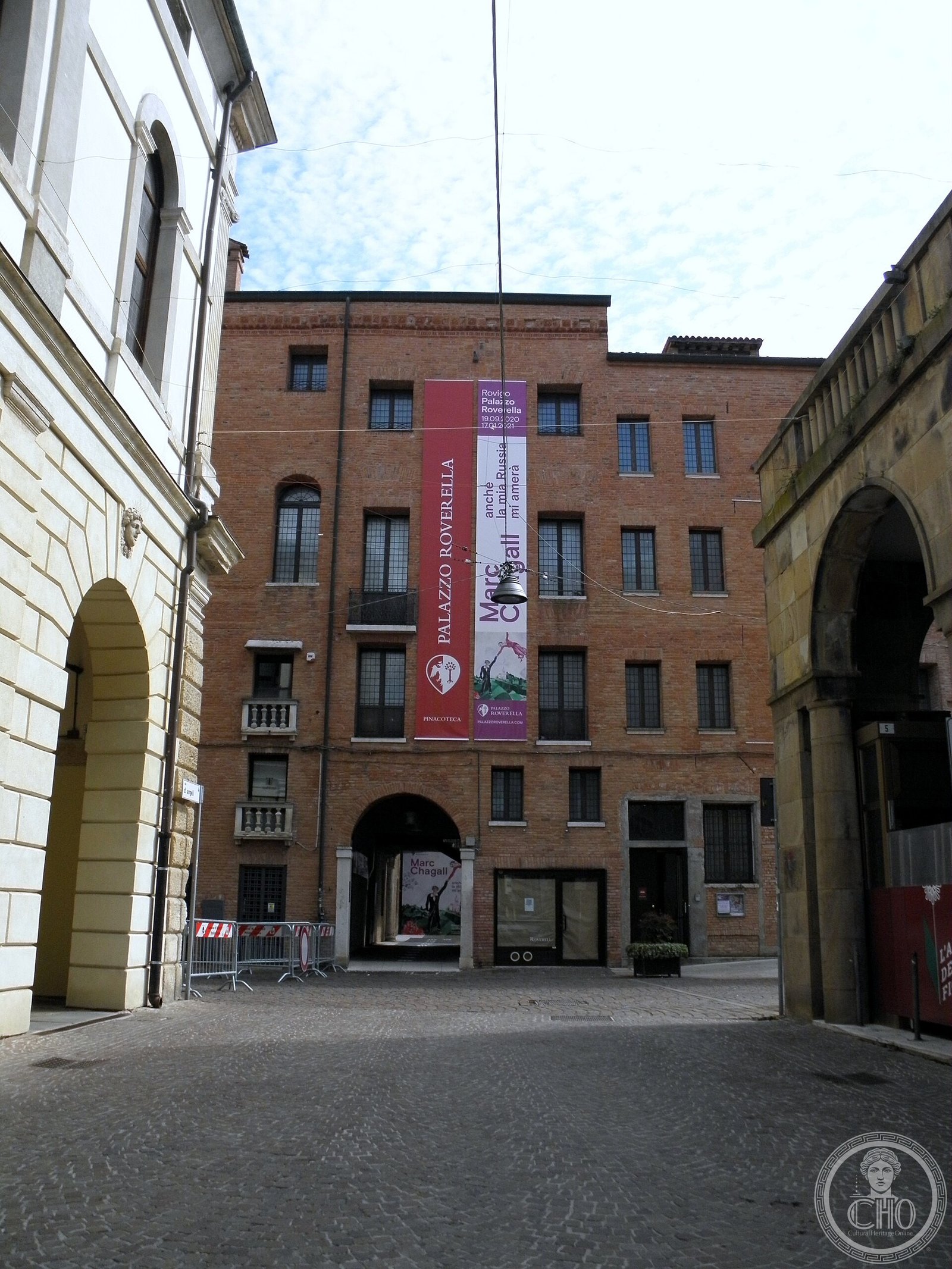
Palazzo Roverella is a Renaissance palazzo in the centre of Rovigo, Veneto, built in the late 15th century and today celebrated as the home of one of Italy’s most respected provincial art exhibition programmes. Managed by the Fondazione Cassa di Risparmio di Padova e Rovigo together with the Accademia dei Concordi, the palace hosts a prestigious annual major exhibition season that regularly attracts national attention, focusing on Italian and European 19th-century art, Post-Impressionism, and Symbolism, with shows drawing significant loans from international museums. Its frescoed rooms, stone courtyard, and terracotta details make it one of the finest surviving examples of Veneto Renaissance civil architecture.
- Address
- Via Laurenti 8–10, 45100 Rovigo RO
- Period
- Late 15th century (construction); adapted for exhibitions in the 20th century
- Style
- Veneto Renaissance
- Original patron
- Roverella family (Venetian noble family prominent in Rovigo)
- Function
- Major temporary art exhibition venue; cultural event space
- Current use
- Managed by Fondazione Cassa di Risparmio di Padova e Rovigo and Accademia dei Concordi
- Coordinates
- 45.0705° N, 11.7899° E
- Notes
- Annual major exhibition season (autumn–spring); adjacent to the Accademia dei Concordi museum with significant Venetian painting collection
At a glance
- Type
- Renaissance civic palace converted into major exhibition venue
- Period
- Late 15th century
- Style
- Veneto Renaissance
- Location
- Historic centre of Rovigo, Veneto, Italy
- Operator
- Fondazione Cassa di Risparmio di Padova e Rovigo + Accademia dei Concordi
Overview
Palazzo Roverella has transformed Rovigo — a city often overlooked by international tourism — into a destination for art lovers, thanks to a sequence of critically acclaimed exhibitions dedicated to European art of the 19th and early 20th centuries. Shows dedicated to Symbolism, Divisionism, Pointillism, and Post-Impressionism have borrowed works from the Musée d’Orsay, the Hermitage, and other leading international collections, placing Rovigo on the map of Italy’s major exhibition circuit. The palace itself, with its elegant courtyard and frescoed interiors, adds a layer of architectural pleasure to every visit.
History
The palace takes its name from the Roverella family, a Ferrarese and later Venetian noble family that held significant influence in Rovigo during the Renaissance. The building dates from the late 15th century and displays the characteristic features of Veneto Renaissance civic architecture: a rusticated ground floor, bifore windows, terracotta ornament, and an internal loggia courtyard. After passing through various owners, the building was acquired in the 19th century by the Accademia dei Concordi, one of Italy’s oldest learned societies (founded in Rovigo in 1580), which continues to be associated with its management.
The transformation of Palazzo Roverella into a major exhibition venue in the early 21st century, backed by the banking foundation Fondazione Cassa di Risparmio di Padova e Rovigo, has been one of the most successful examples of cultural patronage driving civic tourism regeneration in the Veneto region.
What you see
The palace’s street facade presents a sober but refined Renaissance composition in brick and Istrian stone, while the internal courtyard reveals a double loggia with terracotta columns and Renaissance detailing. The exhibition rooms on the piano nobile and upper floors have been sensitively adapted to display art without compromising the historic plasterwork and painted decoration. Adjacent to the main palace, the Accademia dei Concordi galleries preserve a permanent collection of Venetian and Emilian paintings from the 14th through 18th centuries, including works by Palma il Giovane, Giambattista Tiepolo, and Giovanni Bellini.
Cultural significance
Palazzo Roverella is one of the finest Renaissance civic palaces surviving in the Po Delta region and a testament to the cultural ambitions of the minor cities of the Veneto under Venetian dominion. Its contemporary exhibition programme has made it a model for how provincial Italian foundations can generate high-quality cultural tourism without the resources of Rome, Florence, or Venice. Cultural Heritage Online recognises it as a key site for both architectural heritage and living cultural programming in northern Italy.
Practical information
Address: Via Laurenti 8–10, 45100 Rovigo.
Opening hours: During exhibitions, typically Monday–Friday 09:30–19:00, Saturday–Sunday 09:00–20:00; check official website for current schedule.
Admission: Exhibition ticket required; reductions for students, seniors, and groups.
Website: palazzoroverella.com
Getting there
Rovigo is on the main Venice–Bologna railway line; the journey from Venice Santa Lucia takes approximately 40–50 minutes on regional trains. From Rovigo railway station, Palazzo Roverella is a 10-minute walk through the historic centre. By car, Rovigo is reached via the A13 (Padova–Bologna) motorway, exit Rovigo; parking available near Piazza Vittorio Emanuele II.
Sources & resources
See the place
Find it on the map
See this place and what’s around it →Historical events at this place (1)
📷 Become a Cultural Heritage Online photographer
Share your photos of places: they stay published under your name as the author. The more they're seen, the more you get noticed — and soon a contest will reward the most appreciated photos.
Log in or sign up free to add a photoIs this page about you?
This page is read by travellers and heritage enthusiasts who find it on Google. Tell us how you are connected to this place and we will take it from there.