
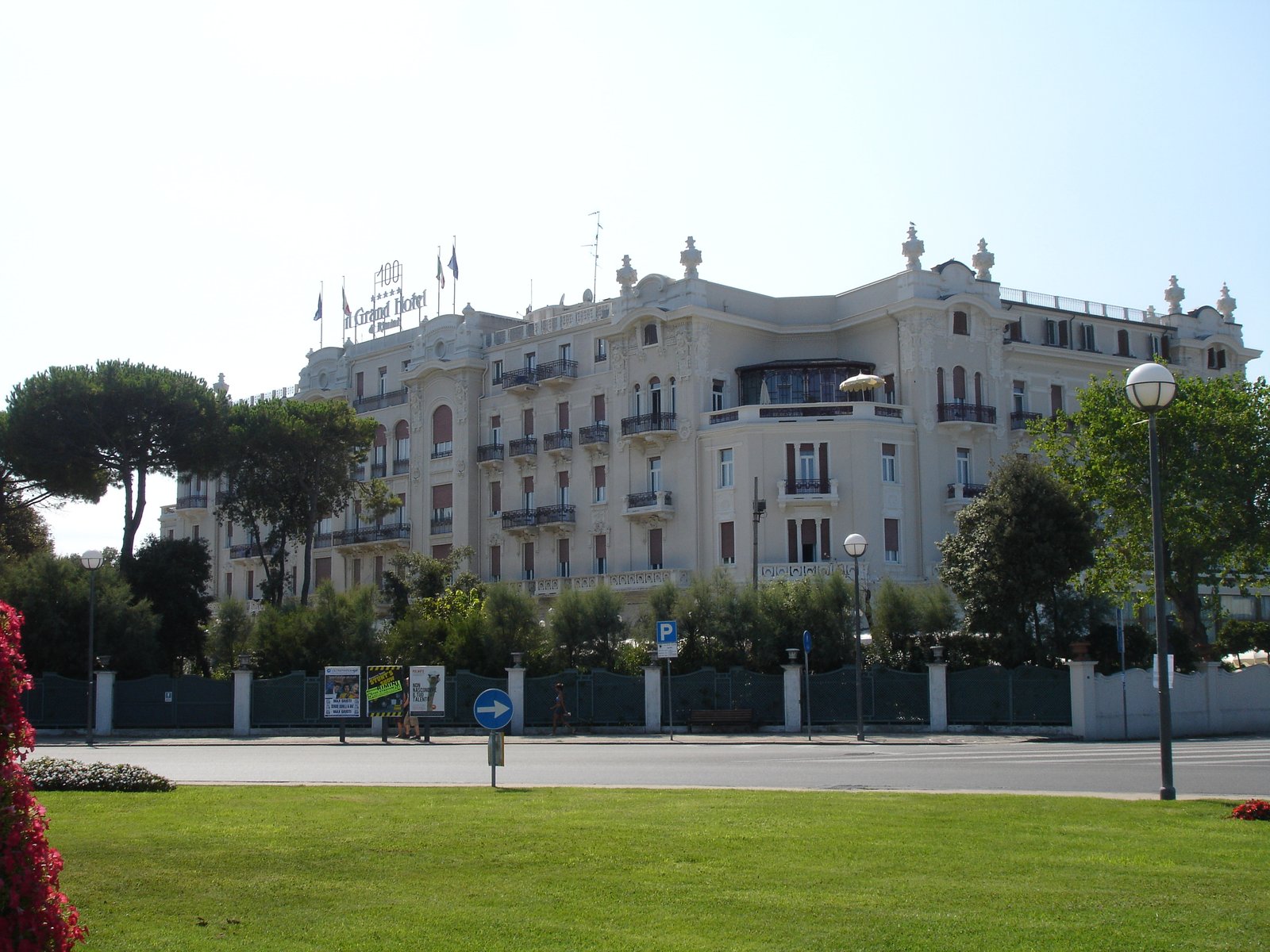
The Grand Hotel Rimini has presided over the Adriatic seafront since 1 July 1908 — a Liberty palace of gilded stucco, Murano glass, and salt air that Federico Fellini called the most beautiful place in the world.
At a glance
Rimini’s Grand Hotel is one of Italy’s last great Belle Époque resort hotels still operating at full luxury standard. Set within Parco Federico Fellini at the southern end of the beach promenade, the five-star property combines original Liberty interiors — period parquet, gilded plasterwork, antique French and Venetian furniture — with contemporary amenities. It is as much a cultural monument as a working hotel, inseparable from the biography of Federico Fellini and from Rimini’s identity as the Adriatic’s most storied resort.
Key facts
- Opened: 1 July 1908
- Architect: Paolito Somazzi (attributed; engineer Giacomo Guazzoni)
- Style: Liberty (Italian Art Nouveau) / Belle Époque eclectic
- Address: Parco Federico Fellini 1, 47921 Rimini RN, Italy
- Status: Active five-star hotel, privately owned
- Designation: Protected monument; part of Rimini’s Fellini heritage trail
- Coordinates: 44.0725° N, 12.5767° E
History
In the closing years of the nineteenth century, Rimini was transforming itself from a modest fishing port into one of the Adriatic coast’s most fashionable summer destinations. The Italian and Austrian aristocracy had discovered the long shallow beach, and investors saw an opportunity. The result was the Grand Hotel: a structure conceived on a scale and in a style that would announce Rimini’s arrival as a serious resort on the European circuit.
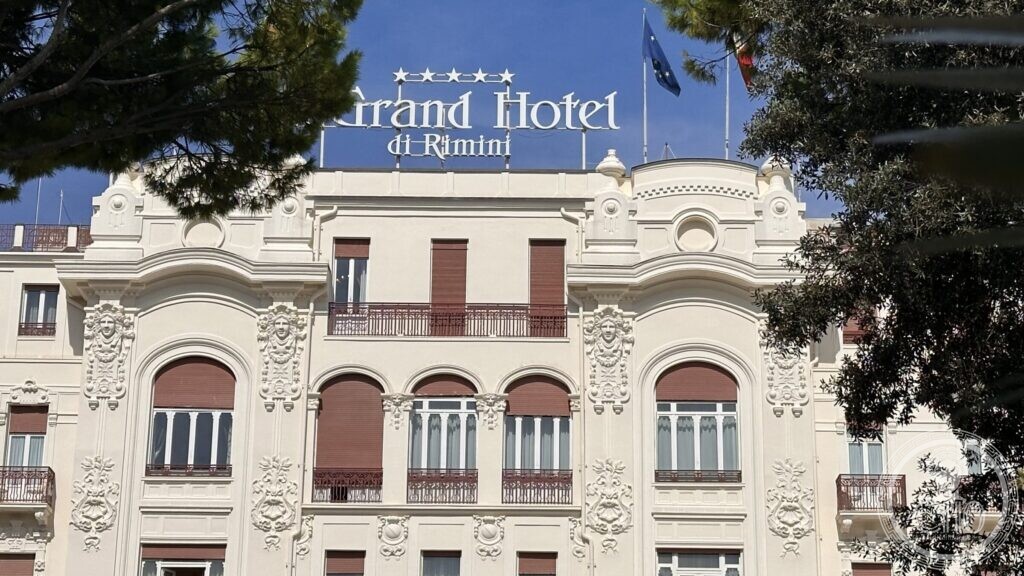
The hotel opened on 1 July 1908, designed by Paolito Somazzi — whose precise biography remains a subject of some scholarly disagreement, though he is most often described as Swiss or Swiss-Italian — with engineering by Giacomo Guazzoni. The building rose in the Liberty manner then sweeping across northern Italy, its cream-and-white façade crowned by two distinctive domes that became landmarks visible from the sea. Inside, the original fit-out was exceptional: eighteenth-century French and Venetian furniture, Murano glass chandeliers, original parquet floors, and gilded stucco ceilings that spoke of a clientele accustomed to the grandest European hotels.
On 14 July 1920, a fire broke out and devastated the upper section of the building. The blaze was severe enough to summon firefighters from Bologna and military units; in the chaos, a seventeen-year-old boy scout named Anacleto Ricci died helping to evacuate guests and was posthumously awarded a gold medal for civil valour. The fire permanently destroyed the two domes, and they were never rebuilt, giving the building the silhouette it retains today.
In 1952 the property was sold to Manfredo Durante, who undertook substantial restoration. The hotel survived the Second World War without the structural damage suffered by much of the Adriatic coast, and by the postwar decades it had become the symbolic heart of Rimini’s new role as Italy’s premier popular seaside resort.
The Fellini dimension deepened over decades. The young Federico Fellini — born in Rimini in 1920, the same year as the fire — worked at the hotel as a caricaturist in his youth and returned throughout his career, eventually keeping suite 315 as a quasi-permanent retreat. In August 1993 he suffered a stroke there; he died in Rome on 31 October of that year. His 1973 film Amarcord, which won the Academy Award for Best Foreign Language Film, features scenes set at the Grand Hotel — though the production was filmed using a replica built at Cinecittà studios rather than the building itself. The park outside was renamed Parco Federico Fellini after his death, completing the identification of place and artist that defines how the world now reads this building.
What you see
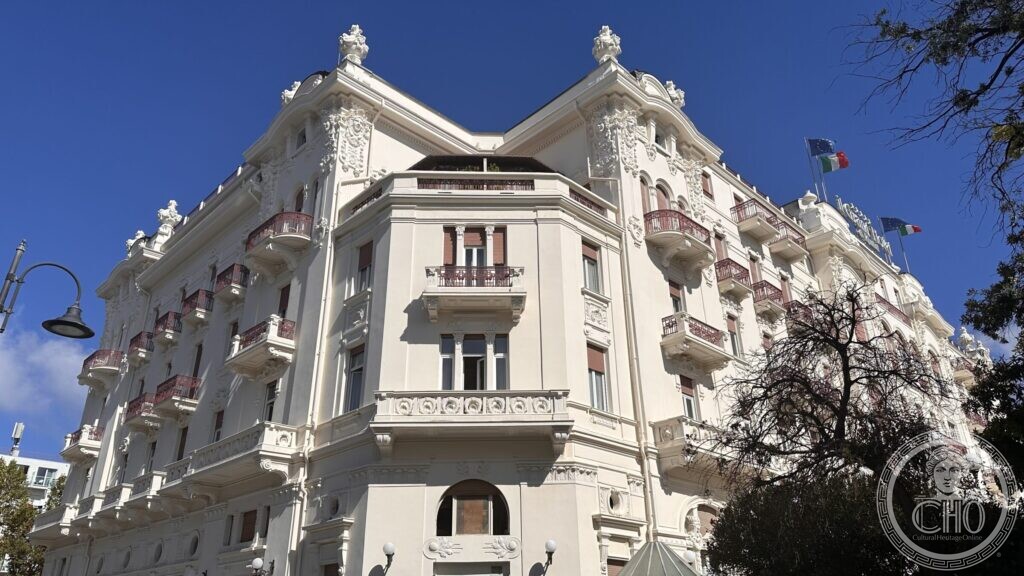
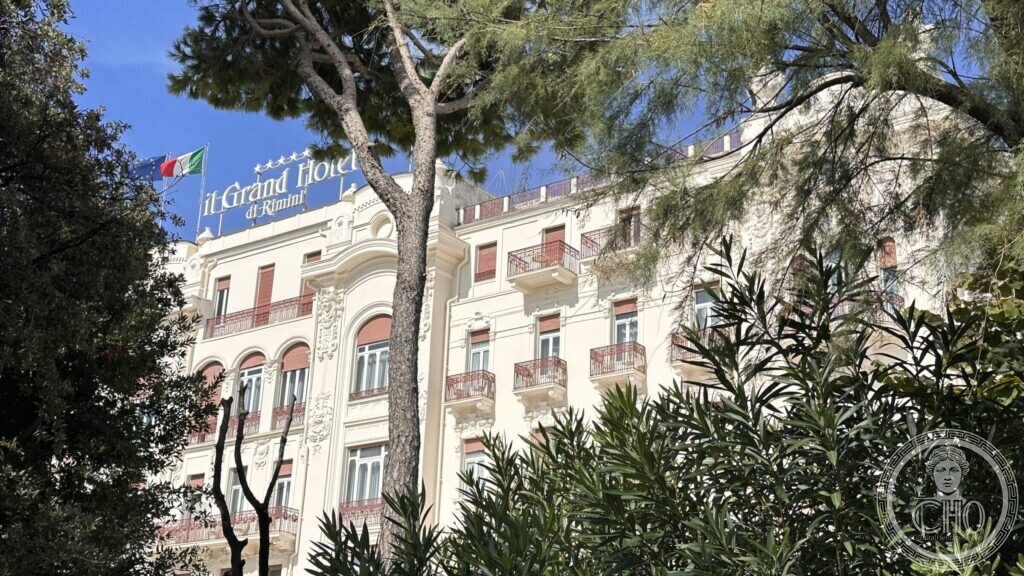
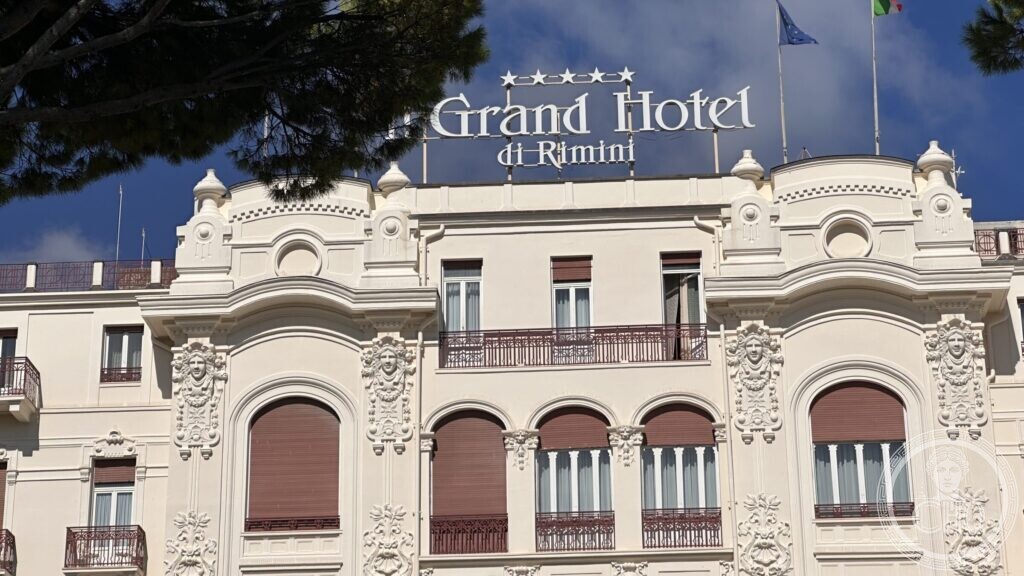
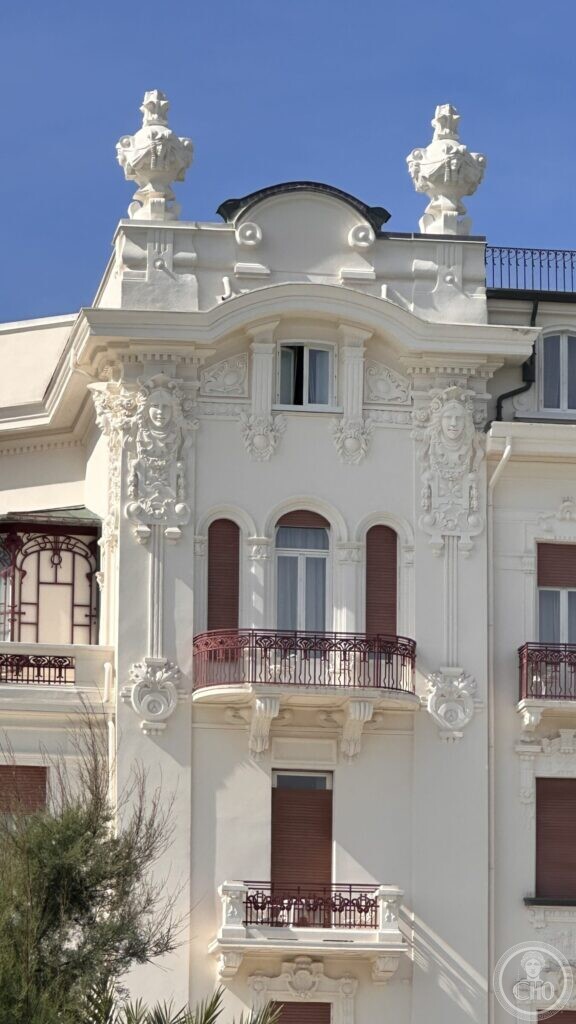
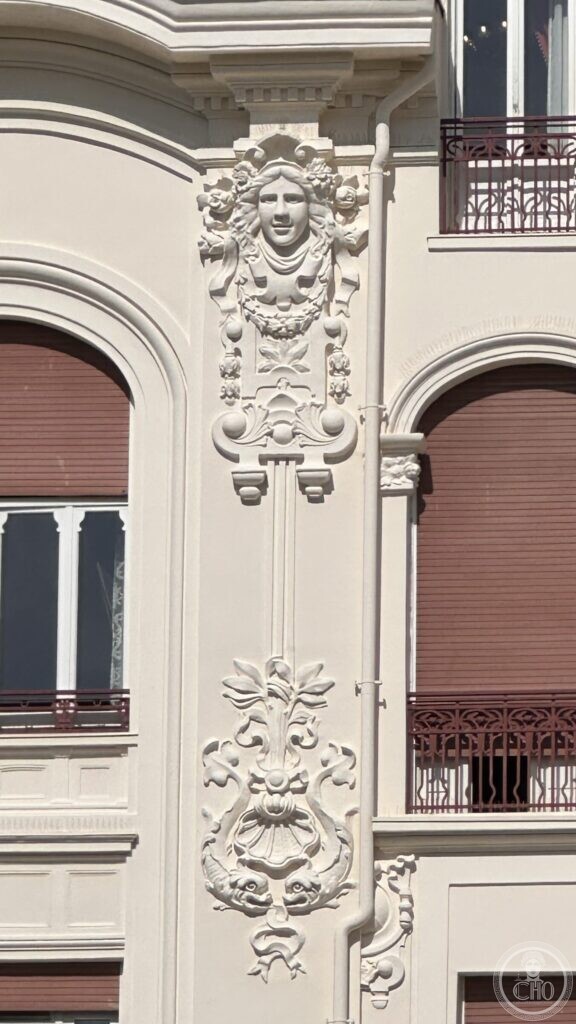
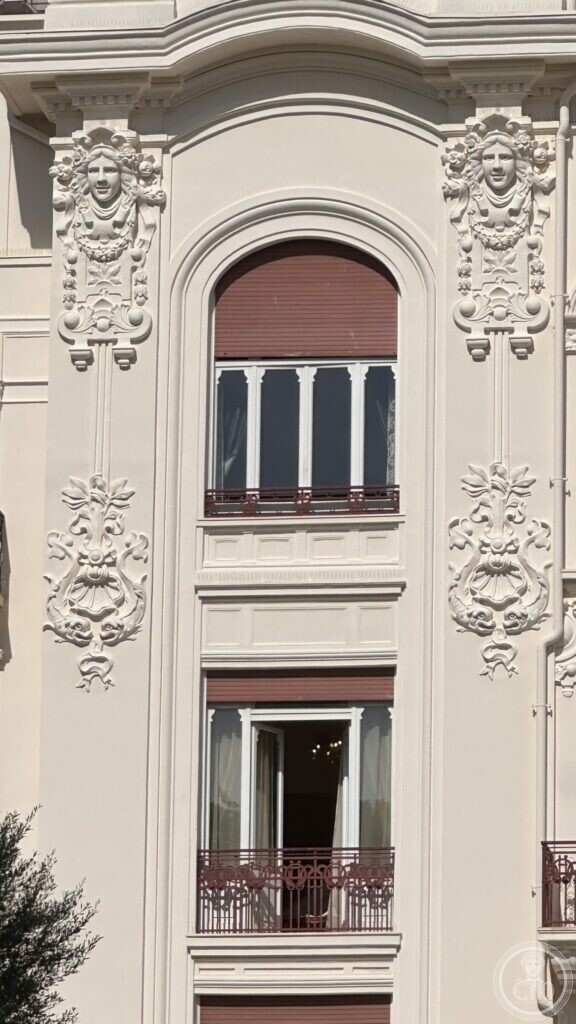
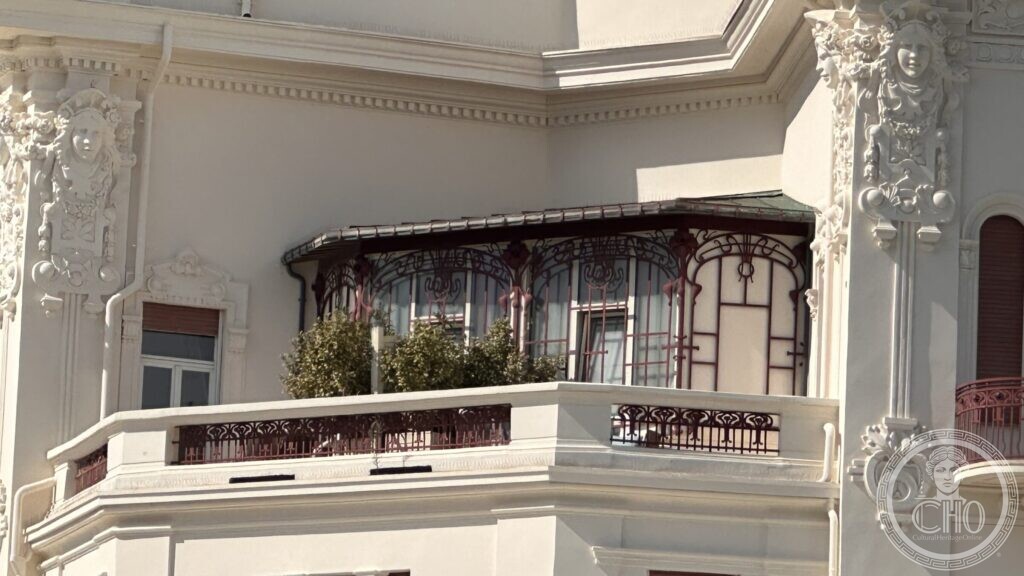
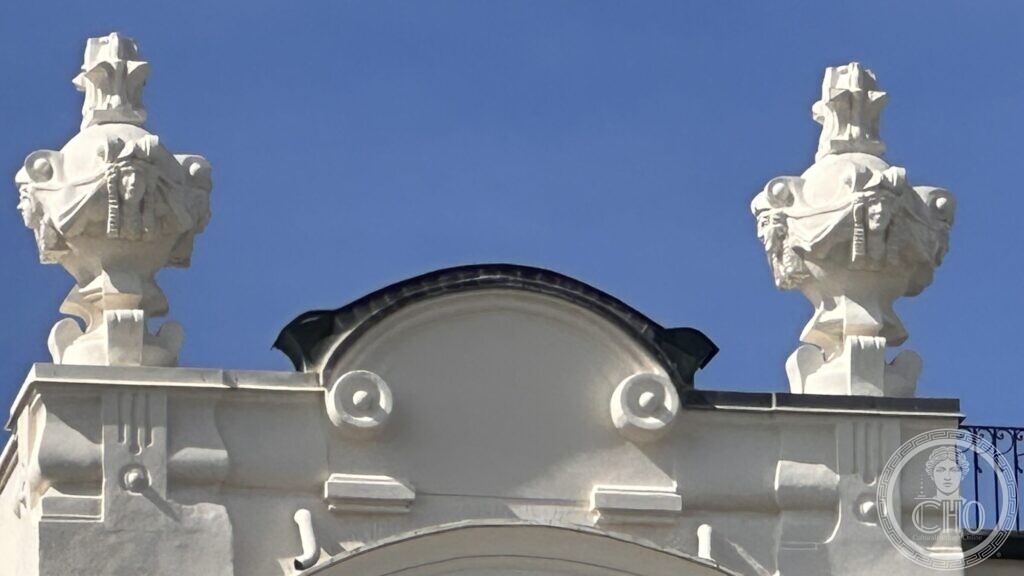
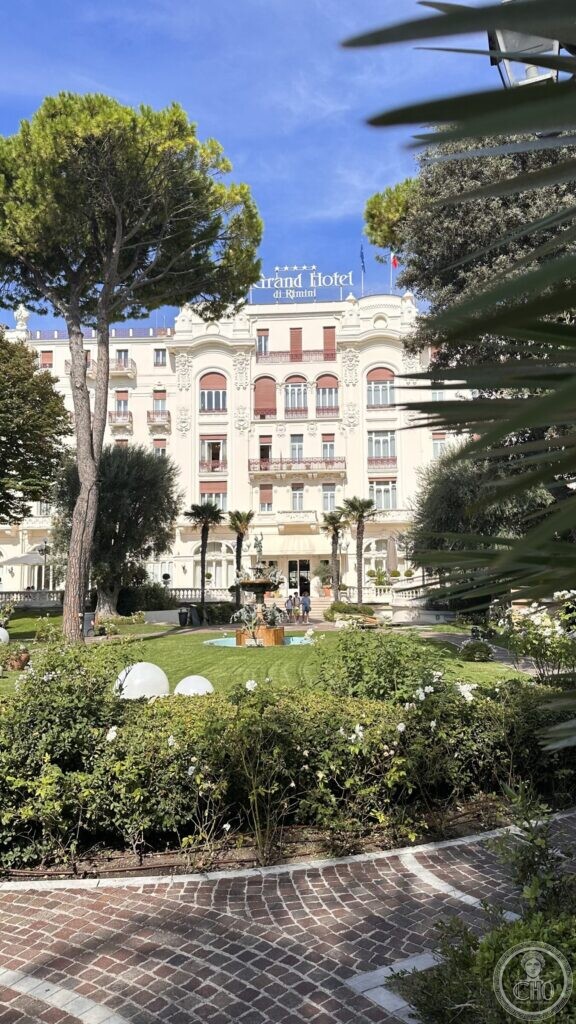
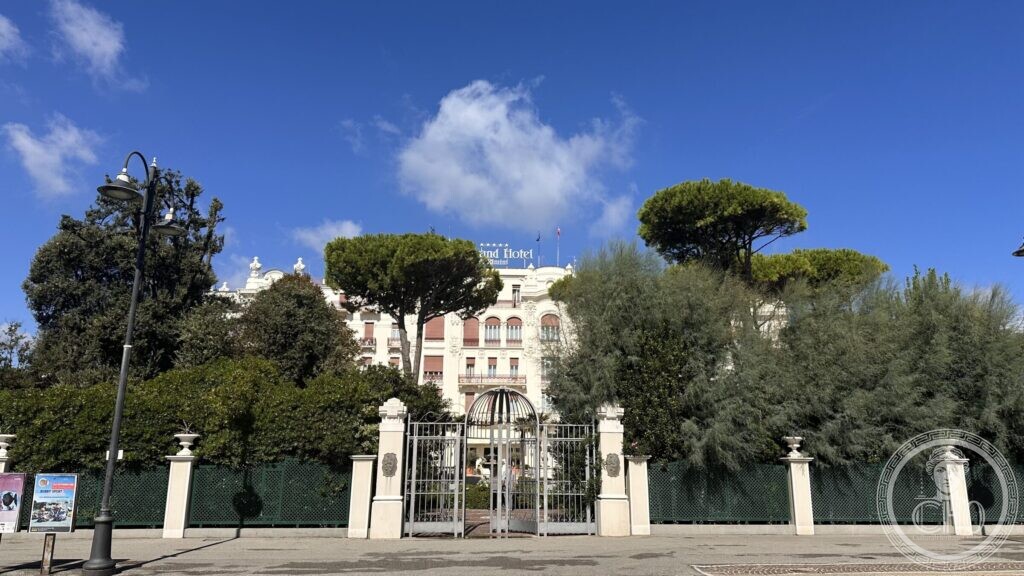
The exterior presents a broad symmetrical façade in cream and white, articulated by loggias, decorative ironwork balconies, and ornamental cornices in the Liberty manner. Without its original domes — lost in the 1920 fire — the roofline reads as a long horizontal plane, giving the building an almost cinematic frontality when viewed from the park or the beach. At dawn, when the Adriatic light is pale and horizontal, the facade takes on a quality that is easy to understand why Fellini found it inexhaustible as an image.
Inside, the principal public rooms have been maintained with exceptional fidelity to their original character: gilded stucco ceilings, period parquet, antique furniture, and Murano glass chandeliers create an atmosphere of sustained late-nineteenth-century luxury. Photographic documentation of Fellini’s association with the hotel is woven through several corridors and reception areas, making the interior a small informal museum of the director’s life alongside its role as a working luxury hotel.
The hotel today
Practical information
- Status: Operating five-star hotel; interior accessible to hotel guests only
- Bar & terrace: The hotel bar and seafront terrace are typically accessible to non-guests; confirm directly with the hotel
- Park: Parco Federico Fellini immediately outside is publicly accessible at all times
- Contact: grandhotelrimini.com · +39 0541 56000
- Nearest transit: Rimini railway station (Trenitalia/Intercity), approx. 1.5 km; bus lines 11 and local taxis to seafront
- Recommended visit duration: 30–60 minutes for the park and exterior; longer for guests
Getting there
Rimini is served by frequent direct trains from Bologna (approximately 1 hour), Milan (2.5 hours), and Rome (3.5 hours) on the Adriatic main line. From Rimini railway station, bus line 11 or a short taxi ride (10 minutes) reaches the seafront. The hotel stands at the southern end of the main beach promenade, directly facing the Adriatic at the edge of Parco Federico Fellini; it is clearly visible from the beach and from the parallel viale Principe di Piemonte.
Nearby
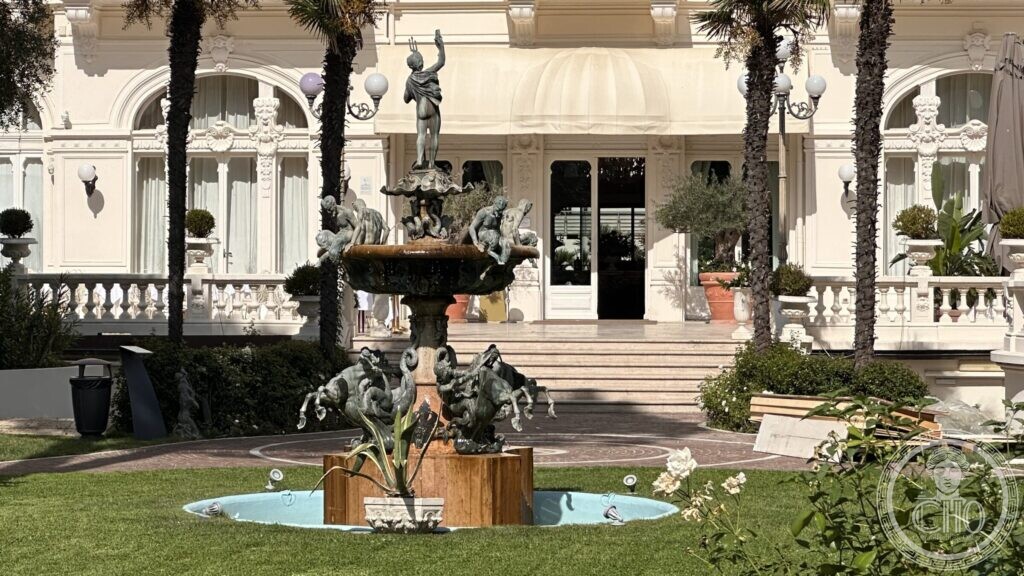
- Parco Federico Fellini — the public park immediately surrounding the hotel, with the Fellini fountain and seafront promenade
- Museo Fellini (Castel Sismondo) — the director’s dedicated museum in the historic centre, approx. 1.5 km
- Arco di Augusto — Roman triumphal arch (27 BC), Rimini historic centre, approx. 1.8 km
- Tempio Malatestiano — Leon Battista Alberti’s Renaissance masterpiece, approx. 1.5 km
See the place
Sources
- Wikipedia, “Grand Hotel Rimini” (EN), citing Archivio di Stato di Rimini and Mario Turci, Il Grand Hotel di Rimini
- Wikipedia, “Grand Hotel (Rimini)” (IT) — architecture, Somazzi, 1920 fire, Fellini details
- Grand Hotel Rimini official website, grandhotelrimini.com — operational and heritage information
- Fellini Museum, Rimini — Fellini biography timeline including hotel connection
- Wikimedia Commons, Grand Hotel Rimini.jpg — Public Domain, photo Michele1978rimini, 2009
Find it on the map
See this place and what’s around it →Record researched and written by Carla Szathvary for Cultural Heritage Online, 2026.
Historical events at this place (1)
📷 Become a Cultural Heritage Online photographer
Share your photos of places: they stay published under your name as the author. The more they're seen, the more you get noticed — and soon a contest will reward the most appreciated photos.
Log in or sign up free to add a photoIs this page about you?
This page is read by travellers and heritage enthusiasts who find it on Google. Tell us how you are connected to this place and we will take it from there.