
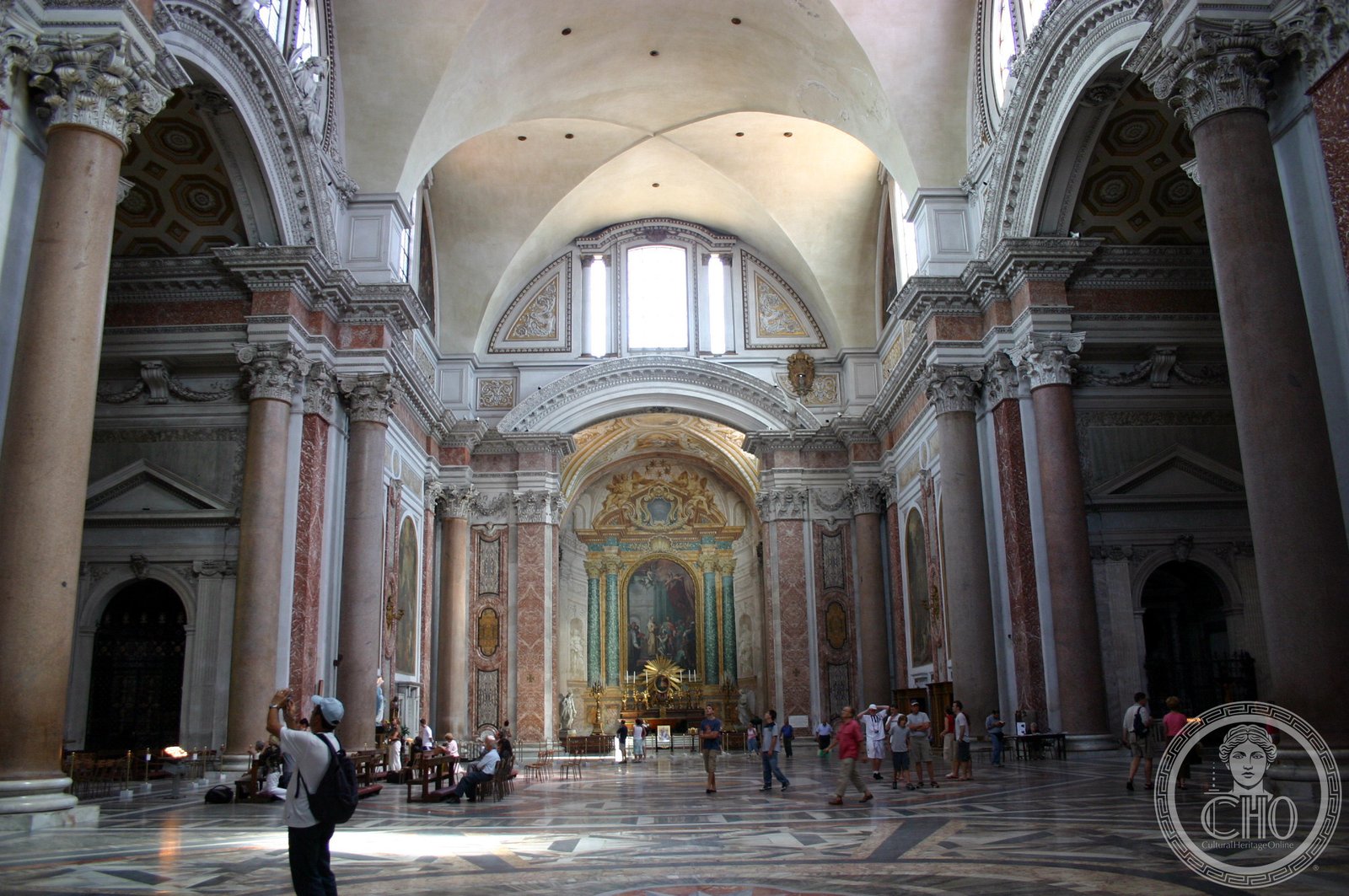
Basilica of Saint Mary of the Angels and the Martyrs
The Basilica of Saint Mary of the Angels and the Martyrs is a Catholic titular minor basilica in Rome, built within the surviving ruins of the frigidarium and tepidarium of the ancient Baths of Diocletian in the Piazza della Repubblica. Designed by Michelangelo in 1563 at the age of 88 — one of his final commissions — and subsequently modified by Luigi Vanvitelli in the 18th century, the church is notable for its vast barrel-vaulted interior, which preserves the monumental scale of the original Roman thermae. It serves as the national basilica for ceremonies of state and for the Italian armed forces.
At a glance
- Type
- Catholic titular minor basilica; former Carthusian conventual church
- Period
- Baths of Diocletian built c. 298–306 CE; church consecrated 1561; transformed by Michelangelo 1563; modified by Vanvitelli 1749
- Style
- Roman thermae shell; Renaissance interior with Baroque modifications
- Location
- Piazza della Repubblica, 00185 Rome, Italy · 41.9031° N, 12.4969° E
Overview
The Basilica of Saint Mary of the Angels and the Martyrs occupies the central hall of the Baths of Diocletian, the largest of all ancient Roman thermae, which once accommodated over 3,000 bathers simultaneously. Pope Pius IV commissioned Michelangelo to convert the ruins into a Christian place of worship, and the result is one of the most striking architectural transformations in Rome, where Roman engineering and Christian faith share the same space. The church faces the Piazza della Repubblica, itself laid out atop the curved exedra of the ancient baths complex.
History
The Baths of Diocletian were completed around 306 CE and fell into disuse after the disruption of the aqueducts in the 6th century. For centuries the ruins served as quarries for marble and building materials. In 1561 the Sicilian priest Antonio Lo Duca, who had long campaigned for a memorial to the Christian martyrs believed to have laboured on the baths’ construction, obtained a papal bull from Pius IV authorising the conversion. Michelangelo was appointed architect and adapted the frigidarium as the church’s nave, retaining the eight monolithic granite columns — each 14 metres high — that still define the interior. Luigi Vanvitelli undertook a significant reorganisation of the interior in 1749, rotating the orientation by 90 degrees and adding the transept chapels.
What you see
Entering through the convex brick facade — actually the curved wall of the ancient caldarium — visitors step into one of Rome’s most dramatically spacious interiors: a cross-shaped nave 90 metres long and 28 metres high, with eight original ancient granite columns still bearing their load. The meridian line inlaid in the floor, installed in 1702 by astronomer Francesco Bianchini on commission from Pope Clement XI, served for almost a century as Italy’s official timepiece. The walls hold a gallery of Baroque paintings and funerary monuments to Italian national heroes including Armando Diaz and Pietro Badoglio.
Cultural significance
The basilica is the only major Roman church built within the shell of a pagan monument with the explicit intention of preserving the ancient fabric, making it a landmark of adaptive reuse long before the concept was formalised. Its status as a national basilica of Italy and its location beside Termini station give it unusual prominence in civic as well as religious life, hosting funerals of state and annual celebrations of the Republic.
Practical information
Address: Piazza della Repubblica, 00185 Rome. The basilica is generally open daily; check the official website for current hours as they may vary for liturgical events. Entry is free. Photography is permitted in non-liturgical hours. Dress code applies.
Getting there
The basilica is directly beside Repubblica metro station (Line A), which is also served by the Termini interchange hub for regional trains, suburban rail, and numerous bus lines. The church entrance faces the Piazza della Repubblica fountain.
Sources & resources
Find it on the map
See this place and what’s around it →Historical events at this place (3)
📷 Diventa un fotografo di Cultural Heritage Online
Condividi le tue foto dei luoghi: restano pubblicate con la tua firma come autore. Più vengono viste, più ti fai conoscere — e presto un concorso premierà le foto più apprezzate.
Accedi o registrati gratis per aggiungere una fotoDo you manage this place?
This page is read by travellers and heritage enthusiasts who find it on Google. Keep it accurate — and make it work for you. Free for non-profit heritage institutions.