
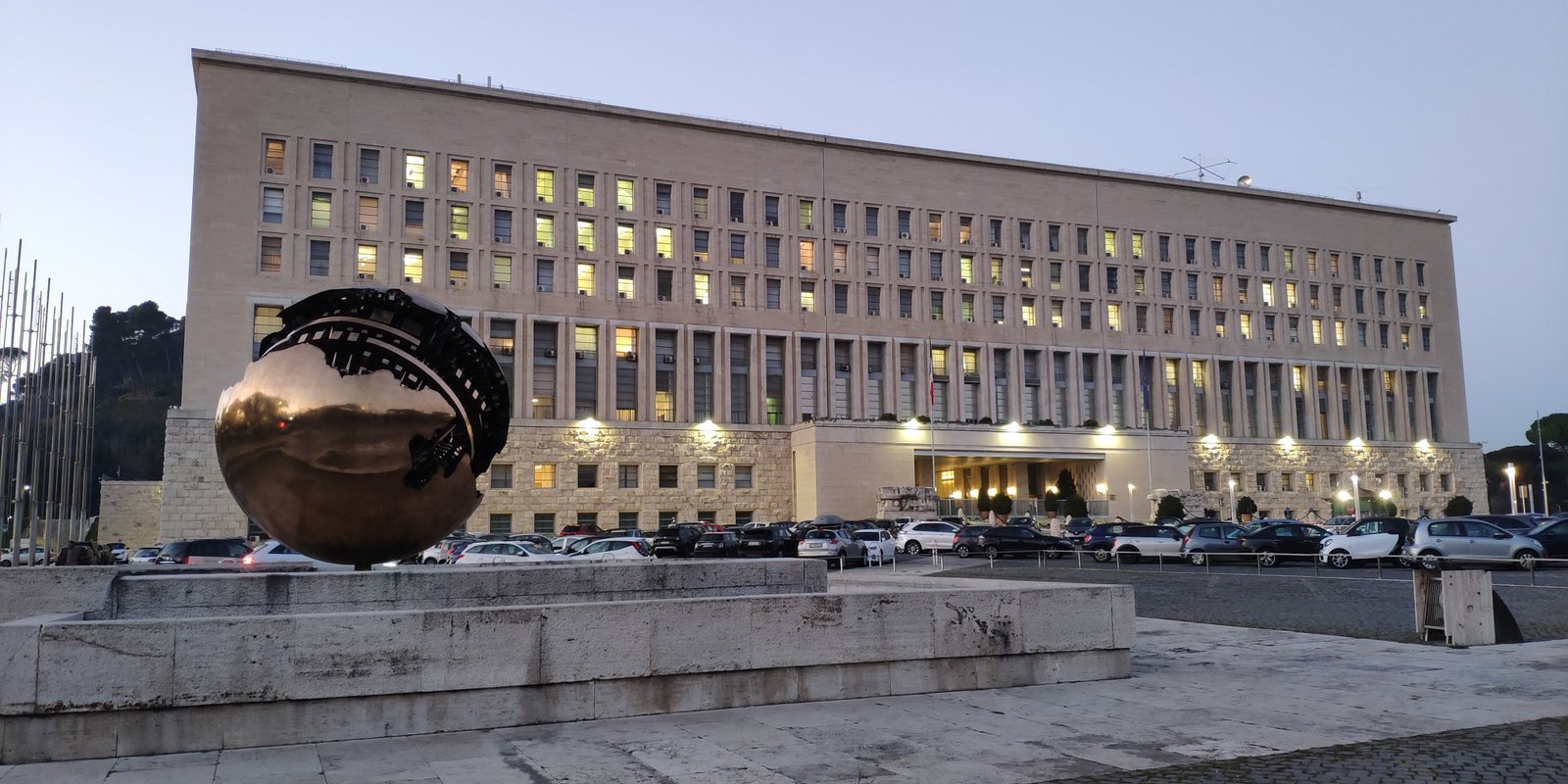
A monumental travertine block on the right bank of the Tiber, designed in 1935 by Enrico Del Debbio, Arnaldo Foschini and Vittorio Ballio Morpurgo as the headquarters of the National Fascist Party, and completed in 1959 to house the Italian Ministry of Foreign Affairs.
At a glance
The Palazzo della Farnesina stands between Monte Mario and the Tiber, on the northern edge of the Foro Italico, as one of the largest civilian buildings ever raised in Italy. Designed in 1935 and only finished a quarter-century later, it carries the architectural memory of two regimes: it was conceived as the parade-ground seat of the Partito Nazionale Fascista, then completed and re-purposed by the republican state as the home of the Ministry of Foreign Affairs. Romans simply call it “la Farnesina”, and the name has long since detached from the building to mean the ministry itself.
Key facts
- Architects: Enrico Del Debbio (1891–1973), Arnaldo Foschini (1884–1968), Vittorio Ballio Morpurgo (1890–1966)
- Design: 1935 · Construction: begun 1937, halted 1943, completed 1959
- Original purpose: headquarters of the National Fascist Party (Palazzo del Littorio)
- Current use: seat of the Ministero degli Affari Esteri e della Cooperazione Internazionale (MAECI)
- Scale: nine stories, 169 m wide, 51 m tall, more than 1,300 rooms, 120,000 m² floor area, ~720,000 m³ internal volume
- Materials: reinforced concrete frame with travertine cladding
- Coordinates: 41.9372° N, 12.4579° E
History
The building belongs to a competition launched in 1934 for the new headquarters of the Partito Nazionale Fascista on the Via dell’Impero, opposite the Basilica of Maxentius. None of the projects submitted in the first round was built on that site. The brief was then transferred to a different location, the Foro Mussolini (today Foro Italico) on the right bank of the Tiber, and entrusted to a team made up of Enrico Del Debbio, Arnaldo Foschini and Vittorio Ballio Morpurgo, three architects already closely associated with the regime’s official commissions in Rome. Their joint scheme, signed in 1935, fixed the shape of the future Farnesina: a nine-story parallelepiped clad in travertine, austere and symmetrical, conceived to dominate the new sports and parade district extending north from the Stadio dei Marmi.
Construction began in 1937 and was carried up to the cornice line, but the war stopped work in 1943. The empty shell stood through the German occupation and the early post-war years. When the Italian Republic eventually took the unfinished structure in hand, it was decided not to demolish it but to complete it as the new seat of the Ministry of Foreign Affairs, which until then had been scattered across thirteen separate offices in Rome. The interiors were finished, finishes simplified, and the building was inaugurated in 1959. From that year the word “Farnesina” began to function as a metonym for Italian foreign policy, in the same way that “the Quirinale” stands for the presidency.
The name itself is older than the building. The land between Monte Mario and the Tiber had been known since the sixteenth century as the Orti della Farnesina, the Farnese gardens, after the family of Pope Paul III. It should not be confused with the small Renaissance villa on Via della Lungara also called the Farnesina, which Baldassarre Peruzzi built for Agostino Chigi around 1509 and which has no architectural relationship to the ministry.
What you see
The mass of the Farnesina reads, from the embankment of the Tiber, as a single travertine block with no visible roof line. The travertine cladding is laid in regular courses and pierced by long files of identical rectangular windows, with no orders, no cornices and no sculpture on the main elevations. The composition belongs to the late-1930s strand of Italian rationalism that Giuseppe Terragni had brought to a smaller, sharper resolution in Como, but at the Farnesina the same vocabulary is stretched across a 169-metre frontage to serve a different purpose: not abstraction, but state representation. The result is closer to the monumental classicism of the Foro Italico than to the experimental rationalism of the northern cities.
Set against the green slope of Monte Mario and approached from the wide Piazzale della Farnesina, the building is best read at a distance, where its proportions resolve into a long horizontal block balanced by the vertical accent of the central entrance bay. From inside the perimeter walls, the scale becomes harder to grasp: corridors run for hundreds of metres, light courts open between the wings, and the building functions, as Wikipedia notes, on a footprint comparable to the eighteenth-century Royal Palace of Caserta.
Practical information
- Access: the building is an active ministry and is not open for unrestricted visits
- Art collections: the Farnesina Collection of 20th-century Italian art, the Farnesina Experimenta collection and the Farnesina Design Collection are accessible through periodic exhibitions and guided visits coordinated by the Ministry
- Open Doors: the ministry runs an annual “Porte Aperte alla Farnesina” day, when the building and parts of its art collection are opened to the public
- Best view from outside: from the Ponte della Farnesina or from Lungotevere Maresciallo Cadorna, on the opposite bank of the Tiber
- Time needed: 20–30 minutes for the exterior; half a day if combining with the Foro Italico
Getting there
The Farnesina sits in the Della Vittoria quarter, just north of the Foro Italico and the Olympic Stadium. From central Rome the simplest route is by tram or bus to the Piazza Mancini terminus, then a short walk across the Ponte Duca d’Aosta; by car, the Lungotevere route along the Tiber leads directly to Piazzale della Farnesina. The nearest railway station is Roma Ostiense via the metro line connections; visitors arriving at Fiumicino airport reach the building in about forty minutes via the GRA ring road exit at Cassia.
Nearby
- Foro Italico — the 1928–1938 sports complex by Enrico Del Debbio and Luigi Moretti, directly south of the Farnesina
- Stadio dei Marmi — the marble-statued running track that anchors the southern end of the Foro Italico
- Ponte Milvio — the ancient Roman bridge, 1 km upstream on the Tiber
- Villa Madama — the Raphael-designed Renaissance villa on the slope of Monte Mario, used today by the Ministry for state ceremonies
See the place
Sources
- Wikipedia — Palazzo della Farnesina (English)
- Wikimedia Commons — Palazzo della Farnesina (Rome)
- Ministero degli Affari Esteri e della Cooperazione Internazionale — official portal of the institution housed in the building
- Wikipedia — Enrico Del Debbio (lead architect, also responsible for the Foro Italico)
Find it on the map
See this place and what’s around it →Historical events at this place (3)
📷 Become a Cultural Heritage Online photographer
Share your photos of places: they stay published under your name as the author. The more they're seen, the more you get noticed — and soon a contest will reward the most appreciated photos.
Log in or sign up free to add a photoIs this page about you?
This page is read by travellers and heritage enthusiasts who find it on Google. Tell us how you are connected to this place and we will take it from there.