
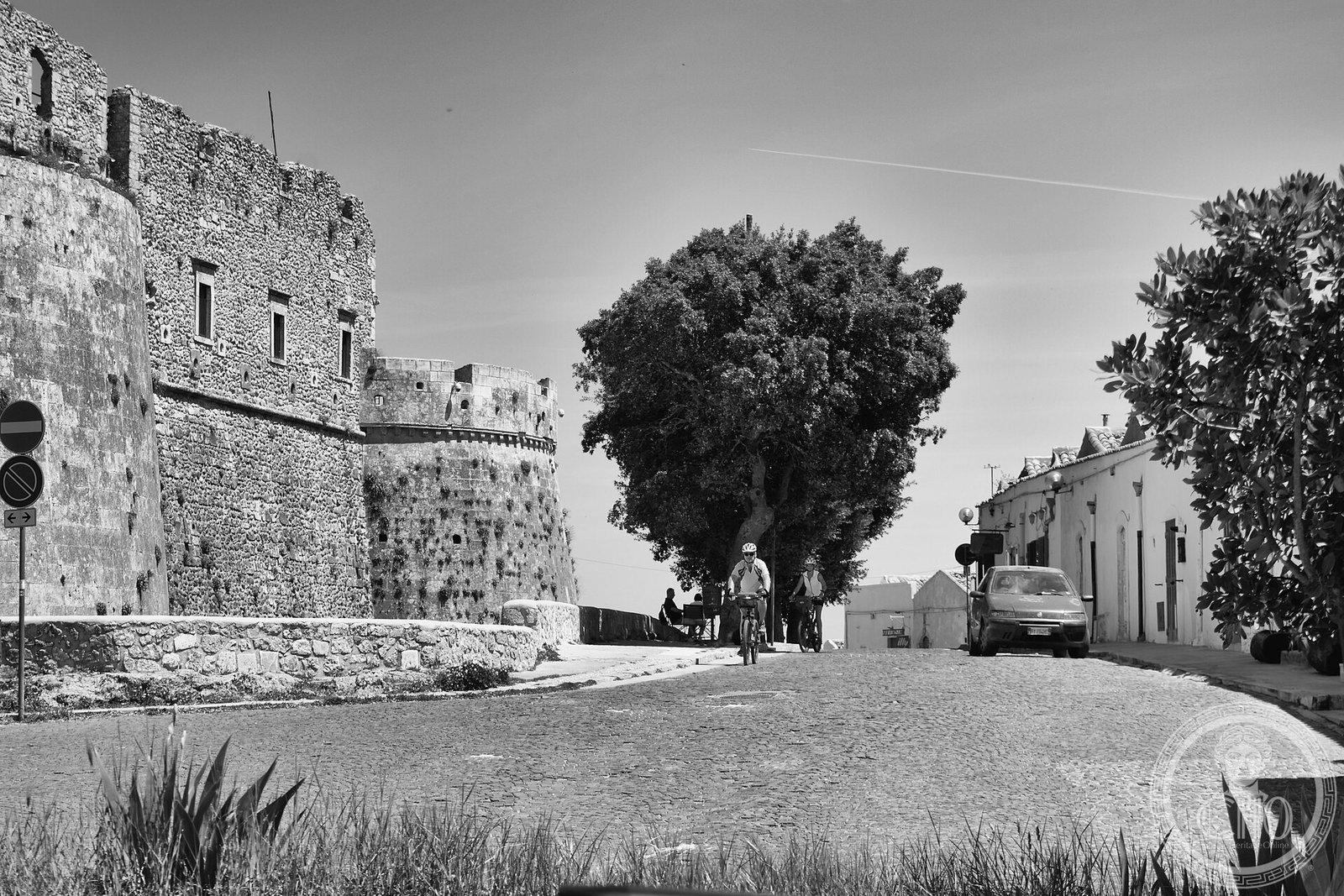
Castel Sant’Angelo crowns the historic hilltop town of Monte Sant’Angelo in the Gargano promontory of Puglia, a site long venerated as the location of the Sanctuary of Saint Michael the Archangel — a UNESCO World Heritage Site since 2011. The castle is a layered Norman–Swabian–Aragonese fortification whose construction history spans from the 11th to the 15th century, reflecting successive waves of southern Italian ruling dynasties that each reinforced the strategic heights above the Adriatic plain. Together with the nearby sanctuary, the castle forms the monumental heart of one of the oldest Christian pilgrimage centres in Europe.
At a glance
- Type
- Medieval castle; archaeological area
- Period
- Norman foundations 11th century; Swabian and Aragonese phases 13th–15th century
- Style
- Norman military architecture with Swabian and Aragonese modifications
- Location
- Monte Sant’Angelo, Province of Foggia, Puglia, Italy
- Coordinates
- 41.7077° N, 15.9530° E
Overview
Monte Sant’Angelo is one of the Borghi più belli d’Italia — Italy’s most beautiful villages — perched at roughly 800 metres on the southern slopes of the Gargano massif in the Province of Foggia. The town has been a major pilgrimage destination since the late 5th century, when apparitions of Saint Michael the Archangel were reported in a cave sanctuary that would become the Santuario di San Michele Arcangelo. The castle that dominates the town from its highest point bears witness to the strategic importance Norman, Hohenstaufen, and Aragonese rulers placed on controlling this sacred and militarily advantageous hilltop.
History
The Normans, who conquered southern Italy in the 11th century, constructed the initial fortifications to consolidate control over Puglia and protect the pilgrimage routes to the sanctuary below. Subsequent Swabian (Hohenstaufen) rulers, notably Frederick II, carried out substantial works in the 13th century as part of the systematic modernisation of the Kingdom of Sicily’s defensive infrastructure. Aragonese rulers expanded and strengthened the castle in the 15th century, adding elements typical of late-medieval military engineering. The archaeological area around the castle has yielded finds attesting to earlier pre-Norman occupation of the site.
What you see
The castle presents a dramatic silhouette of cylindrical and square towers, curtain walls, and a central keep arranged to exploit the natural defensive advantage of the rocky spur. The adjacent archaeological area reveals structural remains from multiple periods of occupation. From the castle platform, panoramic views extend across the Gargano plateau and, on clear days, out to the Adriatic Sea. The nearby Sanctuary of Saint Michael, carved into the living rock and entered via an 11th-century Romanesque portal, forms an essential companion visit.
Cultural significance
Monte Sant’Angelo’s sanctuary complex — including the castle precinct — was inscribed on the UNESCO World Heritage List in 2011 as part of the serial site “Longobards in Italy: Places of Power.” The site encapsulates over fifteen centuries of pilgrimage, representing one of the earliest and most enduring sacred landscapes in Christian Europe, drawing visitors from across the medieval world including Francis of Assisi and Thomas Aquinas.
Practical information
The castle and archaeological area are located in the upper historic centre of Monte Sant’Angelo. The Sanctuary of Saint Michael Archangel is open daily; check the official sanctuary website for castle access and opening hours, as schedules vary seasonally. Admission fees apply.
Getting there
Monte Sant’Angelo is about 45 km northeast of Foggia by road (SS89 then SP53). There is no rail connection; the nearest station is Foggia, from which buses and taxis serve Monte Sant’Angelo. By car from the A14 motorway, exit at Foggia or Manfredonia. The town is also accessible by bus from Manfredonia (about 20 km).
Sources & resources
See the place
Find it on the map
See this place and what’s around it →📷 Become a Cultural Heritage Online photographer
Share your photos of places: they stay published under your name as the author. The more they're seen, the more you get noticed — and soon a contest will reward the most appreciated photos.
Log in or sign up free to add a photo