
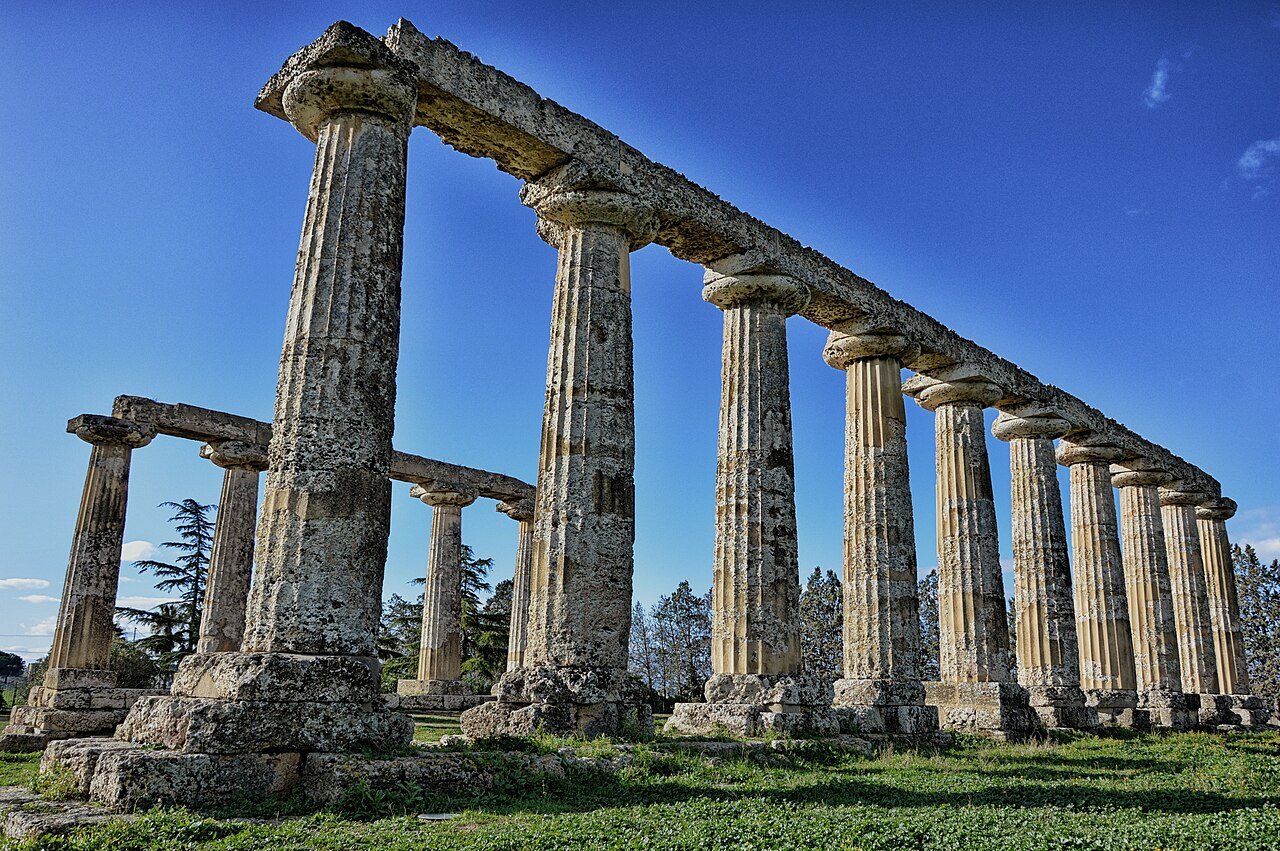
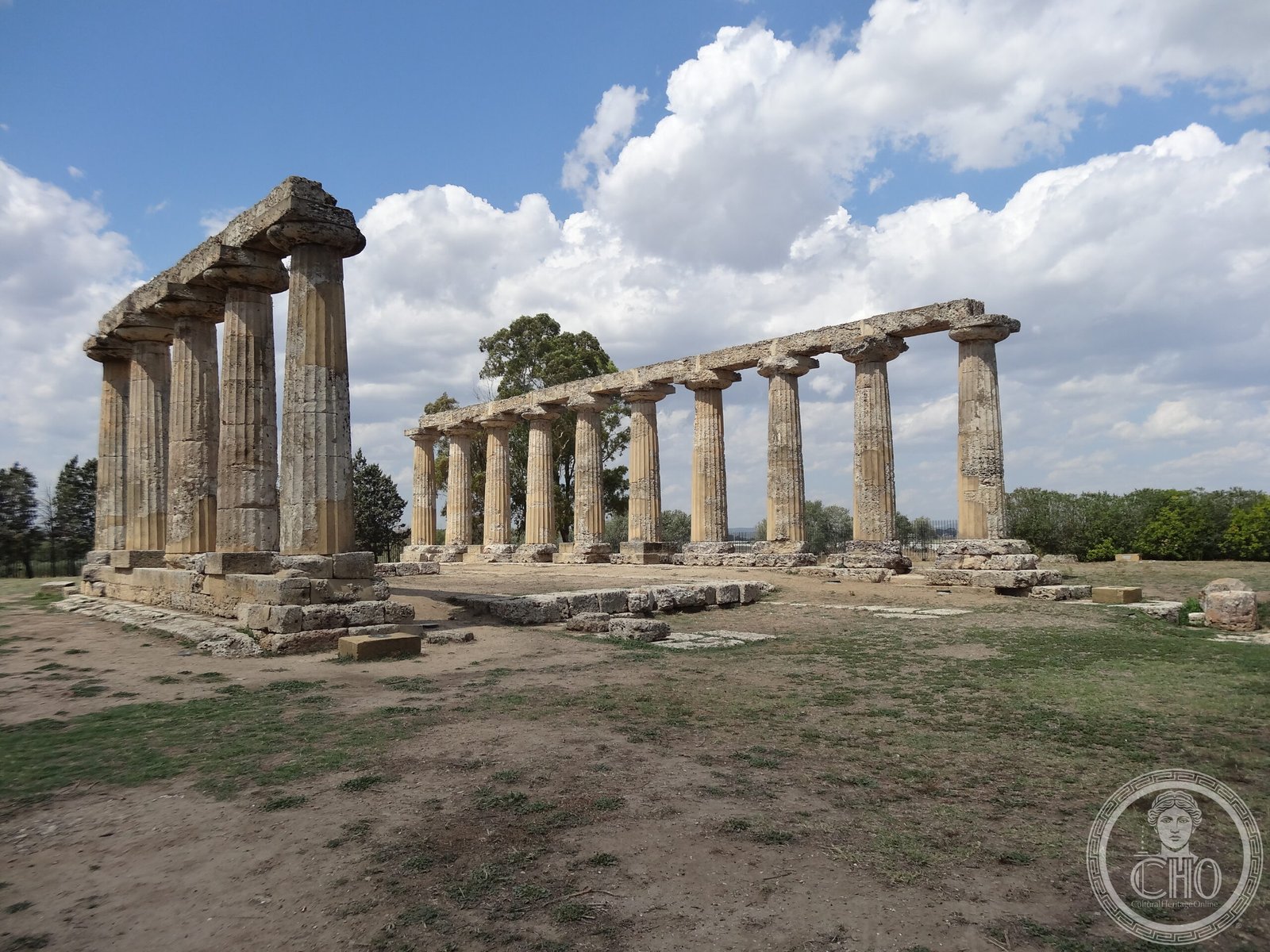
The Tavole Palatine — the Palatine Tables — are the best-preserved standing remains of a Greek temple in Basilicata, rising from the flat plain north of Metaponto beside the river Bradano. Built in the sixth century BC as a hexastyle peripteral temple of the Doric order, the sanctuary was dedicated to the goddess Hera and possibly also honoured Apollo. Fifteen of the original columns still stand in situ, giving the monument an immediate visual power that makes it one of the most photographed ancient sites on the Ionian coast of southern Italy. Together with the adjacent urban archaeological park, the Tavole Palatine anchor the broader Parco Archeologico di Metaponto.
At a glance
- Type
- Ancient Greek peripteral temple (hexastyle Doric)
- Period
- c. 570–530 BC (Archaic period)
- Style
- Doric order, Magna Graecia variant
- Location
- Via Lido, north of Metaponto village, Province of Matera, Basilicata, Italy
- Coordinates
- 40.4160° N, 16.8168° E
- Dedication
- Hera (and possibly Apollo)
- Managed by
- Parco Archeologico di Metaponto / Ministero della Cultura
Overview
The Tavole Palatine are the remains of a hexastyle peripteral Greek temple of Magna Graecia, built in the sixth century BC and dedicated to the goddess Hera and the god Apollo. Standing outside the main urban grid of ancient Metapontum, the sanctuary likely served as an extra-urban religious landmark visible to ships approaching the coast and to travellers along the road from Tarentum. The survival of fifteen columns above ground, an unusual degree of preservation for this region, has made the temple a symbol of the Magna Graecia heritage of Basilicata.
History
The temple was constructed during the Archaic period of Greek colonisation, probably between 570 and 530 BC, when Metapontum was at the height of its early prosperity as a grain-exporting colony. It was built on a low terrace north of the city, on the left bank of the Bradano, in a location that reinforced its role as a territorial sanctuary marking the boundary of the Metapontine chora. Ancient tradition connected the site with Pythagoras, who allegedly died nearby around 495 BC, lending the place an additional layer of intellectual and religious significance. Systematic excavation of the site began in earnest in the twentieth century and revealed a temenos wall, an earlier altar, and votive deposits confirming continuous worship over several centuries.
What you see
Fifteen Doric columns still stand on the three-stepped stylobate of the temple, arranged along two of the long sides and part of one short side, with fallen drums scattered around the base. The columns retain their full height, allowing visitors to appreciate the original proportions of the Doric order as applied in a colonial context far from the mainland Greek canons. The surrounding temenos enclosure is partly visible in the grass, and excavated traces of the altar lie to the east of the main structure. The flat agricultural plain surrounding the temple, with views to the Ionian Sea to the south-east and the Lucanian hills to the north-west, conveys the deliberate landscape positioning that shaped the sanctuary’s ancient meaning.
Cultural significance
The Tavole Palatine are one of the most immediately legible survivals of Magna Graecia architecture anywhere in Italy, offering a visceral sense of the Greek presence on the Italian peninsula without the need for extensive archaeological imagination. Their state of preservation has made them a touchstone for scholarship on Doric temple design in the colonial west, influencing debates about the transmission and adaptation of architectural forms from mainland Greece to the Italian colonies.
Practical information
- Address
- Via Lido, 75010 Metaponto MT, Italy (north of Metaponto village, near the Bradano river)
- Opening hours
- The site is accessible during park opening hours; check the Parco Archeologico di Metaponto or MiC website for current times
- Admission
- Included in the Parco Archeologico di Metaponto ticket
Getting there
The Tavole Palatine lie about 3 km north of Metaponto village and the archaeological museum, signposted from the SS106 Ionica coast road. By rail, arrive at Metaponto station (Taranto–Reggio Calabria line) and take a taxi or cycle north. A bicycle is the most practical way to combine the museum, urban park, and Tavole Palatine in a single visit. Taranto is approximately 45 km to the north along the coast.
Sources & resources
- Wikipedia – Tavole Palatine (Temple of Hera, Metaponto)
- Cultural Heritage Online – culturalheritageonline.com
See the place
Gallery
Find it on the map
See this place and what’s around it →📷 Become a Cultural Heritage Online photographer
Share your photos of places: they stay published under your name as the author. The more they're seen, the more you get noticed — and soon a contest will reward the most appreciated photos.
Log in or sign up free to add a photoIs this page about you?
This page is read by travellers and heritage enthusiasts who find it on Google. Tell us how you are connected to this place and we will take it from there.