
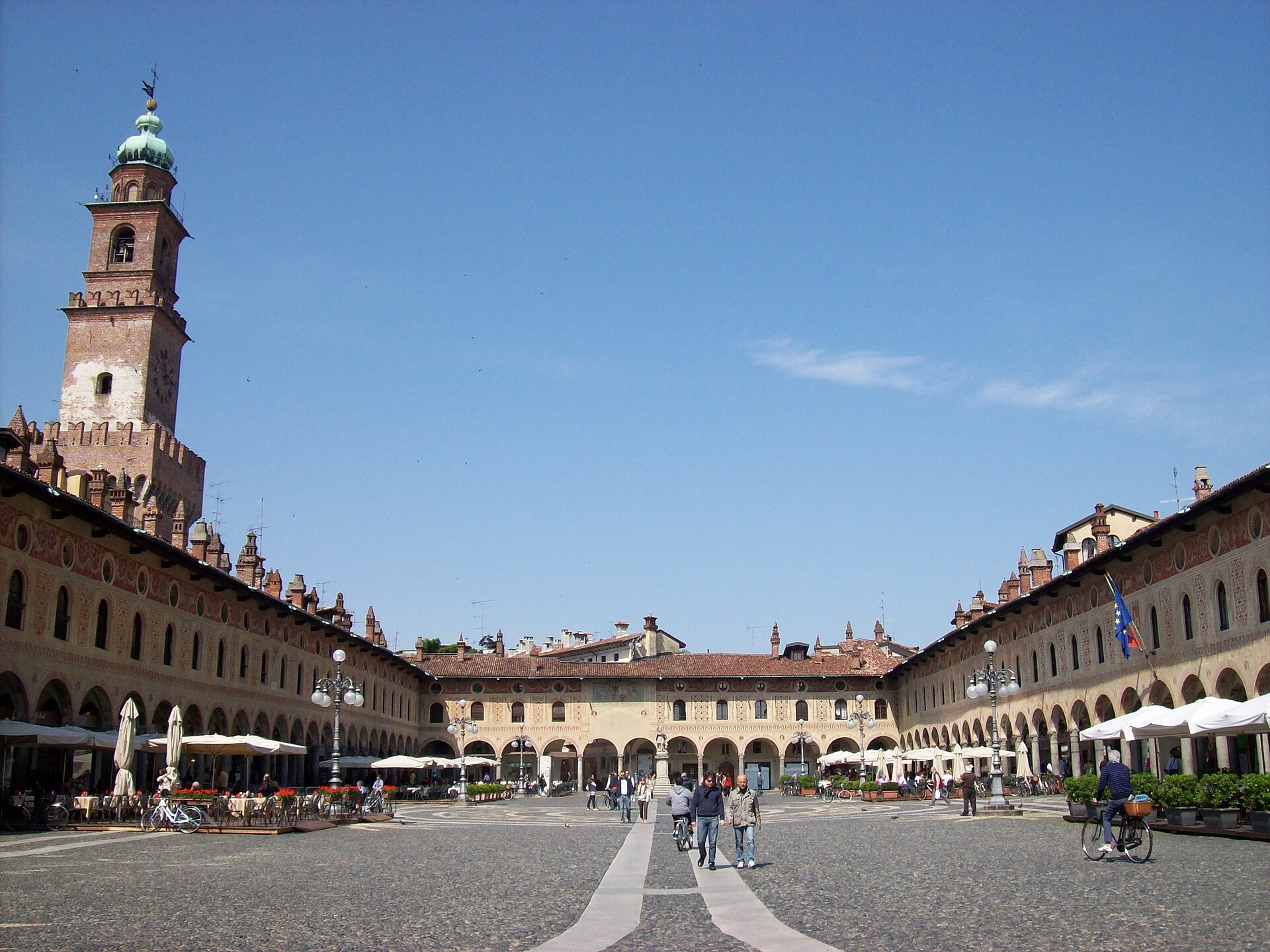
Piazza Ducale in Vigevano, Province of Pavia, is one of the finest Renaissance squares in Italy, commissioned by Ludovico Sforza (Ludovico il Moro) at the end of the fifteenth century and attributed in part to Bramante. Enclosed on three sides by uniform arcaded porticoes and dominated at one end by the Cathedral of Sant’Ambrogio with its Baroque façade, the piazza is renowned for its spatial harmony and the remarkable consistency of its architectural design, making it a landmark of Italian urban planning and a candidate for UNESCO World Heritage recognition.
At a glance
- Type
- Renaissance civic square
- Period
- Designed c. 1492–1494; cathedral facade added 1680
- Style
- Italian Renaissance (piazza); Baroque (cathedral facade)
- Location
- Vigevano, Province of Pavia, Lombardy, Italy
- Coordinates
- 45.3172° N, 8.8584° E
- Patron
- Ludovico Sforza, Duke of Milan
Overview
Piazza Ducale is the monumental centrepiece of Vigevano, a historic town in the Lomellina district of Lombardy. Designed at the behest of Ludovico Sforza, Duke of Milan, the square was conceived as an ideal Renaissance urban space, with uniform arcaded façades enclosing a rectangular plan of exceptional proportions. Vigevano was a favourite residence of the Sforza court, and the piazza was part of a broader programme of architectural embellishment that also included the adjacent Castello di Vigevano. The town received its formal status as a city from Duke Francis II Sforza in 1532.
History
The square was created around 1492–1494 under the patronage of Ludovico Sforza, who employed leading architects of the Milanese Renaissance, with Donato Bramante traditionally credited with a role in the design. The project required the demolition of earlier structures to achieve the unified, rectangular plan. The original scheme connected the piazza directly to the Sforza castle via a covered ramp (the Torre del Bramante), integrating civic and ducal space. The Cathedral of Sant’Ambrogio on the southern short side received its distinctive Baroque façade in 1680, breaking the original Renaissance uniformity but adding a dramatic visual terminus to the space.
What you see
The piazza is enclosed on three sides by identical porticoed façades of two storeys, painted in warm ochre tones and supported by slender columns — an exercise in perspective and repetition that creates an impression of exceptional spatial depth. The long sides each feature 84 arches, while the short sides are closed by the cathedral and the base of the castle tower. Frescoed lunettes originally decorated the vaults of the arcades, and fragments of this decoration survive. The Cathedral of Sant’Ambrogio, with its curved Baroque façade, provides the piazza’s most emphatic visual accent.
Cultural significance
Piazza Ducale is regarded as one of Italy’s most perfectly conceived Renaissance urban spaces, representing the Sforza court’s engagement with humanist ideals of order, proportion, and civic grandeur. Its influence on subsequent Italian urbanism was significant, and the square remains a benchmark of Renaissance spatial design, studied by architects and historians of the period worldwide.
Practical information
- Location
- Piazza Ducale, 27029 Vigevano PV, Italy
- Access
- Open public space; free to visit at any time
- Cathedral
- Cathedral of Sant’Ambrogio open for worship; check hours for tourist visits
- Castle
- Castello di Vigevano adjacent; check sforzesco.it for opening hours and admission
Getting there
Vigevano is approximately 35 km south-west of Milan, served by regional rail from Milan Porta Genova station (approximately 1 hour). By car, the town is accessible from the A26 motorway (Mortara exit). The piazza is in the historic centre, a short walk from the railway station. Combining the piazza with the Castello di Vigevano and the National Archaeological Museum of Lomellina makes for a full day of cultural heritage in the area.
Sources & resources
See the place
Find it on the map
See this place and what’s around it →📷 Become a Cultural Heritage Online photographer
Share your photos of places: they stay published under your name as the author. The more they're seen, the more you get noticed — and soon a contest will reward the most appreciated photos.
Log in or sign up free to add a photoIs this page about you?
This page is read by travellers and heritage enthusiasts who find it on Google. Tell us how you are connected to this place and we will take it from there.