
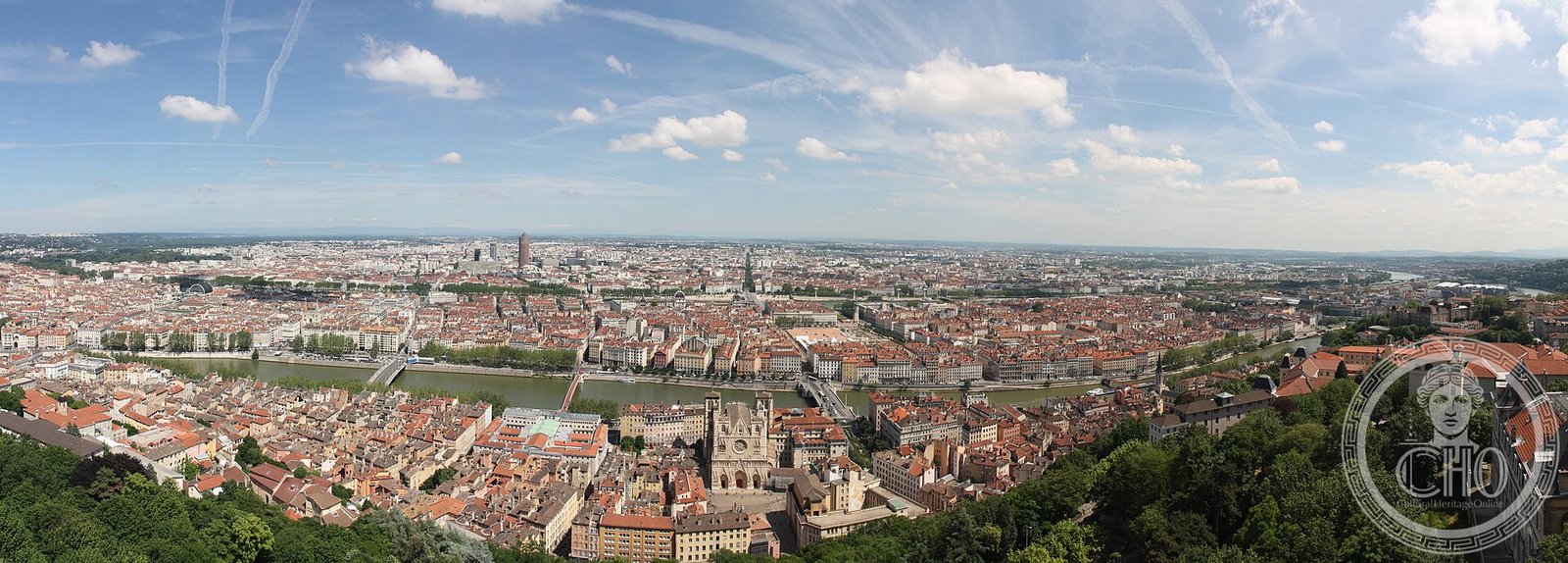
Lyon is a major French city at the confluence of the Rhône and Saône rivers, 391 kilometres southeast of Paris. Its historic centre — Vieux-Lyon, the Presqu’île, and the ancient Roman hilltop of Fourvière — was inscribed as a UNESCO World Heritage Site in 1998, recognised for its exceptional urban continuity from the Roman colony of Lugdunum through Renaissance silk-trading prosperity to the 19th-century industrial era. Today Lyon is France’s third-largest metropolitan area and a leading European destination for gastronomy, silk heritage, and fine arts.
At a glance
- Type
- Historic city and UNESCO World Heritage Site
- Period
- Founded as Roman Lugdunum in 43 BC; UNESCO inscription 1998
- Style
- Roman, Romanesque, Renaissance (traboules), Baroque, Haussmannian, Art Nouveau
- Location
- Lyon, Métropole de Lyon, Auvergne-Rhône-Alpes, France — 45.7595° N, 4.8343° E
Overview
Lyon occupies a strategically pivotal position between northern and Mediterranean France, which drove its rise as the commercial and administrative capital of Roman Gaul and, in the 15th–16th centuries, as Europe’s principal silk and banking city. The historic quarters stretch across two rivers and three distinct topographic zones: the Roman hill of Fourvière with its theatre and amphitheatre, the medieval and Renaissance Vieux-Lyon below, and the Presqu’île peninsula where Haussmannian and Belle Époque architecture line the major commercial streets. The Musée des Beaux-Arts de Lyon, the Musée Gallo-Romain, and the Institut Lumière — celebrating the inventors of cinema — anchor Lyon’s cultural offering.
History
The Roman colony of Lugdunum was founded in 43 BC by Lucius Munatius Plancus at the confluence of the two rivers, rapidly becoming the most important city in Gaul and the seat of the imperial cult. After the fall of Rome, Lyon passed through Burgundian, Frankish, and Holy Roman Imperial hands before joining the Kingdom of France in 1312. The city’s extraordinary wealth in the Renaissance stemmed from its silk manufacturing and international banking fairs, attracting Florentine, German, and Swiss merchants whose traces survive in the Renaissance mansions of Vieux-Lyon. The 19th century brought industrial transformation and the Lumière brothers, who shot their first films in Lyon in 1895.
What you see
Vieux-Lyon preserves one of the largest Renaissance districts in Europe, characterised by the distinctive traboules — covered passageways threading through courtyard blocks — used by silk workers to transport their goods. The Roman theatre on Fourvière hill (15 BC) seats 10,000 and hosts the annual Nuits de Fourvière festival; the adjacent Odeon is among the best-preserved of its type. The Basilica of Notre-Dame de Fourvière (1870–1884), visible from across the city, offers panoramic views over the Presqu’île and the Alps beyond. The Presqu’île’s Place Bellecour — one of the largest pedestrian squares in France — centres the modern commercial city.
Cultural significance
Lyon’s UNESCO inscription recognises an outstanding example of continuous urban development over two millennia, with each historical layer — Roman, medieval, Renaissance, industrial — remaining legible in the city’s fabric. The city is regarded as the birthplace of cinema (Lumière brothers, 1895) and holds a unique position in European culinary culture, home to the bouchon tradition and more Michelin-starred restaurants per capita than almost any other French city. The silk heritage of the Croix-Rousse quarter, where Jacquard looms were first operated at industrial scale, shaped the global textile economy.
Practical information
- Tourist office
- Place Bellecour, 69002 Lyon — check the Lyon Tourisme website for current opening hours and city pass information
- Vieux-Lyon
- Accessible on foot from the Vieux Lyon–Cathédrale Saint-Jean metro station (Line D)
- Fourvière
- Accessible via funicular from the Vieux-Lyon metro station
- Coordinates
- 45.7595° N, 4.8343° E
Getting there
Lyon is served by Lyon-Saint Exupéry Airport, with direct connections across Europe. From Paris, TGV high-speed trains reach Lyon Part-Dieu station in approximately 2 hours. The city’s metro, tram, and funicular network connects the main heritage zones; the Vieux Lyon–Cathédrale Saint-Jean station (Line D) is the gateway to the Renaissance quarter. From Italy, the Turin–Lyon Fréjus route offers scenic rail and road access in under 3 hours.
Sources & resources
Find it on the map
See this place and what’s around it →📷 Become a Cultural Heritage Online photographer
Share your photos of places: they stay published under your name as the author. The more they're seen, the more you get noticed — and soon a contest will reward the most appreciated photos.
Log in or sign up free to add a photo