
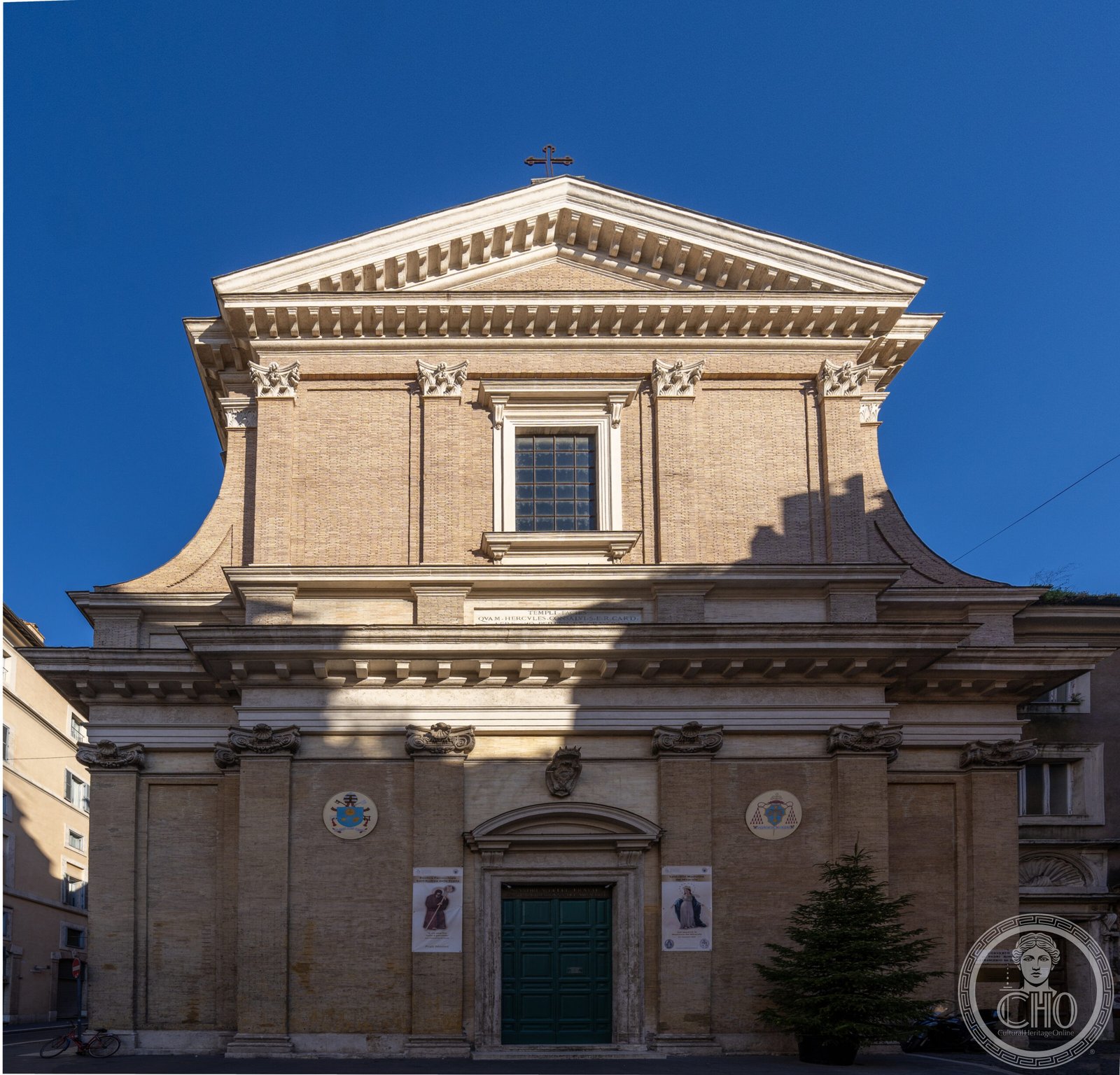
Sant’Andrea delle Fratte is a 17th-century Baroque basilica in the heart of Rome, dedicated to Saint Andrew the Apostle. The church is celebrated for its distinctive campanile and dome, both designed by Francesco Borromini and among the most inventive in the city. It is also a Marian shrine of significant devotional importance: in 1842 the Virgin Mary appeared here to the Jewish banker Alphonse Ratisbonne, an event that led to his conversion and was later approved as miraculous by the Holy See.
At a glance
- Type
- Titular basilica and Marian shrine
- Period
- Origins medieval; rebuilt 17th century; Borromini work c. 1653–1665
- Style
- Roman Baroque
- Location
- Via Sant’Andrea delle Fratte, Rome, Italy
- Coordinates
- 41.9036° N, 12.4837° E
Overview
Sant’Andrea delle Fratte stands in the Trevi district, a short walk from the Trevi Fountain and the Spanish Steps. It is a titular church of the Roman Catholic Church — the title is currently held by Cardinal Ennio Antonelli — and serves simultaneously as a lively parish, a destination for pilgrims to the Marian shrine, and an important repository of Baroque art. The church preserves two original angel statues by Gian Lorenzo Bernini, removed from the Ponte Sant’Angelo to protect them from weathering.
History
A church on this site is documented from at least the 11th century, taking its curious name “delle Fratte” (of the thickets) from the rural character of the area in the medieval period. The current building was begun in the early 17th century by Gaspare Guerra for the Minims of Saint Francis of Paola. Francesco Borromini took over work on the campanile and the dome drum around 1653, leaving two of his most idiosyncratic contributions to the Roman skyline before his death in 1667. In January 1842, Alphonse Ratisbonne — a French Jewish banker openly hostile to Catholicism — reported an apparition of the Virgin Mary in the Cappella di San Michele while waiting for a friend; he converted immediately and subsequently became a priest, later co-founding the Congregation of Our Lady of Zion.
What you see
Borromini’s campanile is the church’s most striking exterior feature: an octagonal drum topped by a crown of paired herms (sculptural busts on pedestals) and a small lantern, a fantastical profile unlike anything else in Rome. The dome drum, though left unfinished at his death, shows Borromini’s characteristic manipulation of geometric forms. Inside, the nave is lined with chapels of varying quality; the Cappella di San Michele at the rear left contains the painting Our Lady of the Miracle (a copy of a miraculous image) and a theatrical devotional arrangement. Two original marble angels by Gian Lorenzo Bernini — Angel with the Crown of Thorns and Angel with the Superscription — are displayed in the apse, visible at close range.
Cultural significance
The church represents an important node in the Baroque geography of Rome, connecting Borromini’s genius to Bernini’s sculpture within a single interior. The Ratisbonne apparition of 1842 made it a point of Jewish-Christian interfaith reflection, and the church remains a centre of the Congregation of Our Lady of Zion. It is listed among Rome’s historic churches under the protection of the Pontificia Commissione per i Beni Culturali della Chiesa.
Practical information
- Address
- Via Sant’Andrea delle Fratte 1, 00187 Roma RM, Italy
- Hours
- Typically open daily morning and late afternoon; check the parish website for current hours and Mass times
- Admission
- Free
Getting there
The church is a 5-minute walk from Piazza di Spagna (Metro Line A, Spagna stop) or from the Trevi Fountain. Bus lines stopping at Via del Tritone or Via del Corso provide convenient access. The surrounding streets of the Trevi district are pedestrianised in the immediate vicinity, making the approach easy on foot.
Sources & resources
Find it on the map
See this place and what’s around it →Historical events at this place (1)
📷 Become a Cultural Heritage Online photographer
Share your photos of places: they stay published under your name as the author. The more they're seen, the more you get noticed — and soon a contest will reward the most appreciated photos.
Log in or sign up free to add a photoIs this page about you?
This page is read by travellers and heritage enthusiasts who find it on Google. Tell us how you are connected to this place and we will take it from there.