
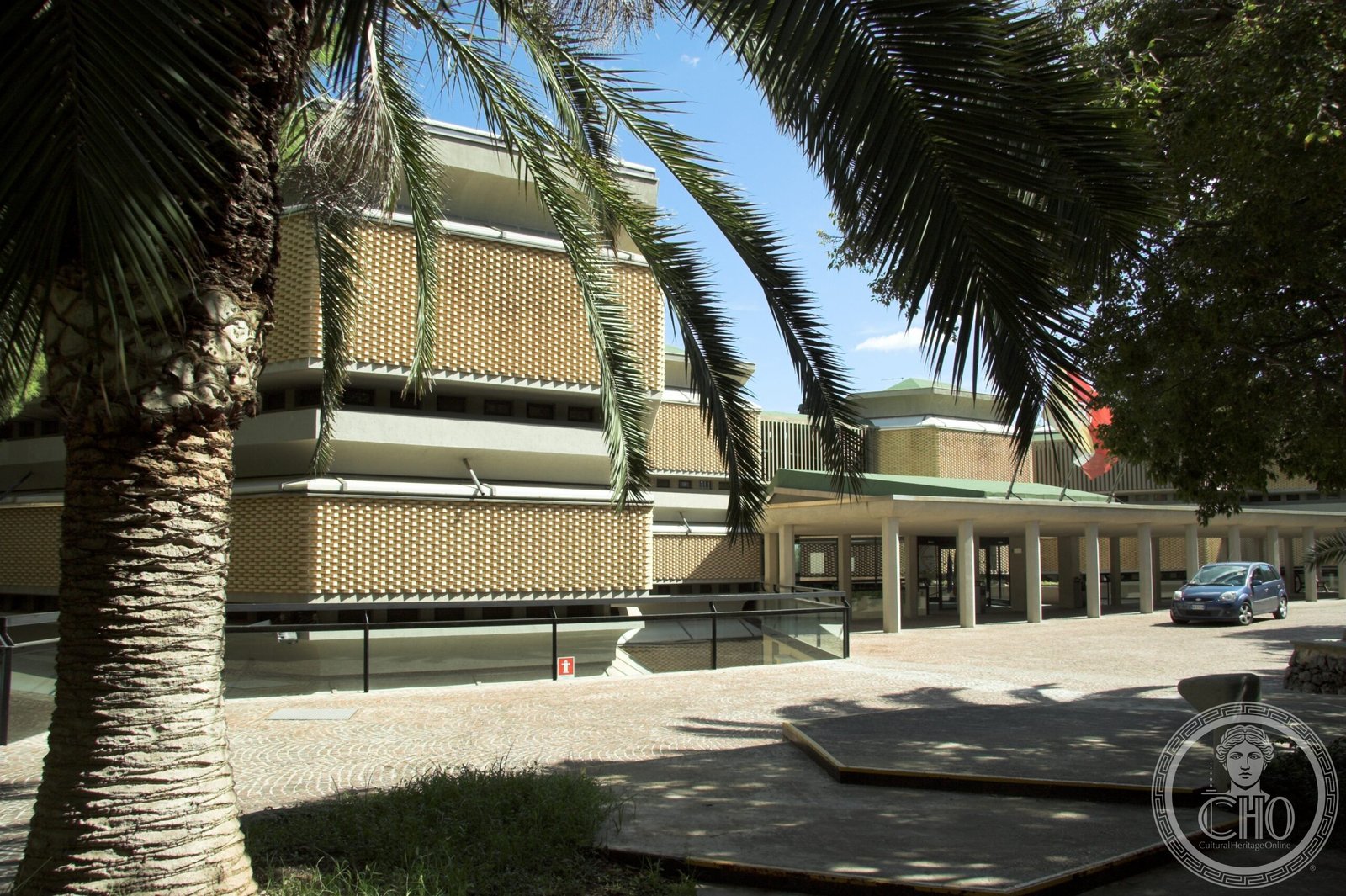
The Museo Archeologico Regionale Paolo Orsi in Syracuse, Sicily, is one of the principal archaeological museums of Europe, housing artefacts spanning from the Upper Palaeolithic through the Roman period across four major collection sectors. Housed in a purpose-built modernist facility designed by architect Franco Minissi and inaugurated in January 1988 within the gardens of Villa Landolina, the museum traces the cultural heritage of Sicily from its earliest prehistoric inhabitants through the Greek colonial era and into late antiquity. A 360-degree virtual tour in partnership with Google makes its collections accessible worldwide.
At a glance
- Type
- Regional archaeological museum
- Period covered
- Upper Palaeolithic to Roman period
- Building opened
- January 1988 (current Minissi building); institutional origins 1780
- Architect
- Franco Minissi; museum layout coordinated by archaeologist Giuseppe Voza
- Location
- Viale Teocrito 66, 96100 Siracusa, Sicily, Italy
- Coordinates
- 37.0763° N, 15.2863° E
- Function
- Public archaeological museum
Overview
The Paolo Orsi Regional Archaeological Museum is widely recognised as one of Europe's most important repositories of ancient Sicilian material culture. Named after the Italian archaeologist Paolo Orsi (1859–1935), who directed the institution from 1895 to 1934 and transformed its scope through systematic excavation campaigns across Sicily, the museum displays approximately 18,000 objects across two exhibition floors totalling 9,000 m².
The building's design by Franco Minissi responds to the natural light of Sicily, with gallery illumination obtained by filtering sunlight directly through roof skylights and lateral clerestory openings. The structure revolves around a central body used as a conference hall at basement level and as a main exhibition space at ground floor level.
In 2016 the museum launched a 360-degree virtual tour in partnership with Google, allowing online visitors to explore the galleries and experience the spatial arrangement of the collections without travelling to Syracuse.
History
The museum's institutional history stretches back to 1780, when Bishop Alagona inaugurated the Museo del Seminario as a repository for local antiquities. This evolved into the Museo Civico by 1808 and into the Museo Archeologico Nazionale di Siracusa, established by royal decree in 1878 and opened to the public in 1886 near the cathedral square of Syracuse.
The tenure of Paolo Orsi from 1895 to 1934 transformed the institution. His prolific excavations at sites including Megara Hyblaea, Akrai, and Kamarina generated a massive expansion of the collections, establishing Syracuse as the primary centre for Sicilian archaeological research.
The current building in the gardens of Villa Landolina was inaugurated in January 1988. An upper floor dedicated to the classical period opened in 2006, and a gallery focusing on catacomb finds was added in 2014.
What you see
The collection is organised into four sectors. Sector A presents prehistoric materials from the Upper Palaeolithic through the Iron Age, including Quaternary fauna, obsidian tools from the Aeolian Islands, and Bronze Age funerary assemblages. Sector B focuses on the Greek colonial period, with artefacts from Ionic and Doric settlements, including architectural terracottas and figured pottery.
Sector C covers finds from Syracuse's colonies and eastern Sicilian centres such as Akrai and Kamarina. Sector D addresses the Hellenistic and Roman periods; highlights include the Sarcophagus of Adelphia, a fourth-century Christian marble sarcophagus with relief scenes, and the Venus Landolina, a Roman marble copy of a Hellenistic Venus.
The 360-degree virtual tour allows detailed examination of individual objects and room layouts online, making the museum unusually accessible for remote study and pre-visit planning.
Cultural significance
Syracuse was a major centre of Greek colonisation in the central Mediterranean from the late eighth century BC, and its archaeological record is exceptional in depth and continuity. The Paolo Orsi museum is the primary custodian of this heritage, offering a structured narrative from prehistoric Sicily through the classical apex of Syracusan power to late Roman occupation.
The museum's contribution to the understanding of Sicilian prehistory and Greek colonialism has shaped scholarly consensus internationally. The Venus Landolina and the Sarcophagus of Adelphia are among the most studied objects of their respective periods in the western Mediterranean world.
Plan your visit
- Address
- Viale Teocrito 66, 96100 Siracusa, Sicily, Italy
- Hours
- Tuesday to Saturday 9:00am–7:00pm (ticket office closes 6:00pm); Sundays and holidays 9:00am–1:45pm (ticket office closes 1:00pm)
- Closed
- Mondays
- Tickets
- €10 full, €5 reduced; combined ticket with the Neapolis Archaeological Park €18 (reduced €9)
- Book
- Regione Siciliana official page (online sales via TicketOne)
Hours and prices checked on the official website in July 2026; confirm before you travel.
Is the Paolo Orsi museum open on Mondays?
No, the museum is closed on Mondays.
Is there a combined ticket with the Neapolis Archaeological Park?
Yes: €18 full or €9 reduced, covering both the park and the museum.
What are Sunday hours?
On Sundays and holidays the museum opens 9:00am–1:45pm, with the ticket office closing at 1:00pm.
Getting there
The museum is in the Neapolis district of Syracuse, adjacent to the Parco Archeologico della Neapolis. From the city centre take bus line 11 or 25 towards the archaeological park. By car, follow signs for Parco Archeologico from the A18 motorway exit at Siracusa Nord; parking is available on Via Teocrito. Siracusa railway station is approximately 2.5 km from the museum.
Sources & resources
- Wikipedia: Museo Archeologico Regionale Paolo Orsi
- Cultural Heritage Online: culturalheritageonline.com
See the place
Find it on the map
See this place and what’s around it →Historical events at this place (1)
- 2023 Argentovivo
📷 Become a Cultural Heritage Online photographer
Share your photos of places: they stay published under your name as the author. The more they're seen, the more you get noticed — and soon a contest will reward the most appreciated photos.
Log in or sign up free to add a photoIs this page about you?
This page is read by travellers and heritage enthusiasts who find it on Google. Tell us how you are connected to this place and we will take it from there.