
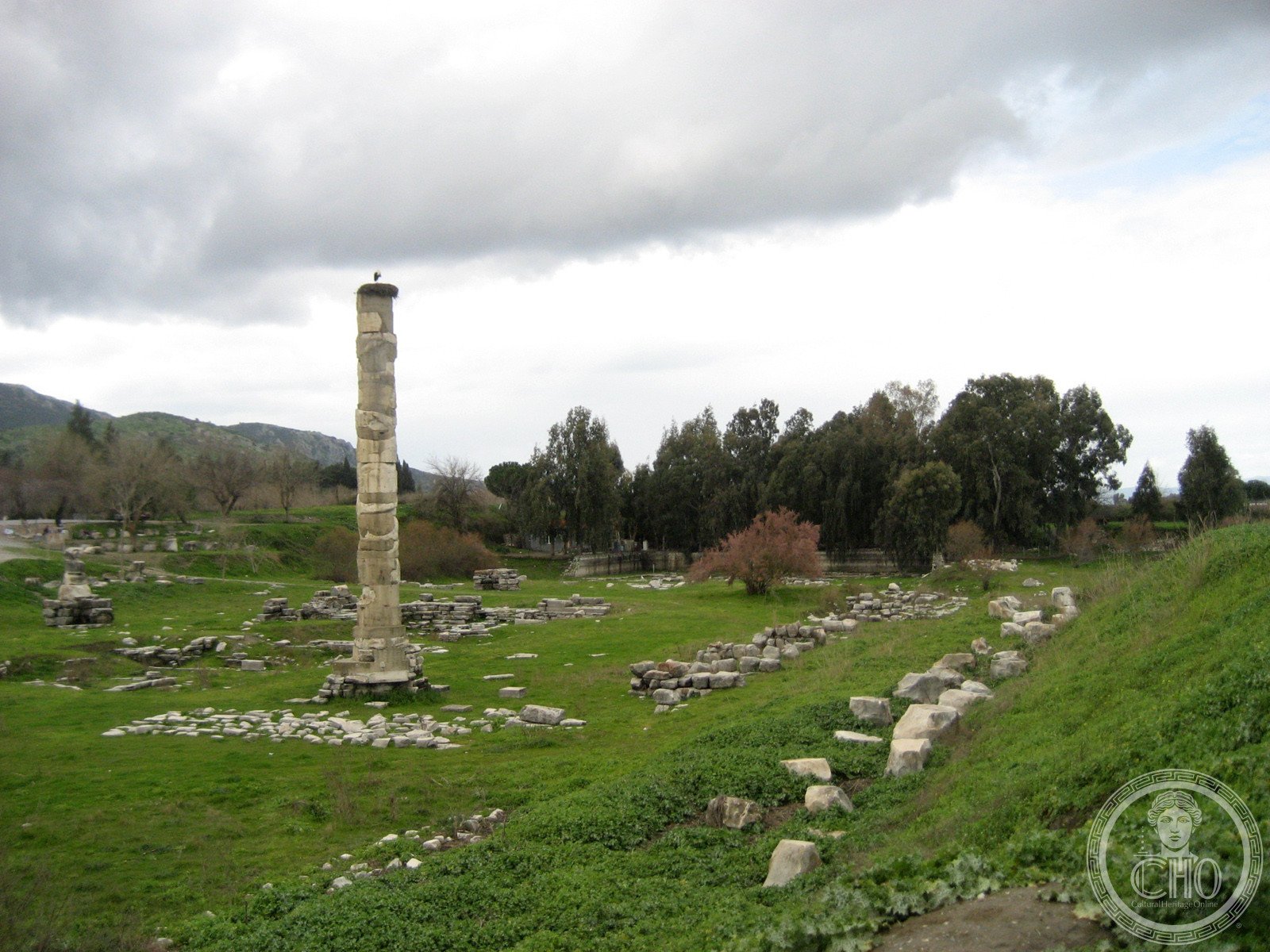
The Temple of Artemis at Ephesus — also called the Artemision or Temple of Diana — was one of the Seven Wonders of the Ancient World. Dedicated to a localised form of the goddess Artemis, it stood near what is now Selçuk in western Turkey. After multiple destructions and rebuildings over centuries, the final temple was razed in 401 CE, and only scattered foundations and marble fragments survive today.
At a glance
- Type
- Ancient Greek temple (Seven Wonders of the Ancient World)
- Period
- Original construction c. 550 BCE; final version rebuilt after 356 BCE; destroyed 401 CE
- Style
- Ionic Greek architecture
- Location
- Ephesus, near modern Selçuk, İzmir Province, Turkey
- Coordinates
- 37.9497° N, 27.3636° E
Overview
The Temple of Artemis was a monumental Ionic sanctuary dedicated to Artemis, the Greek goddess of the hunt and wilderness. It was one of the largest temples ever built in the ancient world, attracting pilgrims and merchants from across the Mediterranean. Today only the foundation platform and a single reconstructed column remain at the site outside Selçuk.
History
The first great temple on the site was commissioned by the Lydian king Croesus around 550 BCE and designed by Chersiphron and his son Metagenes. In 356 BCE Herostratos burned it down on the night of Alexander the Great’s birth. A new and grander temple was then built, becoming renowned throughout the Hellenistic world as one of the Seven Wonders. The final structure was progressively dismantled after the adoption of Christianity in the Roman Empire and was ultimately destroyed in 401 CE.
What you see
Visitors to the modern site encounter a low, marshy field punctuated by a single re-erected column and scattered marble blocks. Excavations conducted by the British Museum in the 19th century revealed column drums, sculptural friezes, and dedications, many now held in London and Istanbul. The foundations hint at an original footprint measuring approximately 115 x 55 metres with more than 127 columns.
Cultural significance
The Artemision was one of the rare structures deemed worthy of inclusion among the Seven Wonders of the Ancient World by Hellenistic writers, celebrated for its sheer scale and the quality of its sculptural decoration. Its fame made Ephesus a major pilgrimage and trade centre for centuries, and the temple’s image circulated widely on ancient coins.
Practical information
The archaeological site is located about 1.5 km north-east of Selçuk town centre. Entrance is free. The site is open year-round during daylight hours. The nearby Ephesus Archaeological Museum in Selçuk displays artefacts recovered from the Artemision and the wider Ephesus region.
Getting there
Selçuk is served by direct trains from İzmir Basmane station (journey approx. 1 hour). From Selçuk station the temple site is a 20-minute walk north. Buses and minibuses connect Selçuk with Kuşadası and İzmir. The international airport at İzmir (ADB) is approximately 80 km away.
Sources & resources
Find it on the map
See this place and what’s around it →📷 Become a Cultural Heritage Online photographer
Share your photos of places: they stay published under your name as the author. The more they're seen, the more you get noticed — and soon a contest will reward the most appreciated photos.
Log in or sign up free to add a photo