
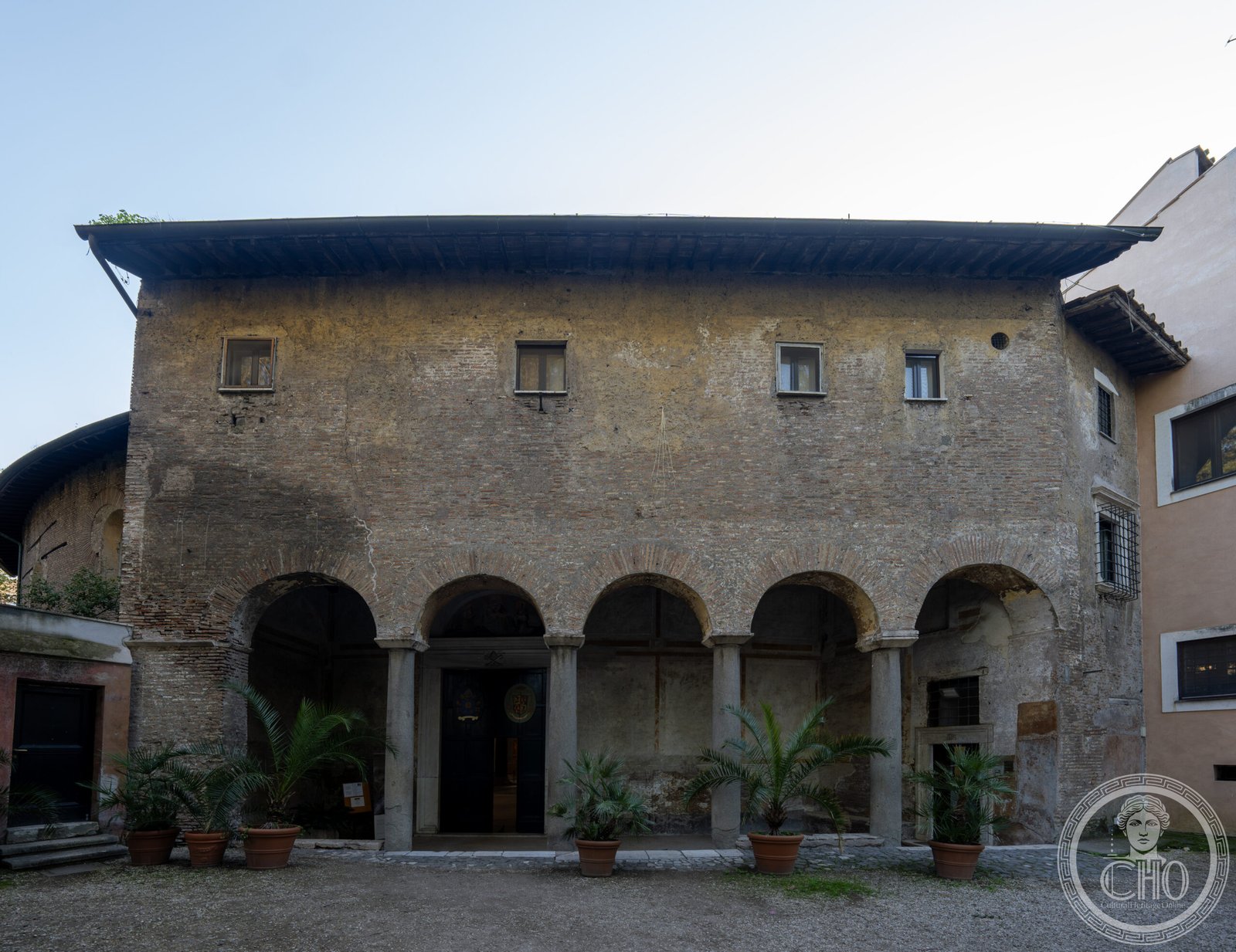
Santo Stefano Rotondo is one of Rome’s oldest and most unusual churches: a late-antique circular basilica on the Caelian Hill, built in the second half of the 5th century. Hungary’s national church in Rome, it is dedicated to both Saint Stephen the first Christian martyr and Saint Stephen I, the first king of Hungary. The church is notable for its austere early Christian architecture, its 16th-century cycle of martyr frescoes, and its centuries-long role as the rectory church of the Pontifical Collegium Germanicum et Hungaricum.
At a glance
- Type
- Minor basilica; titular church; national church of Hungary in Rome
- Period
- Built c. 468–483 CE under Pope Simplicius; major restorations 12th and 16th century
- Style
- Late antique circular plan; early Christian architecture
- Location
- Via di Santo Stefano Rotondo, Celio (Caelian Hill), Rome
- Coordinates
- 41.8846° N, 12.4967° E
Overview
Santo Stefano Rotondo is one of the largest circular churches in the world and one of the earliest surviving centrally planned Christian buildings in Rome. Its round nave was originally divided into three concentric rings by two colonnades and lit by a clerestory. The church served as a model for later round churches across Europe and retains a sense of immense early-Christian spatial ambition despite later reductions in its footprint.
History
The basilica was founded under Pope Simplicius around 468–483 CE, possibly reusing an earlier Roman building on the same site. It became closely associated with the Hungarian royal house after the canonisation of Stephen I of Hungary in 1083, establishing the Hungarian national presence in Rome that continues today. A major restoration under Pope Nicholas V (15th century) and subsequent interventions by Nicholas Poussin’s patron Cardinal Cesi in the 16th century altered the original three-ring plan, reducing it to its current single nave. The Pontifical Collegium Germanicum et Hungaricum, founded in 1552 by Saint Ignatius of Loyola, adopted the church as its rectory from the late 16th century.
What you see
The interior presents a wide, luminous circular space with granite columns supporting the clerestory drum. The walls are lined with a cycle of 34 large frescoes by Niccolò Circignani (called Pomarancio) and Antonio Tempesta, painted c. 1582, depicting the martyrdoms of early Christian saints in graphic and often disturbing detail — images that made a strong impression on the novices of the German College studying here. The original ancient columns and the quiet garden setting are remarkable features of this ancient church.
Cultural significance
Santo Stefano Rotondo is a touchstone of early Christian architecture and a living symbol of the Catholic Church’s international character. Charles Dickens famously described its martyr frescoes as some of the most harrowing images he had ever seen. The church remains an active place of worship for the Hungarian national community in Rome.
Practical information
Address: Via di Santo Stefano Rotondo 7, 00184 Rome. The church is managed by the Pontifical Collegium Germanicum et Hungaricum. Check official sources for current visiting hours; entry is typically free. Photography may be restricted inside.
Getting there
The Caelian Hill is a 10-minute walk from the Colosseum (metro Line B, Colosseo stop). Bus lines 81 and 117 pass near the church. From Circus Maximus metro station (Line B) it is about a 15-minute walk through the residential streets of the Celio district. The church is also close to the Villa Celimontana park.
Sources & resources
Find it on the map
See this place and what’s around it →Historical events at this place (1)
📷 Become a Cultural Heritage Online photographer
Share your photos of places: they stay published under your name as the author. The more they're seen, the more you get noticed — and soon a contest will reward the most appreciated photos.
Log in or sign up free to add a photoIs this page about you?
This page is read by travellers and heritage enthusiasts who find it on Google. Tell us how you are connected to this place and we will take it from there.