
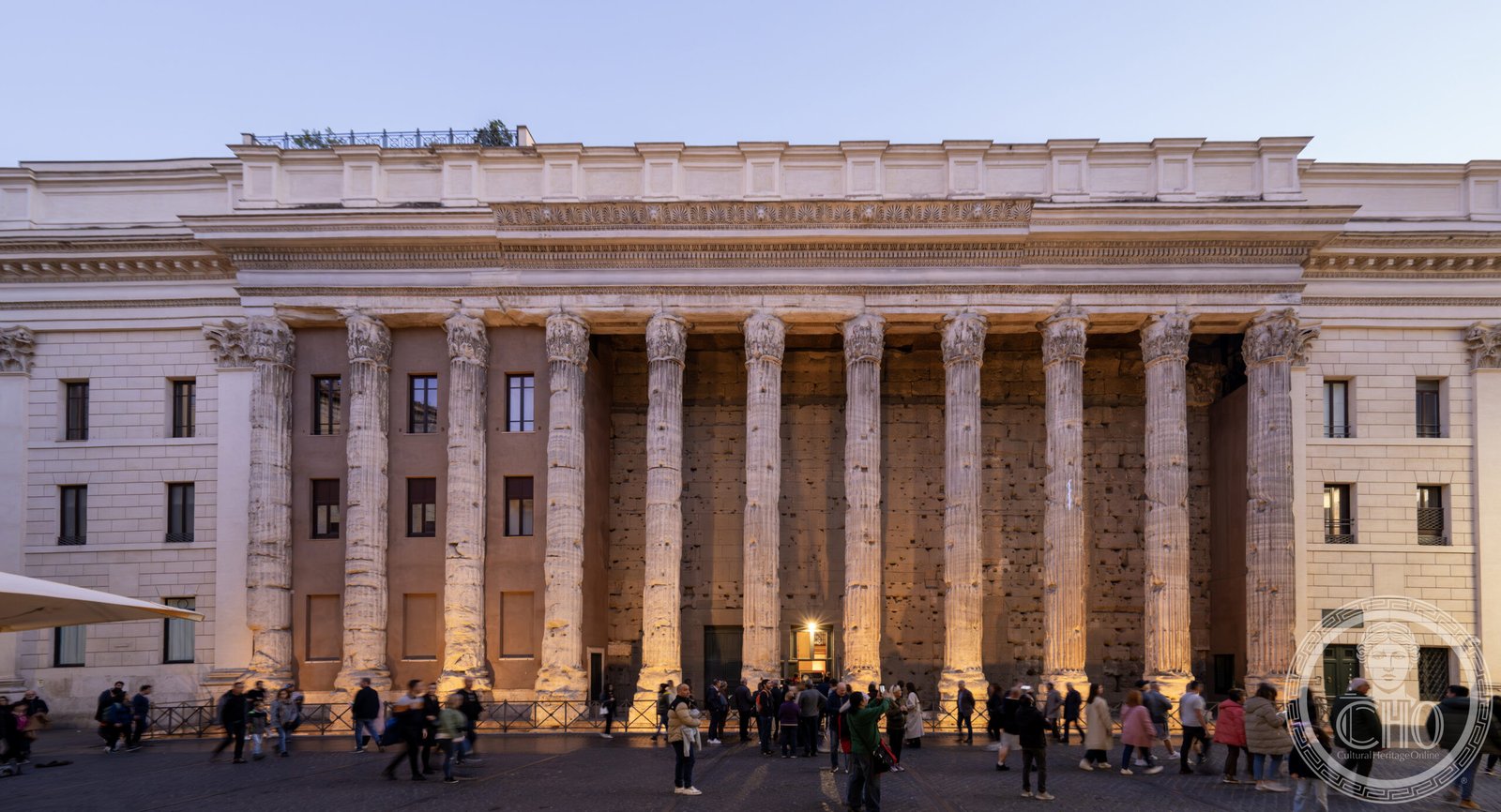
The Temple of Hadrian is an ancient Roman temple dedicated to the deified emperor Hadrian, erected in the Campus Martius by his successor Antoninus Pius in AD 145. Eleven of its original Corinthian columns and the massive cella wall are preserved within the later Baroque and Neo-classical envelope of the Palazzo della Borsa, which served as Rome’s Stock Exchange from the nineteenth century. Today the building houses the Rome Chamber of Commerce, and the ancient columns remain visible from Piazza di Pietra.
At a glance
- Type
- Ancient Roman temple incorporated into later civic building
- Period
- Dedicated AD 145; Baroque additions 17th century; current facade 19th century
- Style
- Roman Imperial (Corinthian order); later Baroque and Neoclassical envelope
- Location
- Piazza di Pietra, Campus Martius, Rome, Lazio, Italy
- Coordinates
- 41.8998° N, 12.4792° E
Overview
Piazza di Pietra takes its name — “square of stone” — directly from the ancient blocks of the temple that have stood here for nearly two millennia. The surviving colonnade of fifteen-metre-tall Corinthian columns in Luna marble is one of the most complete glimpses of a Roman imperial temple anywhere in the city. The building has been continuously reused since antiquity, serving variously as a customs house, a papal administrative office, and Rome’s principal financial exchange before its current function.
History
Emperor Hadrian died in AD 138 and was deified by the Senate; his successor Antoninus Pius fulfilled the acts of consecratio and dedicated the new temple on the Campus Martius in AD 145 as a focal point of the imperial cult. In the seventeenth century Pope Innocent XII commissioned Carlo Fontana to transform the ruins into a customs house, embedding the ancient cella wall and colonnade within a new Baroque structure. The building was further remodelled in the nineteenth century under the newly unified Italian state to serve as the Roman Stock Exchange, with a Neoclassical facade added facing Piazza di Pietra. Since 1928 the complex has housed the Rome Chamber of Commerce.
What you see
Eleven of the original fifteen Corinthian columns of the temple’s northern flank stand fully intact to their full height of approximately fifteen metres, their entablature and cornice largely preserved, forming one of the most photogenic ancient streetscapes in Rome. Behind them rises the massive opus cementicium cella wall, its surface bearing the characteristic Roman brick-and-concrete construction typical of the Antonine period. The modern Neoclassical facade of the Chamber of Commerce fills the southern side of the piazza, creating a striking architectural dialogue between the Roman, Baroque, and nineteenth-century layers of the building.
Cultural significance
The Temple of Hadrian is a key monument for understanding the topography of the ancient Campus Martius and the imperial practice of posthumous deification. Its uninterrupted reuse across nearly nineteen centuries illustrates the adaptive continuity that defines Rome’s urban history, where ancient structures have been absorbed into the living city rather than isolated as archaeological ruins.
Practical information
- Address
- Piazza di Pietra, 00186 Rome, Lazio
- Current use
- Rome Chamber of Commerce; exterior colonnade freely visible from the piazza
- Hours
- Exterior: always accessible. Interior: check the Chamber of Commerce for organised visits
- Admission
- Exterior free; interior visits by arrangement
Getting there
Piazza di Pietra lies in the heart of the historic centre, a short walk from the Pantheon (5 minutes) and Piazza Navona (10 minutes). The nearest bus stop is on Via del Corso or Via della Guglia; several central bus lines (40, 46, 62, 64) stop nearby. No metro station is immediately adjacent; the closest is Spagna (Line A), about 15 minutes on foot via Via del Corso.
Sources & resources
See the place
Find it on the map
See this place and what’s around it →Historical events at this place (1)
- 2022 Il Tempio di Adriano
📷 Become a Cultural Heritage Online photographer
Share your photos of places: they stay published under your name as the author. The more they're seen, the more you get noticed — and soon a contest will reward the most appreciated photos.
Log in or sign up free to add a photoIs this page about you?
This page is read by travellers and heritage enthusiasts who find it on Google. Tell us how you are connected to this place and we will take it from there.