
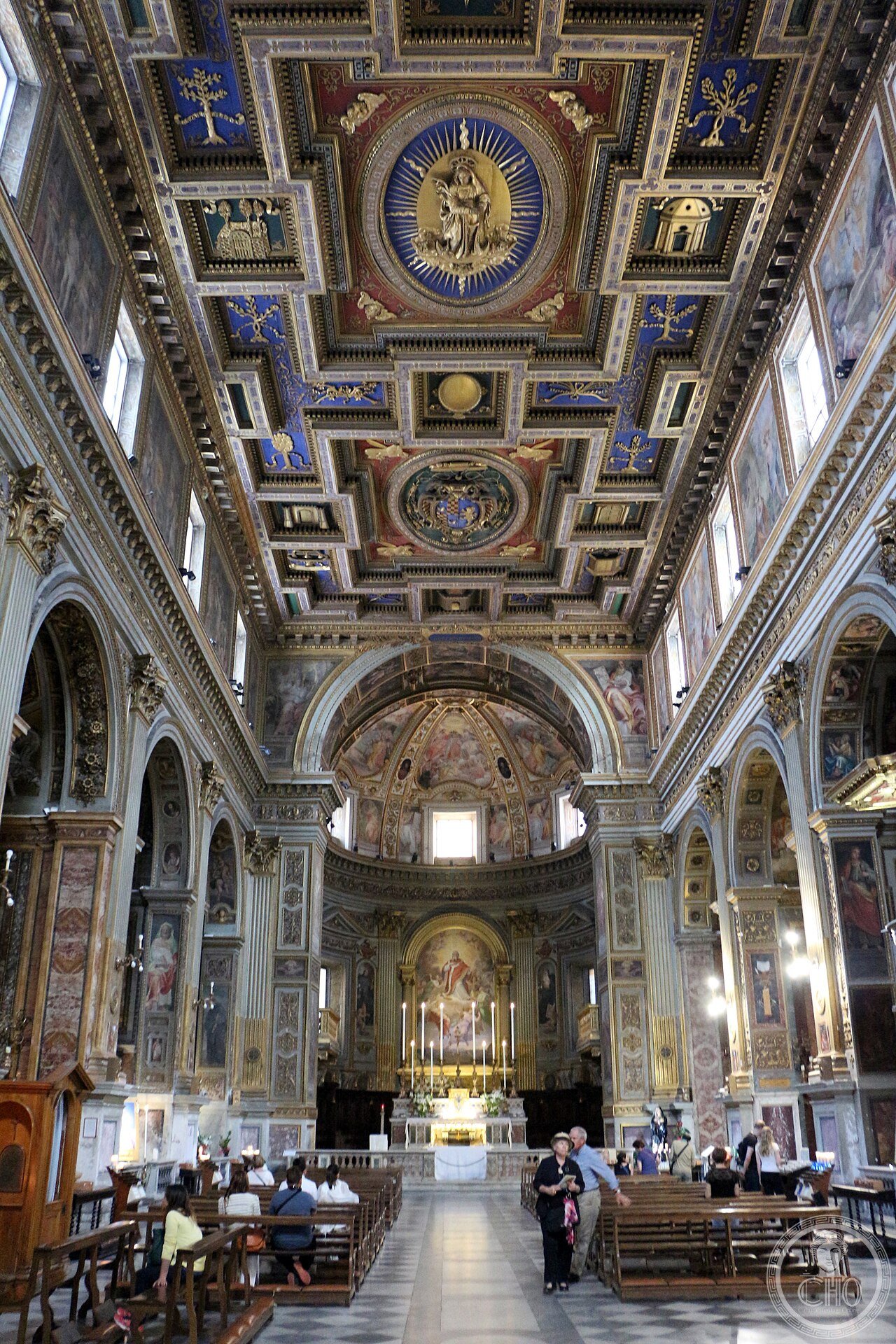
San Marcello al Corso is one of Rome’s oldest titular churches, dedicated to Pope Marcellus I who died a martyr in AD 309. The Servite Order has served the church since around 1375 and maintains its General Curia here. The present facade — a concave Baroque composition by Carlo Fontana completed in 1683 — is one of the finest set-piece streetscapes on the Corso, while the interior preserves chapels and frescoes spanning the sixteenth through eighteenth centuries following a devastating fire in 1519.
At a glance
- Type
- Titular and conventual church; headquarters of the Servite Order General Curia
- Period
- Ancient origins (4th century); rebuilt after 1519 fire; facade 1683
- Style
- Roman Baroque (facade); Renaissance and Baroque interior
- Architect
- Facade: Carlo Fontana (1683); interior chapels by various 16th–18th century architects
- Location
- Via del Corso, Rome, Lazio, Italy
- Coordinates
- 41.8986° N, 12.4818° E
Overview
San Marcello al Corso is an ancient titular and conventual church in Rome, Italy, that has been served by friars of the Servite Order since approximately 1375 and today serves as the headquarters of their General Curia. The church holds the rank of minor basilica and carries a cardinal-protector from among the cardinal priests of the Catholic Church. Its position on the Via del Corso — the historic spine of papal Rome and the route of carnival processions — has made it one of the most visited churches in the city’s Baroque urban landscape.
History
A Christian oratory was established on this site as early as the fourth century, linked to the memory of Pope Marcellus I. The medieval structure was assigned to the Servites in the late fourteenth century and became a flourishing conventual complex. A catastrophic fire on the night of 22–23 May 1519 destroyed most of the church; the rebuilding took several decades and involved leading architects and painters of the Roman Renaissance and early Baroque. Carlo Fontana’s sweeping concave facade, finished in 1683, gave the church its defining architectural character and has influenced Baroque church design across Europe.
What you see
The exterior is dominated by Fontana’s concave two-storey Baroque facade in travertine, its curved form creating a dramatic spatial dialogue with the narrow street in front. The interior follows a single-nave plan with deep lateral chapels, several of which retain frescoed vaults and altarpieces by sixteenth- and seventeenth-century Roman masters including Perino del Vaga and Francesco Salviati. A venerated image of Christ on the cross, reportedly miraculous, is preserved in the church and has been an object of popular devotion since the Renaissance period.
Cultural significance
San Marcello al Corso represents a continuous layer of Roman religious and urban history stretching from the late antique period to the present, and its Baroque facade by Carlo Fontana is a benchmark work of late seventeenth-century ecclesiastical architecture. As the headquarters of the Servite Order’s General Curia, the church retains an active international religious significance alongside its role as a heritage monument and pilgrimage site on the Via del Corso.
Practical information
- Address
- Via del Corso 2, 00186 Rome, Lazio
- Current use
- Active Roman Catholic church served by the Servite Order; minor basilica
- Hours
- Open daily for worship; check posted notice at the church for current visiting hours
- Admission
- Free entry
Getting there
San Marcello al Corso stands on the Via del Corso between Piazza Venezia and Piazza del Popolo. The nearest metro station is Spagna (Line A), about 10 minutes on foot southward along the Corso. Bus lines 40, 46, 62, 64, and 117 serve the Via del Corso and Piazza Venezia area. From the Pantheon, the church is a 5-minute walk east along Via del Corso.
Sources & resources
Find it on the map
See this place and what’s around it →Historical events at this place (1)
📷 Become a Cultural Heritage Online photographer
Share your photos of places: they stay published under your name as the author. The more they're seen, the more you get noticed — and soon a contest will reward the most appreciated photos.
Log in or sign up free to add a photoIs this page about you?
This page is read by travellers and heritage enthusiasts who find it on Google. Tell us how you are connected to this place and we will take it from there.