
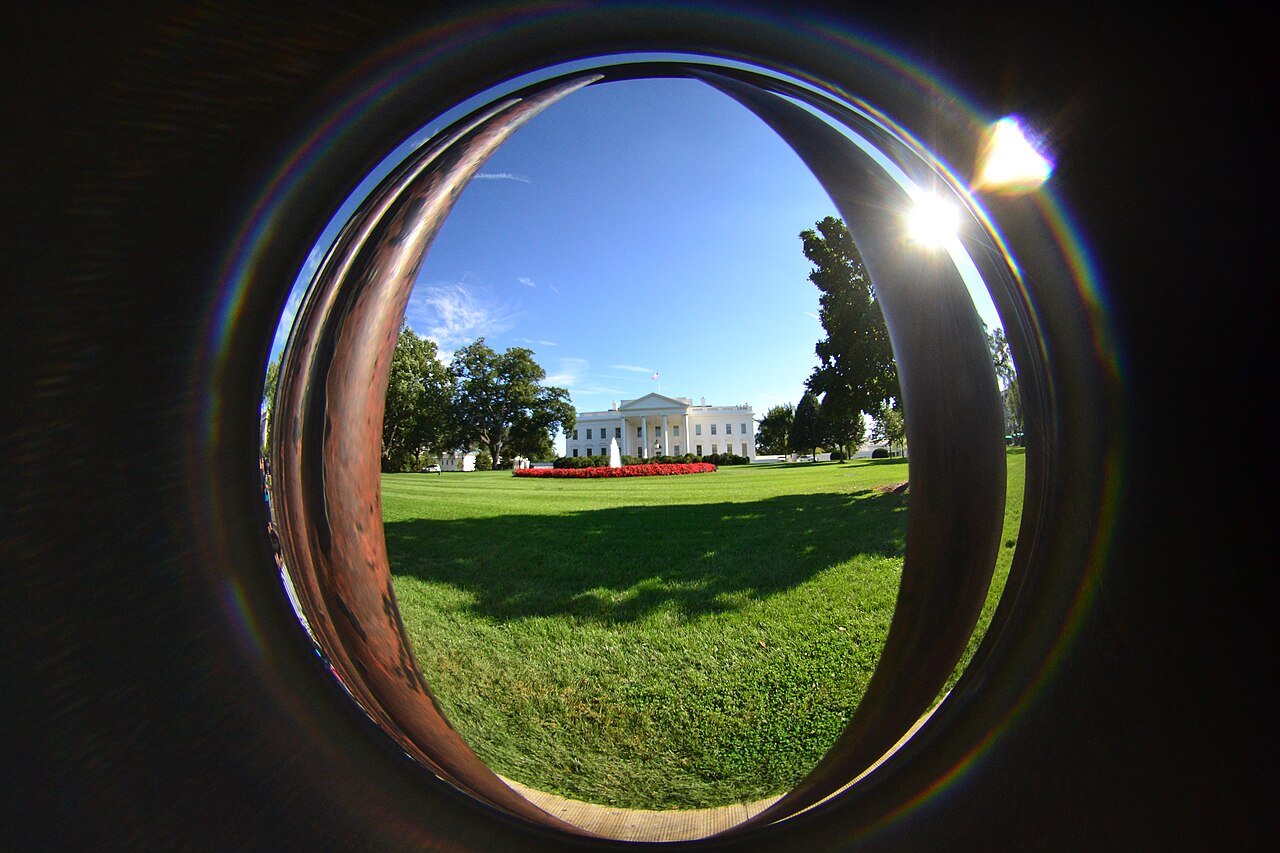
The White House is the official residence and workplace of the President of the United States, located at 1600 Pennsylvania Avenue NW in Washington, D.C. Every American president since John Adams has lived and governed from this address, making it one of the most continuously occupied — and most scrutinised — official residences in the world. Designed by Irish-born architect James Hoban in a Neoclassical style influenced by Leinster House in Dublin, the building has been altered, expanded, and rebuilt multiple times since its initial completion in 1800, yet its austere white sandstone exterior has remained the defining symbol of American executive power.
At a glance
- Type
- Official presidential residence and executive office
- Period
- Construction 1792–1800; rebuilt after British burning 1814–1817; West Wing added 1902; East Wing 1942
- Style
- Neoclassical (Palladian influences)
- Location
- 1600 Pennsylvania Avenue NW, Washington, D.C., USA · 38.8977° N, 77.0366° W
Overview
The White House functions simultaneously as a private family residence, a public symbol of the American presidency, and the operational hub of the executive branch of the U.S. government. Its 132 rooms, 35 bathrooms, and 6 floors include the Oval Office, the Cabinet Room, the State Dining Room, and a range of ceremonial spaces used for state visits and official functions. The surrounding 18-acre grounds include the Rose Garden and the Jacqueline Kennedy Garden.
History
President George Washington selected the site and oversaw the design competition, which Irish-born architect James Hoban won in 1792 with a Neoclassical proposal. Construction using Aquia Creek sandstone began that year, and John Adams became the first president to occupy the residence in November 1800. During the War of 1812, British forces burned the building in August 1814, destroying much of the interior; Hoban supervised the rebuilding, completed by 1817. Theodore Roosevelt added the West Wing in 1902 to separate the executive offices from the family residence, and the building underwent a full structural renovation under Harry Truman from 1948 to 1952.
What you see
The north and south facades present the building’s most iconic faces: the north portico with its Ionic columns opens onto Pennsylvania Avenue, while the elliptical south portico overlooks the South Lawn. The interior’s public rooms — the Blue Room, Red Room, Green Room, East Room, and State Dining Room — are furnished with period American antiques and artworks dating from the early republic to the present. The Rose Garden on the west side of the colonnade connecting the main house to the West Wing is one of the most photographed outdoor spaces in American political life.
Cultural significance
As the residence of every U.S. president since 1800, the White House carries an unmatched density of American historical memory — from Lincoln signing the Emancipation Proclamation to Kennedy navigating the Cuban Missile Crisis. It is both a functioning government building and one of the world’s most recognised architectural symbols, reproduced on currency, in film, and as a universal shorthand for American executive power.
Practical information
- Address
- 1600 Pennsylvania Avenue NW, Washington, D.C. 20500
- Public tours
- Available for U.S. citizens through their Congressional representative; foreign nationals may request tours through their embassy. Check whitehouse.gov for current procedures.
- Visitor Centre
- White House Visitor Center at 1450 Pennsylvania Avenue NW; open to the public
Getting there
The nearest Metro stations are McPherson Square (Blue/Orange/Silver Lines) and Farragut West (Blue/Orange/Silver Lines), both within a short walk on 17th or 15th Street. The White House Visitor Center on Pennsylvania Avenue is easily reached on foot from Metro Center station. Pennsylvania Avenue itself is closed to vehicle traffic in front of the north facade.
Sources & resources
Find it on the map
See this place and what’s around it →📷 Become a Cultural Heritage Online photographer
Share your photos of places: they stay published under your name as the author. The more they're seen, the more you get noticed — and soon a contest will reward the most appreciated photos.
Log in or sign up free to add a photoIs this page about you?
This page is read by travellers and heritage enthusiasts who find it on Google. Tell us how you are connected to this place and we will take it from there.