
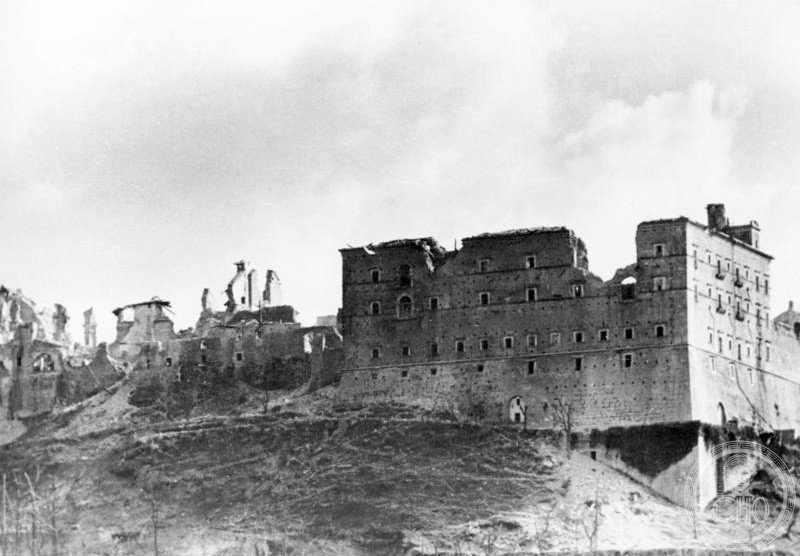
The Abbey of Montecassino is a Benedictine monastery perched on a rocky hilltop approximately 130 kilometres southeast of Rome, in the Latin Valley above the town of Cassino. Founded by Saint Benedict of Nursia around 529 AD on the site of the ancient Roman town of Casinum, it is the first and mother house of the Benedictine Order, the community for which the Rule of Saint Benedict was composed. Destroyed four times over its fifteen centuries of history — by Lombards, Saracens, earthquake, and Allied bombing in 1944 — and each time rebuilt, Montecassino stands as one of the most resilient symbols of Western monasticism and European civilisation.
At a glance
- Type
- Benedictine abbey and pilgrimage site
- Period
- Founded c. 529 AD; current structure rebuilt 1944–1964 after WWII destruction
- Style
- Baroque (17th–18th century reconstruction); post-war faithful restoration
- Location
- Montecassino, Cassino, Province of Frosinone, Lazio, Italy
- Coordinates
- 41.4900° N, 13.8133° E
Overview
Montecassino occupies a dominant hilltop position at 519 metres above sea level, commanding views over the Liri valley and the historic Via Latina, the ancient road linking Rome to the south. The abbey is the spiritual and institutional origin of Benedictine monasticism, whose Rule — ora et labora (pray and work) — shaped the religious, cultural, and agricultural landscape of medieval Europe. Today it functions as an active monastery housing a community of Benedictine monks while receiving hundreds of thousands of pilgrims and cultural tourists each year.
History
Benedict of Nursia founded the abbey around 529 on a hilltop previously occupied by a sanctuary to Apollo, converting a pagan sacred site into a Christian monastic community. The abbey was sacked and burned by the Lombards in 577, rebuilt in the 8th century, destroyed again by Saracens in 883, and severely damaged by earthquake in 1349. The magnificent baroque complex that stands today was constructed principally during the 17th and 18th centuries, only to be almost entirely obliterated by Allied aerial bombardment on 15 February 1944 during the Italian Campaign of the Second World War; reconstruction was completed by 1964, with the abbey reconsecrated by Pope Paul VI.
What you see
The abbey’s monumental entrance leads through a sequence of three cloisters — the Bramante Cloister, the Cloister of the Benefactors, and the Cloister of the Loggia — before reaching the basilica, whose interior is decorated with inlaid marble floors, gilded ceilings, and mosaics reconstructed after the war. The crypt contains the tombs of Saint Benedict and his twin sister Saint Scholastica. The abbey’s museum holds illuminated manuscripts, medieval bronzes, and ecclesiastical treasures rescued from the destruction of 1944, alongside a section dedicated to the Battle of Monte Cassino.
Cultural significance
Montecassino is a UNESCO candidate and among Italy’s most symbolically charged religious sites, representing the transmission of classical learning through the Dark Ages by Benedictine scriptoria, the endurance of Western Christianity, and the human cost of the Second World War in Italy. Its post-war reconstruction was itself a statement of European cultural renewal. The adjacent Cassino War Cemetery and Polish Military Cemetery commemorate the tens of thousands of soldiers who died in the battles of 1943–1944.
Practical information
- Address
- Abbazia di Montecassino, Via Montecassino, 03043 Cassino FR, Italy
- Opening hours
- Daily approximately 09:00–12:30 and 15:30–17:00; check official website for seasonal variations
- Admission
- Free to visit the basilica; fee for the museum
- Official website
- abbaziadimontecassino.org
Getting there
Cassino is served by frequent trains from Rome Termini (approximately 1h 20min on the Rome–Naples line) and from Naples (approximately 1h). From Cassino station, local buses or taxis run to the abbey at the summit of the hill, approximately 9 km from the town centre. By car, exit the A1 motorway at Cassino and follow signs for Montecassino; a winding road leads to the abbey car park near the summit.
Sources & resources
See the place
Find it on the map
See this place and what’s around it →📷 Become a Cultural Heritage Online photographer
Share your photos of places: they stay published under your name as the author. The more they're seen, the more you get noticed — and soon a contest will reward the most appreciated photos.
Log in or sign up free to add a photo