
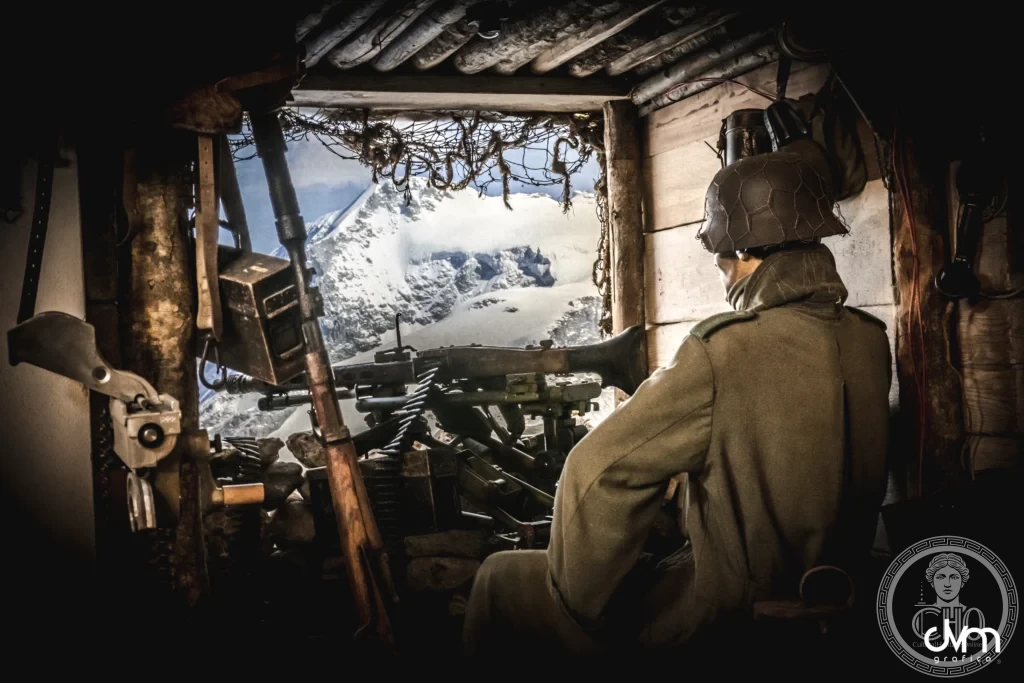
The Museum Winterline Venafro commemorates the bitter autumn and winter campaign of 1943–1944 in which Allied forces breached the German Winter Line — a heavily fortified defensive belt stretching across central Italy — on their advance toward Monte Cassino and Rome. Housed within or near the historic town of Venafro in Molise, the museum documents the human cost and strategic significance of one of the most gruelling chapters of the Italian Campaign through artefacts, maps, photographs, and documentary material.
At a glance
- Type
- Military history museum
- Period
- Dedicated to the Winter Line campaign, October 1943 – January 1944
- Location
- Venafro, Province of Isernia, Molise, Italy
- Coordinates
- 41.4866° N, 14.0448° E
- Current use
- Public museum and memorial site
Overview
The Winter Line was the collective name for a series of German defensive fortifications — the Bernhard Line, the Gustav Line, and related positions — that ran from the Tyrrhenian to the Adriatic coast of Italy in 1943–1944. Venafro and its surrounding valley were central to the Allied effort to break through this barrier in the autumn of 1943, when American, British, and multinational forces engaged in weeks of intense mountain warfare against entrenched German positions. The museum preserves and interprets this history for a regional audience and for the many visitors who follow the Italian Campaign routes each year.
History
Following the Allied landings in Sicily in July 1943 and the Italian armistice of September 1943, German forces withdrew to a series of prepared defensive lines across the Italian peninsula. The Winter Line positions around Venafro and the Volturno valley saw heavy fighting from October 1943, as American Fifth Army units advanced from the south in difficult mountainous terrain and against well-prepared German defences. The campaign prefigured the even bloodier Battle of Monte Cassino (January–May 1944) and formed a critical phase in the long Allied advance to Rome. The museum at Venafro grew from local and national efforts to document and honour the sacrifice of soldiers and civilians during this campaign.
What you see
The museum’s collections include period weapons, uniforms, personal effects, maps, and photographic documentation of the Winter Line battles. Visitors can trace the tactical positions of Allied and German units, understand the terrain challenges of mountain warfare in the Apennines, and engage with the human stories of soldiers and local civilians caught in the conflict. An exhibition by Scottish artist Elaine Shemilt titled Winterline (shown December 2014–May 2016) documented the conflict routes through an artistic lens; four of her works were acquired for Italy’s national collection as a result.
Cultural significance
The Museum Winterline forms part of a broader network of Italian Campaign memorials and museums stretching from the Volturno valley to Monte Cassino and the Anzio beaches. For the Molise region, it represents a significant act of historical memory and connects local communities to the global dimensions of the Second World War. The museum’s presence contributes to heritage tourism and educational programmes for schools and international visitors following the Italian Campaign trail.
Practical information
- Address
- Venafro, Province of Isernia, 86079 Molise, Italy
- Virtual tour
- A 360° virtual tour is available online — check culturalheritageonline.com for the link
Getting there
Venafro is located approximately 30 km northwest of Isernia in the Volturno valley. By car, exit the A1 (Autostrada del Sole) at Caianello and follow the SS6 north, or exit at Cassino and approach via the SS6 Via Casilina. Local bus services connect Venafro to Isernia and Cassino. The nearest mainline railway station is at Caianello, with bus connections onward to Venafro.
Sources & resources
See the place
Find it on the map
See this place and what’s around it →📷 Become a Cultural Heritage Online photographer
Share your photos of places: they stay published under your name as the author. The more they're seen, the more you get noticed — and soon a contest will reward the most appreciated photos.
Log in or sign up free to add a photoRequest to use these images
Each photograph is offered by the person who took it — the seller is the photographer named on the image; Cultural Heritage Online runs the payment and delivers the file on their behalf. Buying gives you the right to use the image in your own project — a website, an article, a presentation — with the file and a written licence. Read the Terms of Sale.
DSC02568
Sold by War Museum Winterline Venafro
€3.00
2560 × 1707 px
Is this page about you?
This page is read by travellers and heritage enthusiasts who find it on Google. Tell us how you are connected to this place and we will take it from there.