
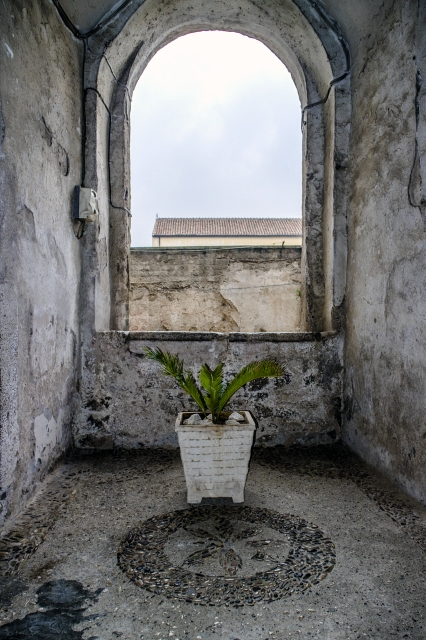
The Ducal Castle of Sant’Agata de’ Goti is a medieval fortress rising above the dramatic tufa cliff on which the historic town of Sant’Agata de’ Goti is built, in the province of Benevento, Campania. Originally erected in the Norman period on foundations that may date to Lombard fortifications, the castle was progressively enlarged and transformed by successive feudal lords — including the Carafa, Marzano, and Spinelli dynasties — until the Duchy of Sant’Agata de’ Goti was extinguished in the 19th century. Together with the cathedral and the town’s extraordinary cliff-top urban layout, it forms one of the most evocative historic townscapes in southern Italy.
At a glance
- Type
- Medieval ducal castle and fortress
- Period
- Norman origins (11th–12th century); major enlargements 13th–15th century
- Style
- Norman and Angevin military architecture
- Location
- Sant’Agata de’ Goti, Province of Benevento, Campania, Italy
- Coordinates
- 41.0883° N, 14.5041° E
- Current use
- Partially accessible historic monument; check local authority for visitor access
Overview
Sant’Agata de’ Goti is one of the best-preserved medieval towns in the Campania region, built entirely on a narrow tufa promontory above the confluence of two rivers — the Isclero and the Martorano — creating a natural defensive island accessible only by bridges. The Ducal Castle occupies the highest point of this promontory, commanding views over the surrounding valleys and the Matese massif. The town’s intact medieval street plan, romanesque cathedral, and cliff-edge palaces have led it to be listed among Italy’s “Most Beautiful Villages” (I Borghi più belli d’Italia).
History
The site’s strategic importance was recognised at least as early as the Lombard period, when a settlement called Saticula controlled this section of the Apennine foothills. The Normans, who conquered southern Italy in the 11th century, built or substantially rebuilt the castle as a seat of feudal authority over the surrounding territory. The town and its castle passed through several feudal families under Angevin and Aragonese rule, including the Carafa — one of the most powerful dynasties of the Kingdom of Naples — who held the duchy from the late 15th century and left their mark on the castle’s residential quarters. The feudal system was abolished following the Napoleonic reforms of 1806, ending the castle’s political function; the building subsequently became private property and fell into partial disrepair before restoration efforts began in the 20th century.
What you see
The castle presents a compact but imposing silhouette of towers and curtain walls built in the local tufa stone, which takes on a warm ochre colour in direct sunlight. The keep and principal residential tower survive to their full height, while lower walls and secondary towers reflect centuries of modification. The approach along the town’s single main street reveals the castle progressively against a backdrop of sky, the cliff dropping away on either side to the river valleys far below. The surrounding historic centre — with its Roman bridge, 11th-century cathedral, and cliff-edge churches — provides essential context for understanding the castle’s defensive logic and feudal significance.
Cultural significance
The Ducal Castle is inseparable from the extraordinary urban landscape of Sant’Agata de’ Goti, which the Italian heritage community considers one of the finest surviving examples of medieval cliff-top urbanism in the Mezzogiorno. The castle and town together illustrate the feudal geography of the Kingdom of Naples across a millennium, from the Norman conquest to the Bourbon reforms. Sant’Agata de’ Goti’s inclusion in the “Most Beautiful Villages of Italy” circuit has brought renewed attention to the castle as a centrepiece of cultural tourism in inland Campania.
Practical information
- Address
- Sant’Agata de’ Goti, 82019 BN, Italy
- Opening hours
- Check official website or local tourism office for current visitor access arrangements
- Admission
- Check local authority for current admission policy
Getting there
Sant’Agata de’ Goti lies approximately 35 kilometres north-east of Naples and 20 kilometres north-west of Benevento. By car, take the A1 motorway towards Caserta, exit at Capua or Caianello, then follow the SS265 and SS7 towards Benevento. There is no direct rail service to the town; the nearest station is Arienzo-San Felice on the Napoli–Benevento line, from which local buses connect to Sant’Agata de’ Goti. From Naples, regional bus services (ANMB) provide direct connections.
Sources & resources
See the place
Find it on the map
See this place and what’s around it →📷 Become a Cultural Heritage Online photographer
Share your photos of places: they stay published under your name as the author. The more they're seen, the more you get noticed — and soon a contest will reward the most appreciated photos.
Log in or sign up free to add a photo