
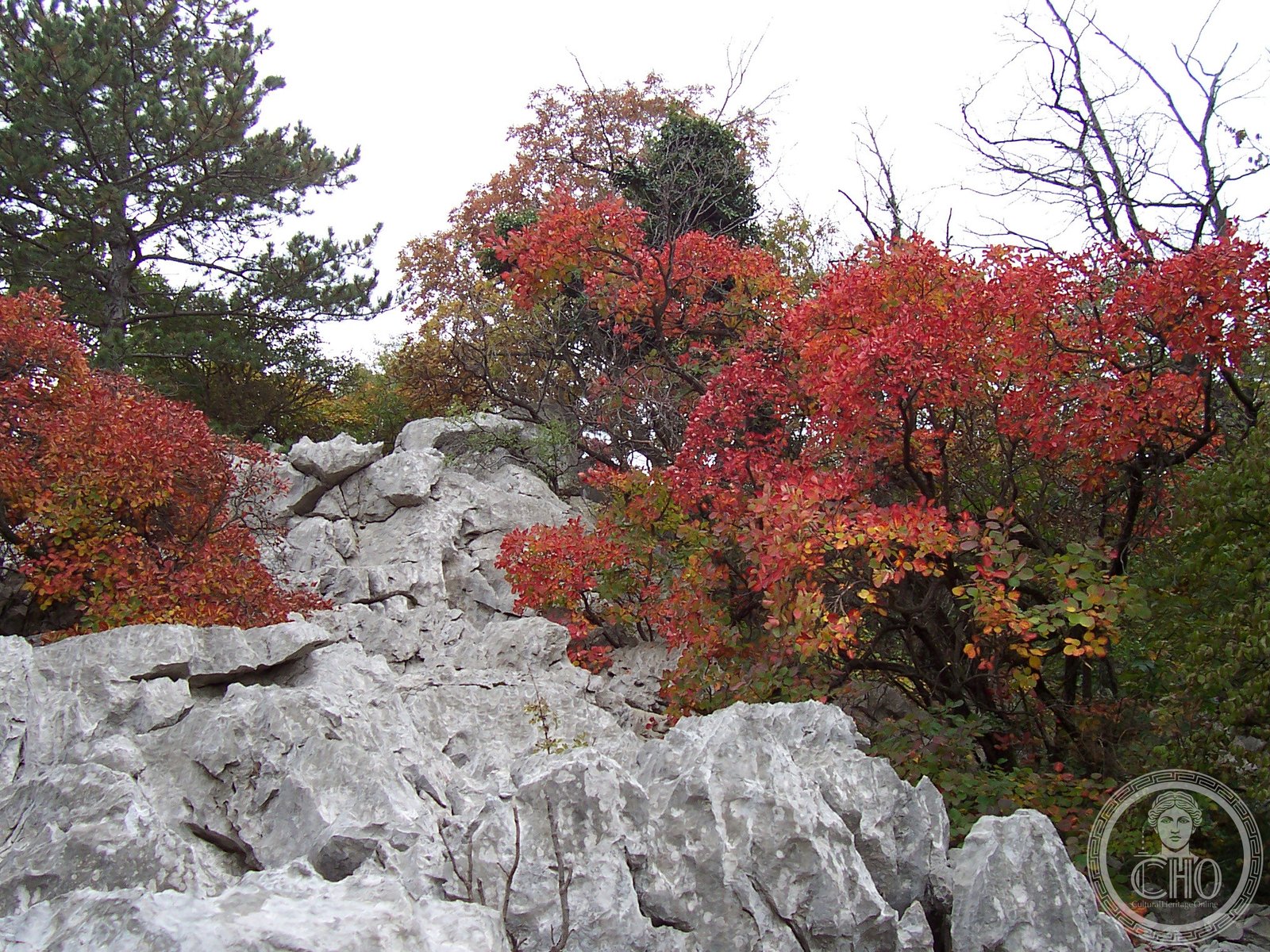
The Karst Plateau (Italian: Carso; Slovenian: Kras) is the limestone tableland that gave its name to an entire family of geological landforms worldwide and that stretches across the border between north-eastern Italy — encompassing the provinces of Trieste and Gorizia — and south-western Slovenia. Averaging 334 metres above sea level, the plateau is defined by its bare white rock, disappearing rivers, sinkholes, and extensive cave systems including the Grotta Gigante near Trieste, the largest accessible show cave in the world. The Carso Isontino, Goriziano, and Triestino sub-regions each present a distinct blend of Italian, Slovenian, and Austro-Hungarian cultural heritage shaped by contested twentieth-century borders.
At a glance
- Type
- Karst plateau and protected natural landscape
- Period
- Geological formation: Cretaceous limestone; human settlement since the Bronze Age
- Style
- Classical Karst topography — sinkholes, caves, bare limestone, disappearing rivers
- Location
- Provinces of Trieste and Gorizia, Friuli Venezia Giulia, Italy; and Kras region, Slovenia
- Area
- Approx. 429 km² (Slovenian portion); Italian portion includes the provinces of Trieste and Gorizia
- Coordinates
- 45.7330° N, 13.7361° E
Overview
The Karst Plateau is one of Europe’s most geologically and culturally significant landscapes. It is the type locality for karst topography — the term “karst” entered scientific language from this very region — and is characterised by a surface of porous limestone carved into dolines (sinkholes), dry valleys, and cave systems over millions of years. The Italian section, known as the Carso Triestino and Carso Goriziano or Isontino, lies immediately behind the city of Trieste and extends north along the Isonzo valley, forming a dramatic escarpment above the Gulf of Trieste. The plateau carries deep layers of cultural memory: it was a frontline of World War I, a contested borderland under Fascism and post-war partition, and remains a living landscape for Slovene-speaking communities who have inhabited it for centuries.
History
The plateau has been settled since the Bronze Age, with a network of prehistoric hillforts (castellieri) testifying to continuous human occupation of this strategic terrain. Under Rome it formed part of the Via Postumia corridor. In the modern era it was incorporated into the Habsburg Empire and the cultural landscape reflects Austro-Hungarian planning and architecture, particularly in the villages and railway infrastructure around Trieste. The First World War left its most devastating mark here: the Battles of the Isonzo (1915–17) were fought across these rocky plateaus at catastrophic human cost, a history preserved in war cemeteries, memorial sites, and the open-air museum of Redipuglia. Post-1945, the border settlement under the Treaty of Paris divided the Carso between Italy and Yugoslavia; the region became part of the Italian Republic definitively by the Treaty of Osimo (1975).
What you see
The landscape is immediately distinctive: white and grey limestone outcrops emerge from sparse vegetation, punctuated by the red Triestine earth (terra rossa) that fills dolines and hollows. Villages of pale stone — Duino, Aurisina, Monrupino, Komen, Štanjel — preserve vernacular Karst architecture of compact houses with heavy stone roofs. Grotta Gigante near Trieste offers the world’s largest accessible cave chamber to visitors. The coastal edge between Aurisina and Duino presents dramatic cliffs above the Adriatic. Vineyards producing Terrano/Teran wine occupy sheltered pockets, and the distinctive bora wind sculpts both vegetation and daily life. The 360° virtual tour captures the interplay of bare rock, sky, and sea that defines the Carso experience.
Cultural significance
The Karst plateau holds exceptional significance as the region that gave science a universal vocabulary for dissolved-limestone landscapes, and as the literary landscape of Rainer Maria Rilke (who wrote the Duino Elegies at Duino Castle) and Italo Svevo. It is also a memorial landscape of the First World War and a living territory of Slovenian cultural heritage within Italy, with a bilingual tradition protected by Italian law. Karst prosciutto and Teran wine carry EU protected geographical status, anchoring the landscape’s identity in its agricultural produce.
Practical information
The Karst plateau is openly accessible as a landscape. Grotta Gigante (grottavisitabile.it) operates guided tours year-round with admission charges. The Redipuglia war memorial is free to visit. Local tourist offices in Trieste and Gorizia provide maps and itineraries. The 360° virtual tour is available online — check the Cultural Heritage Online listing for the current link.
Getting there
Trieste is the main gateway, served by Trieste Airport (TRS) and by train from Venice (approx. 2 hours) and Ljubljana. From Trieste, the plateau is immediately accessible by car via the SS58 (Strada del Carso) or local buses towards Monrupino and Sistiana. The Gorizia sector is accessible from Gorizia city, served by trains from Venice and Trieste. Cycling and hiking routes cross the plateau, including sections of the Alpe Adria Trail.
Sources & resources
See the place
Find it on the map
See this place and what’s around it →📷 Become a Cultural Heritage Online photographer
Share your photos of places: they stay published under your name as the author. The more they're seen, the more you get noticed — and soon a contest will reward the most appreciated photos.
Log in or sign up free to add a photo