
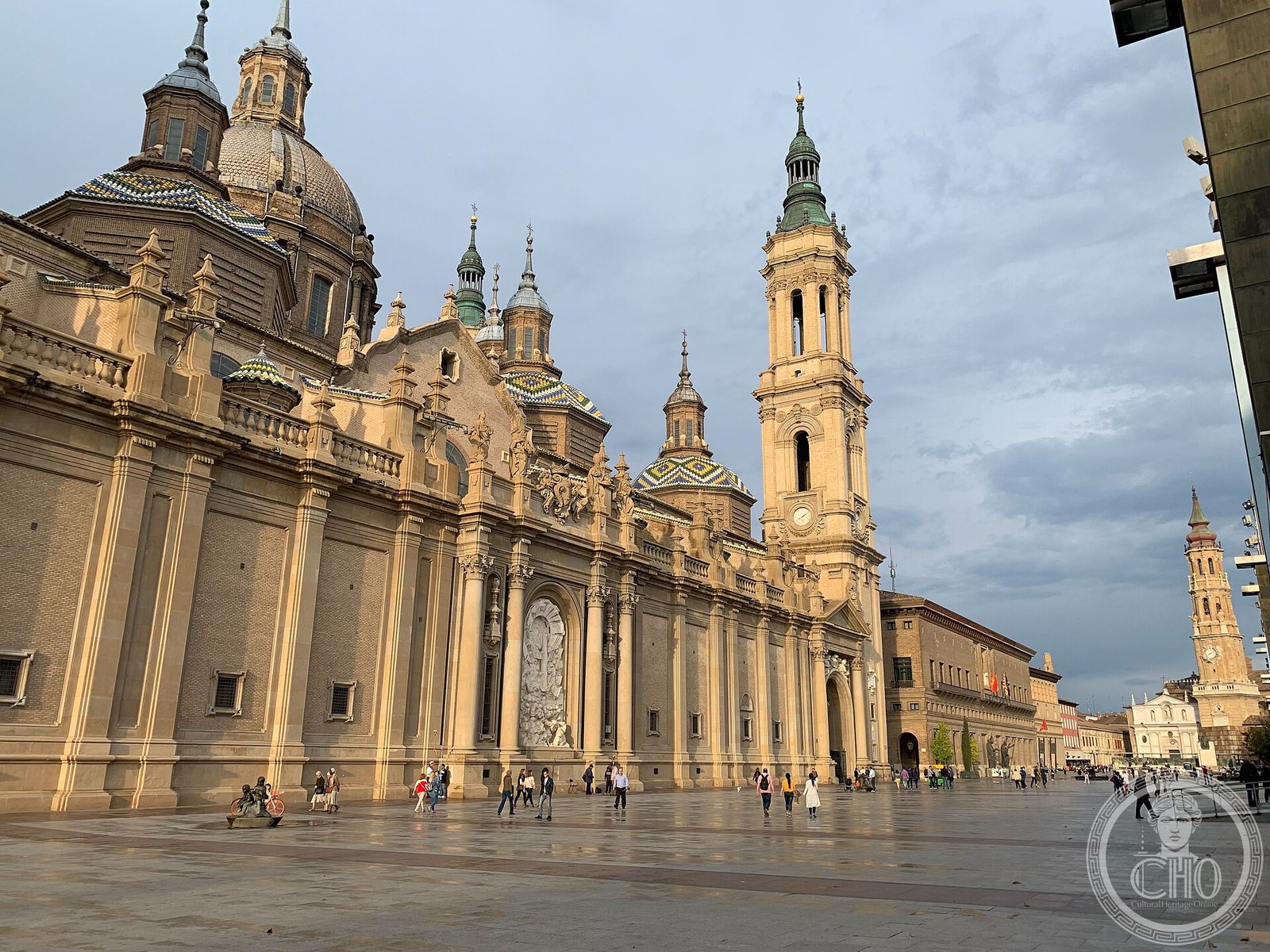
The Basilica of Our Lady of the Pillar (Basílica de Nuestra Señora del Pilar) in Zaragoza is one of the most important Marian sanctuaries in the Catholic world and a supreme example of Spanish Baroque architecture. According to tradition, the Virgin Mary appeared to the Apostle James on this site beside the River Ebro in 40 CE, standing on a jasper pillar, making it one of the earliest Marian apparitions recorded in Christian history. The current structure, built between 1681 and 1872, is crowned by eleven domes and four towers and houses ceiling frescoes by Francisco Goya.
At a glance
- Type
- Catholic basilica / pilgrimage church
- Period
- Present building 1681–1872; earlier churches on site from 4th century
- Style
- Spanish Baroque; Herreran and late-Baroque elements
- Location
- Plaza del Pilar s/n, 50003 Zaragoza, Spain
- Coordinates
- 41.6565° N, 0.8796° W
- Architects
- Francisco de Herrera the Younger (initial design 1681); Ventura Rodríguez (nave vault remodelling, 18th c.)
Overview
The basilica stands on the south bank of the Ebro in central Zaragoza, its eleven-domed profile forming one of the most recognisable silhouettes on the Aragonese skyline. It is the focal point of the Fiestas del Pilar each October 12th, Spain’s National Day, when up to a million pilgrims gather to offer flowers to the venerated image of the Virgin. The interior combines vast Baroque nave spaces with intimate devotional chapels, and the sacred jasper pillar stands in a silver-sheathed chapel accessible for veneration every day of the year.
History
Christian tradition holds that the Virgin Mary appeared to Saint James the Apostle on this Ebro riverbank in 40 CE, before her death in Jerusalem, giving him a column of jasper to anchor a chapel. Archaeological evidence confirms a Roman church on the site by the 4th century, followed by Romanesque and Gothic structures. The decision to rebuild on a Baroque monumental scale was taken in 1681; construction progressed across nearly two centuries, with bell towers and final domes completed only in the 19th century. During the Spanish Civil War two bombs fell through the roof but failed to detonate, an event attributed locally to miraculous protection; the unexploded shells remain displayed inside the church.
What you see
The interior is dominated by a vast nave running 130 metres, flanked by side aisles and lateral chapels. The ceiling vaults carry frescoes by Francisco Goya — his earliest major commission — alongside works by Antonio González Velázquez and Francisco Bayeu. The Santa Capilla (Holy Chapel), designed by Ventura Rodríguez in the 18th century, shelters the jasper pillar surmounted by a polychrome Gothic statue of the Virgin; a small section of the pillar is exposed for the faithful to kiss. The building’s eleven domes are covered in coloured ceramic tiles that shimmer in the Aragonese sunlight. A tower elevator offers panoramic views over the city and the Ebro valley.
Cultural significance
The Basilica del Pilar is one of Spain’s most visited religious monuments and the spiritual centre of Aragonese identity, attracting over two million visitors annually. Its dedication to the Virgin of the Pillar, patroness of the Spanish Civil Guard and of the Spanish-speaking world, gives it a significance that extends across the Hispanic diaspora. The presence of Goya’s earliest monumental frescoes makes it equally important in art history.
Practical information
- Address
- Plaza del Pilar s/n, 50003 Zaragoza, Spain
- Hours
- Basilica: daily 06:45–21:30 (check website for seasonal variations); Museum and tower: paid, check current hours at basilicadelpilar.es
- Admission
- Basilica free; museum and tower access paid; 360° virtual tour available online
- Virtual tour
- 360° tour available at the official website
Getting there
The basilica is in central Zaragoza on Plaza del Pilar, a 15-minute walk from Zaragoza-Delicias high-speed rail station (AVE connections to Madrid 1h20, Barcelona 1h40). By car, take the A-2 motorway and follow city-centre signs. The plaza is pedestrianised; parking is available in the nearby Car Park Paseo Echegaray. Local bus lines 21, 29, 34, and 51 stop near the cathedral.
Sources & resources
See the place
Find it on the map
See this place and what’s around it →📷 Become a Cultural Heritage Online photographer
Share your photos of places: they stay published under your name as the author. The more they're seen, the more you get noticed — and soon a contest will reward the most appreciated photos.
Log in or sign up free to add a photoIs this page about you?
This page is read by travellers and heritage enthusiasts who find it on Google. Tell us how you are connected to this place and we will take it from there.