
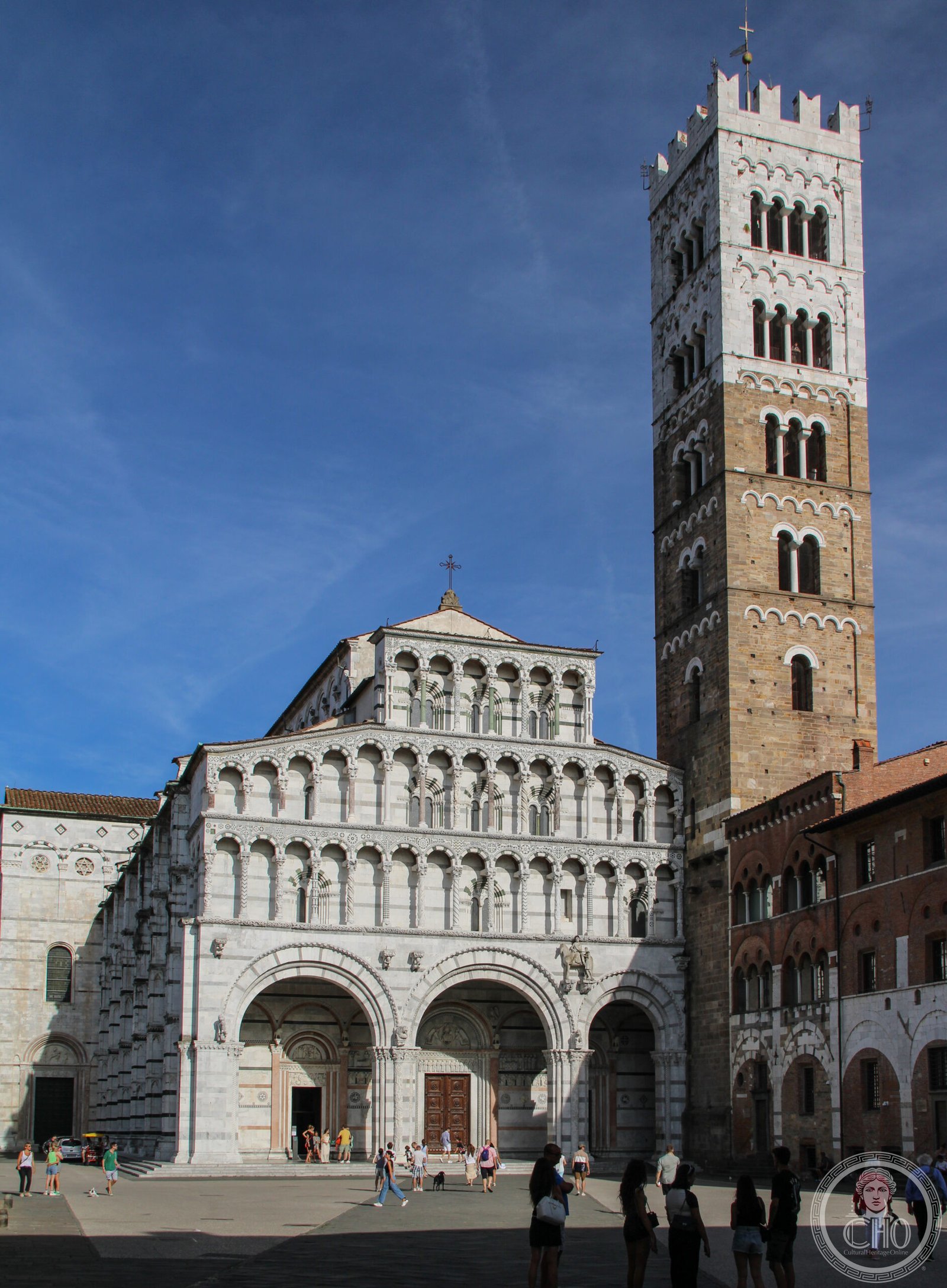
The Cathedral of Lucca, dedicated to Saint Martin of Tours, is the Roman Catholic cathedral of Lucca and the seat of the Archbishop of Lucca. Standing in the heart of Lucca’s walled historic centre, this Romanesque–Gothic monument began construction in the 11th century under Bishop Anselmo da Baggio (later Pope Alexander II) and was repeatedly enlarged through the 14th and 15th centuries. It is renowned for the Volto Santo — a dark wooden crucifix of great devotion — and for the tomb of Ilaria del Carretto by Jacopo della Quercia, one of the masterpieces of early Italian Renaissance sculpture.
At a glance
- Type
- Roman Catholic cathedral (co-cathedral)
- Period
- Founded 6th century; current structure begun 1063; façade completed 14th–15th century
- Style
- Lucchese Romanesque with Gothic nave interior
- Location
- Piazza San Martino, 55100 Lucca LU, Tuscany, Italy
- Coordinates
- 43.8409° N, 10.5050° E
Overview
Lucca Cathedral is a Roman Catholic cathedral dedicated to Saint Martin of Tours and serves as the seat of the Archbishop of Lucca. The building presents one of the finest examples of the distinctive Lucchese Romanesque style, characterised by its asymmetric façade of tiered loggias and polychrome marble inlay. Its interior houses exceptional works of art spanning six centuries of patronage by Lucca’s mercantile and ecclesiastical elite.
History
The original church on this site was consecrated in the 6th century and tradition holds it was founded by San Frediano. Bishop Anselmo da Baggio commissioned a major rebuilding in 1063, which became the nucleus of the current structure. The current Romanesque façade was begun in 1204 by Guidetto da Como, while the Gothic interior was progressively rebuilt through the 14th and early 15th centuries. The bell tower — partially Romanesque, partially Gothic — was completed in stages between the 12th and 14th centuries.
What you see
The façade features three arched portals richly carved with biblical scenes, and three tiers of open galleries with slender columns decorated in polychrome marble. Inside, the nave culminates in a Gothic apse containing the Tempietto — a small octagonal marble temple (1484) by Matteo Civitali — that enshrines the Volto Santo, a dark wooden crucifix venerated since at least the 11th century. The left transept holds the marble sarcophagus of Ilaria del Carretto (c. 1406–1408), sculpted by Jacopo della Quercia and considered a founding work of Italian Renaissance funerary sculpture.
Cultural significance
The Volto Santo (“Holy Face”) of Lucca was one of the most venerated objects in medieval Christendom, attracting pilgrims on the Via Francigena and inspiring copies across Europe. Ilaria del Carretto’s effigy has been cited as a model of Renaissance portraiture and naturalism since Giorgio Vasari. The cathedral complex — including the Sacristy Museum — is a UNESCO candidate site and listed as a national monument of Italy.
Practical information
- Address
- Piazza San Martino, 55100 Lucca LU
- Hours
- Check official website for current opening times; museum access is ticketed
- Admission
- Cathedral free; Sacristy Museum ticketed (combined ticket available)
- Website
- museocattedralelucca.it
Getting there
Lucca railway station (Lucca FS) is a 10-minute walk from the cathedral via Piazza Napoleone. By car, exit at Lucca Est or Lucca Ovest on the A11 motorway; parking is available outside the city walls at Parcheggio Carducci or Piazzale Verdi. The cathedral is within the walled city, easily reached on foot or by bicycle.
Sources & resources
See the place
Find it on the map
See this place and what’s around it →📷 Become a Cultural Heritage Online photographer
Share your photos of places: they stay published under your name as the author. The more they're seen, the more you get noticed — and soon a contest will reward the most appreciated photos.
Log in or sign up free to add a photoIs this page about you?
This page is read by travellers and heritage enthusiasts who find it on Google. Tell us how you are connected to this place and we will take it from there.