
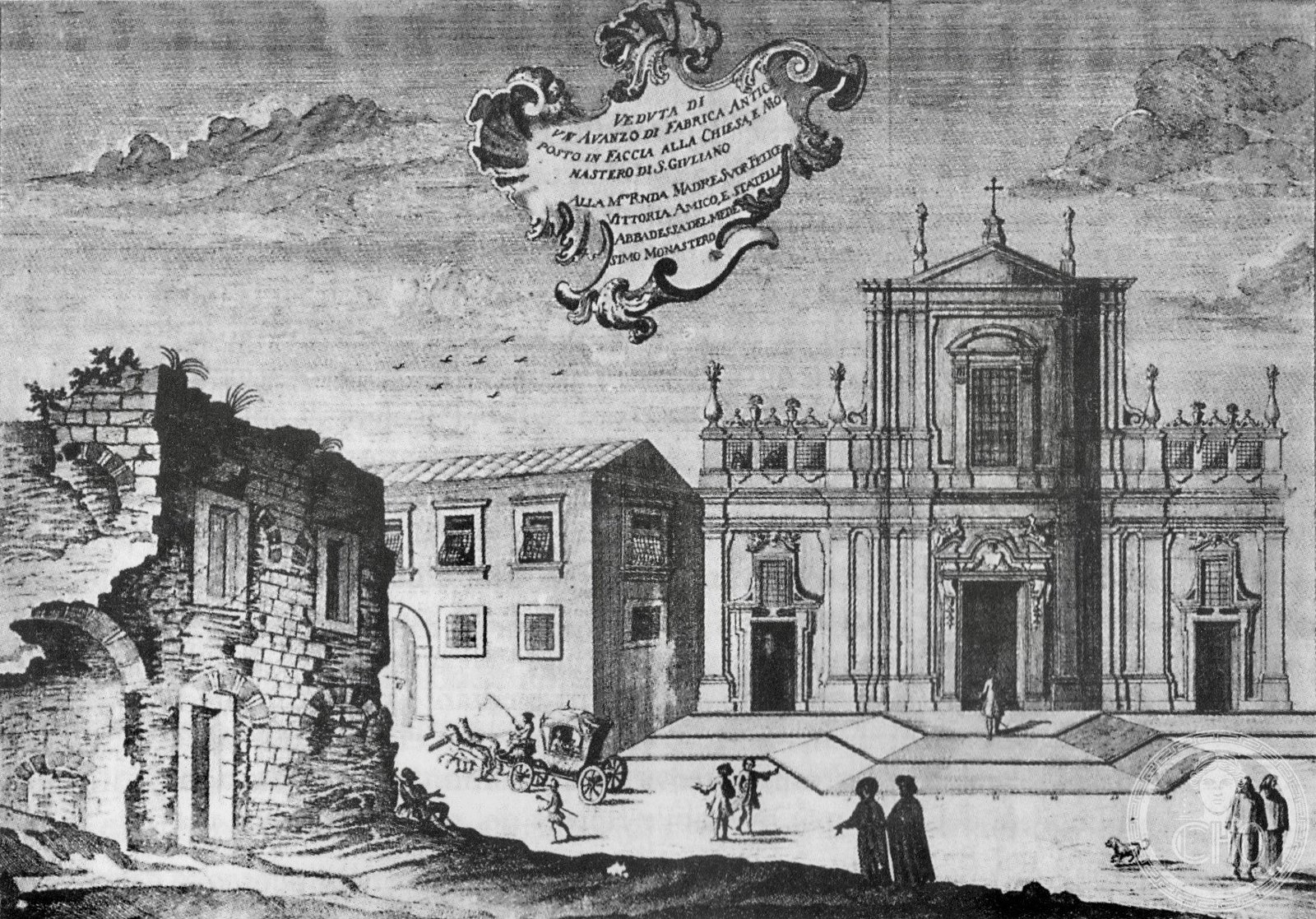
The Church of San Giuliano is a Baroque church in the historic centre of Catania, Sicily, located on Via Crociferi — one of the most celebrated Baroque streetscapes in southern Italy. Built between 1739 and 1751 for the Benedictine nuns of the Monastery of San Giuliano, the church was designed by the Catanese architect Francesco Battaglia and presents a convex façade that curves rhythmically outward from the street, a signature feature of Sicilian Baroque spatial invention. Via Crociferi and its flanking churches and monasteries form part of the Late Baroque Towns of the Val di Noto, a UNESCO World Heritage Site inscribed in 2002.
At a glance
- Type
- Roman Catholic conventual church (formerly Benedictine convent)
- Period
- 1739–1751; rebuilt after the 1693 earthquake
- Style
- Sicilian Baroque
- Location
- Via Crociferi, 95124 Catania CT, Sicily, Italy
- Coordinates
- 37.5045° N, 15.0849° E
- UNESCO
- Part of the Late Baroque Towns of the Val di Noto (2002)
Overview
San Giuliano is among the finest Baroque churches on Via Crociferi, a street internationally recognised as one of the most coherent Baroque urban ensembles in Europe. The church belongs to a group of religious buildings — including San Benedetto, San Francesco Borgia, and the Collegio dei Gesuiti — that were rebuilt en masse following the catastrophic 1693 Val di Noto earthquake, which levelled most of eastern Sicily. Together they represent a deliberate and rapid urban reconstruction programme in the exuberant late-Baroque idiom of the Catanese school.
History
The Benedictine monastery of San Giuliano was established in Catania in the early modern period and was almost entirely destroyed in the earthquake of 11 January 1693, which killed an estimated 60,000 people across eastern Sicily. Reconstruction of the church began under the patronage of the convent and was entrusted to Francesco Battaglia, a leading architect of the Catanese Baroque, with construction continuing from 1739 and reaching completion by 1751. The building survived the 1908 Messina earthquake with minor damage and has been conserved as part of the UNESCO heritage zone.
What you see
The church’s convex façade — organised in two superimposed orders of pilasters and articulated by curved cornices — is the architectural centrepiece of the upper section of Via Crociferi. The interior is a single nave with side chapels, decorated with polychrome marble altars and 18th-century devotional paintings. The adjacent monastery enclosure, though not fully open to the public, features characteristic lava-stone and limestone stonework typical of Catanese Baroque construction. The best view of the façade is from the bridge of Via Crociferi, looking south toward the church.
Cultural significance
Via Crociferi’s churches and convents represent the most cohesive surviving example of Sicilian Baroque urban planning and constitute a key component of the UNESCO World Heritage listing. San Giuliano’s convex façade has been studied as a textbook example of how Baroque architects in Catania adapted Roman spatial concepts — notably those of Francesco Borromini — to the compressed urban grain of a quickly rebuilt post-earthquake city. The church and street remain a major reference point for architectural historians of Italian Baroque.
Practical information
- Address
- Via Crociferi, 95124 Catania CT
- Hours
- Check official website or contact the parish; opening times vary seasonally
- Admission
- Free entry to the church; guided tours of Via Crociferi available through local operators
Getting there
Via Crociferi is in the heart of Catania’s historic centre, approximately 500 metres north of Piazza del Duomo. The nearest metro stop is Giovanni XXIII (Line 1); from the city centre, the street is a 10-minute walk east of Via Etnea. By car, the historic centre is a Limited Traffic Zone; parking is available in Piazza Borsellino or along the seafront. Catania Fontanarossa International Airport is 6 km south; buses and taxis connect directly to the city centre.
Sources & resources
- Church of San Giuliano, Catania — Wikipedia
- UNESCO — Late Baroque Towns of the Val di Noto
- Cultural Heritage Online — Italy guides and place cards
See the place
Find it on the map
See this place and what’s around it →📷 Become a Cultural Heritage Online photographer
Share your photos of places: they stay published under your name as the author. The more they're seen, the more you get noticed — and soon a contest will reward the most appreciated photos.
Log in or sign up free to add a photo