
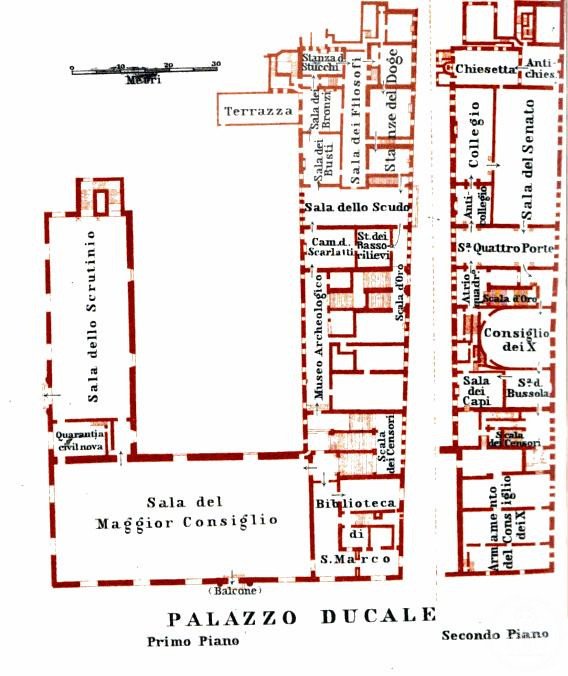
The Doge’s Apartment (Appartamento del Doge) is a sequence of ceremonial and private rooms on the upper floor of the Doge’s Palace in Venice, occupying the eastern wing above the Piazzetta San Marco. Serving as the official residence of the Doge — the elected head of the Venetian Republic — from the 14th century until the fall of the Republic in 1797, the apartment contains original furnishings, Venetian tapestries, gilded ceilings and paintings by Titian, Tintoretto, Jacopo Bellini and other masters of the Venetian school, offering one of the most complete survivals of a Renaissance princely interior in Italy.
At a glance
- Type
- Historic state apartment within a Gothic–Renaissance palace
- Period
- Palace begun 9th century; current Gothic structure 14th–15th century; apartment in present form largely 16th century after fire of 1483
- Style
- Venetian Gothic with Renaissance interior decoration
- Location
- Palazzo Ducale, Piazza San Marco 1, 30124 Venezia VE, Italy
- Coordinates
- 45.4341° N, 12.3399° E
Overview
The Doge’s Apartment forms part of the larger Palazzo Ducale (Doge’s Palace) complex on the south side of Piazza San Marco, overlooking the Bacino di San Marco. It is accessible as part of the standard museum itinerary through the palace, which also includes the Sala del Maggior Consiglio, the Bridge of Sighs, and the prison cells. The apartment’s rooms give an intimate sense of the constrained but lavishly decorated life of the doge, who was elected for life but was in many respects a ceremonial prisoner of state, forbidden from communicating freely with foreign powers or leaving Venice without permission.
History
The Palazzo Ducale has occupied the corner of Piazza San Marco and the Riva degli Schiavoni since at least the 9th century, though the current Gothic structure dates primarily from the 14th and early 15th centuries. The doge’s residential quarters were substantially rebuilt and redecorated after a devastating fire in 1483 and again following fires in 1574 and 1577 that destroyed many original Bellini and Titian canvases. The post-fire decoration programme, directed by Antonio da Ponte and involving Tintoretto, Veronese, Palma il Giovane and other leading Venetian painters, produced the sumptuous interior visible today. After Napoleon dissolved the Venetian Republic in 1797, the apartment was stripped of many furnishings; subsequent museum administration has restored much of the original character using period pieces from other Venetian collections.
What you see
The apartment comprises a suite of rooms including the Sala degli Scarlatti (used by the doge’s councillors), the Sala dello Scudo with large maps of the world as known to the Venetian Republic, the Sala Grimani, the Sala Erizzo, and the doge’s private chapel. Ceilings throughout are richly carved and gilded, with paintings set into lacunars. The Sala dello Scudo’s enormous 16th-century maps — depicting known continents and ocean routes — are among the most remarkable cartographic documents surviving in situ in any European palace. The rooms contain Flemish tapestries, antique furniture and portraits of doges painted by the most celebrated Venetian masters.
Cultural significance
The Doge’s Apartment is an irreplaceable document of Venetian Republican governance and aristocratic taste at the height of the Republic’s commercial and artistic power. As the working residence of Venice’s head of state for nearly five centuries, the rooms embody the unique constitutional structure of a republic that consistently balanced oligarchic power with elaborate ceremonial constraint. The Palace as a whole, including the apartment, is a UNESCO World Heritage Site as part of the Venice and its Lagoon inscription.
Practical information
- Address
- Palazzo Ducale, Piazza San Marco 1, 30124 Venezia VE
- Opening hours
- Generally open daily; hours vary by season — check the official Musei Civici Veneziani website
- Admission
- Included in the Palazzo Ducale ticket; combined Musei di Piazza San Marco passes available
Getting there
The Palazzo Ducale is located directly on the waterfront at Piazza San Marco. By vaporetto: lines 1 and 2 stop at San Zaccaria or San Marco Vallaresso, both within a two-minute walk. By foot from Santa Lucia station: approximately 30–40 minutes through the city centre, or take the vaporetto from Ferrovia. Water taxis arrive directly at the Riva degli Schiavoni a few steps from the palace entrance. No car access to central Venice; mainland parking available at Piazzale Roma or Tronchetto.
Sources & resources
- Doge’s Palace, Venice — Wikipedia
- Official Palazzo Ducale website
- Cultural Heritage Online — Italy guides
See the place
Find it on the map
See this place and what’s around it →Events here — now on & upcoming
- Etruschi e Veneti. Acque, culti e santuari06 Mar 2026 — 29 Sep 2026See the event →
Historical events at this place (1)
📷 Become a Cultural Heritage Online photographer
Share your photos of places: they stay published under your name as the author. The more they're seen, the more you get noticed — and soon a contest will reward the most appreciated photos.
Log in or sign up free to add a photoIs this page about you?
This page is read by travellers and heritage enthusiasts who find it on Google. Tell us how you are connected to this place and we will take it from there.